For hundreds of years, artists have used cartoons to criticize bad rulers or landowners. As early as the 19 th century, people produced and read books of drawings. In many ways, they were similar to modern comics(漫画). They contained stories of naughty children and playful animals. The owl and the elephant were usually wise animals, ready to give advice. The lion and tiger were brave. The fox and wolf were cunning, greedy and dangerous.

    A century ago, an American newspaper published the first-color comic strip. It was so popular that sales of the newspaper, Morning Journal, increased quickly. Since then, newspapers throughout the world have included comic strips.

    In modern time, comics are popular in China, Japan, the USA and almost everywhere. Not even video games or CD-ROMs have reduced their popularity. Names such as Snoopy, Woodstock and Garfield are well known in dozens of countries. The Peanuts comic strip appears in over 2,000 newspapers and in more than 25 languages.

    Perhaps one day, you may like to create your own comic strip and become a millionaire. First, you must think of a good plot. It should be funny, exciting or interesting in some way. It should have plenty of action. Moreover, the language must be realistic and simple. The words should suit the characters in your story.

    Furthermore, the characters in your story must be clear to readers. They should be obviously good or bad. In many comic strips—especially those showing crime of adventure—there should also be a hero or heroine. This will attract the reader to keep on reading the story. 

1. Which of the following is NOT the name of a cartoon character?

  A. Snoopy             B. Garfield         C. Peanuts        D. Woodstock

2. We can know from the first paraphaph that rulers ________.

  A. asked the artists to draw cartoons           B. probably did not like cartoons about them.

C. often drew cartoons many years ago.        D. used cartoons to give people advice.

3. According to the passage, what makes a popular and successful comic strip?

 A. Good plot         B. suitable language      C. clear characters      D. All of above

4. The underlined word “plot” is similar in meaning to ______.

 A. places              B. stories            C. events               D. characters

For hundreds of years, artists have used cartoons to criticize bad rulers or landowners. As early as the 19 th century, people produced and read books of drawings. In many ways, they were similar to modern comics(漫画). They contained stories of naughty children and playful animals. The owl and the elephant were usually wise animals, ready to give advice. The lion and tiger were brave. The fox and wolf were cunning, greedy and dangerous.

    A century ago, an American newspaper published the first-color comic strip. It was so popular that sales of the newspaper, Morning Journal, increased quickly. Since then, newspapers throughout the world have included comic strips.

    In modern time, comics are popular in China, Japan, the USA and almost everywhere. Not even video games or CD-ROMs have reduced their popularity. Names such as Snoopy, Woodstock and Garfield are well known in dozens of countries. The Peanuts comic strip appears in over 2,000 newspapers and in more than 25 languages.

    Perhaps one day, you may like to create your own comic strip and become a millionaire. First, you must think of a good plot. It should be funny, exciting or interesting in some way. It should have plenty of action. Moreover, the language must be realistic and simple. The words should suit the characters in your story.

    Furthermore, the characters in your story must be clear to readers. They should be obviously good or bad. In many comic strips—especially those showing crime of adventure—there should also be a hero or heroine. This will attract the reader to keep on reading the story. 

1. Which of the following is NOT the name of a cartoon character?

  A. Snoopy             B. Garfield         C. Peanuts        D. Woodstock

2. We can know from the first paraphaph that rulers ________.

  A. asked the artists to draw cartoons           B. probably did not like cartoons about them.

C. often drew cartoons many years ago.        D. used cartoons to give people advice.

3. According to the passage, what makes a popular and successful comic strip?

 A. Good plot         B. suitable language      C. clear characters      D. All of above

4. The underlined word “plot” is similar in meaning to ______.

 A. places              B. stories            C. events               D. characters

In the modern world more and more people meet the problem of identity.The most interesting example is that of a so – called “banana”, which refers to an American who has an Asian face but holds Western values.
In Shanghai, there now live a group of people from abroad.They look no different from the locals and speak fluent Chinese or even Shanghai dialect, but when it comes to writing Chinese characters, they are almost illiterate(文盲).Jack is such an example.He never learned to read or write Chinese characters, which he finds mysterious and difficult.From time to time, he files to the US as he does not feel Shanghai is where he comes from.“But when I am in the States, I feel that’s not my home either,” he said.
At De Gaulle Airport in France, there is a Swiss man who has been living in the waiting – room for a long time because he lost h is passport during his travels.He was refused entry into several countries.But when he was eventually allowed to return to Swizerland, he refused to leave the airport.His reason was very simple—“I am sure who I am.I need no acknowledgement from others,” he said during an interview.For th is reason  he was honored by the Western media as “the Hero of identity.”
As the Internet becomes more and more popular, the problem of identity becomes more serious.In a virtual world, people can have different addresses registered with different names.In the Internet chat room, even one’s gender(性别) is hard to determine.It seems that in the glohal village, people are saying hello every day to each other without knowing whom they are talking to.
What will be the next crisis(危机) of identity? With the development of cloning technology, it might be: who is the real “I”?
【小题1】What does the passage mainly talk about?

A.The importance of identity.
B.The crisis of identity.
C.Differences between Eastern and Western cultures.
D.Difficulty in living in foreign counties.
【小题2】The Swiss man had to live in De Gaulle Airport in France because      
A.he needed to board a plane at any time
B.he couldn’t afford to live in a hotel
C.he needed others acknowledgement
D.he couldn’t prove who he was
65.A “banana” in the passage is in fact an     
A.American traveling to Asia   B.American keeping Eastern culture
C.American born in Asia    D.America – born Asian
【小题3】We can infer from the passage that the author believes      
A.there will be more problems relating to identity in the future
B.Internet technology helps solve problems of identity
C.only people traveling abroad have problems of identity
D.people don’t need to worry about identity

In the modern world more and more people meet the problem of identity.The most interesting example is that of a so – called “banana”, which refers to an American who has an Asian face but holds Western values.

In Shanghai, there now live a group of people from abroad.They look no different from the locals and speak fluent Chinese or even Shanghai dialect, but when it comes to writing Chinese characters, they are almost illiterate(文盲).Jack is such an example.He never learned to read or write Chinese characters, which he finds mysterious and difficult.From time to time, he files to the US as he does not feel Shanghai is where he comes from.“But when I am in the States, I feel that’s not my home either,” he said.

At De Gaulle Airport in France, there is a Swiss man who has been living in the waiting – room for a long time because he lost h is passport during his travels.He was refused entry into several countries.But when he was eventually allowed to return to Swizerland, he refused to leave the airport.His reason was very simple—“I am sure who I am.I need no acknowledgement from others,” he said during an interview.For th is reason  he was honored by the Western media as “the Hero of identity.”

As the Internet becomes more and more popular, the problem of identity becomes more serious.In a virtual world, people can have different addresses registered with different names.In the Internet chat room, even one’s gender(性别) is hard to determine.It seems that in the glohal village, people are saying hello every day to each other without knowing whom they are talking to.

What will be the next crisis(危机) of identity? With the development of cloning technology, it might be: who is the real “I”?

1.What does the passage mainly talk about?

   A.The importance of identity.

   B.The crisis of identity.

   C.Differences between Eastern and Western cultures.

   D.Difficulty in living in foreign counties.

2.The Swiss man had to live in De Gaulle Airport in France because      

   A.he needed to board a plane at any time

   B.he couldn’t afford to live in a hotel

   C.he needed others acknowledgement

   D.he couldn’t prove who he was

65.A “banana” in the passage is in fact an     

   A.American traveling to Asia                                          B.American keeping Eastern culture

   C.American born in Asia                                               D.America – born Asian

3.We can infer from the passage that the author believes      

   A.there will be more problems relating to identity in the future

   B.Internet technology helps solve problems of identity

   C.only people traveling abroad have problems of identity

   D.people don’t need to worry about identity


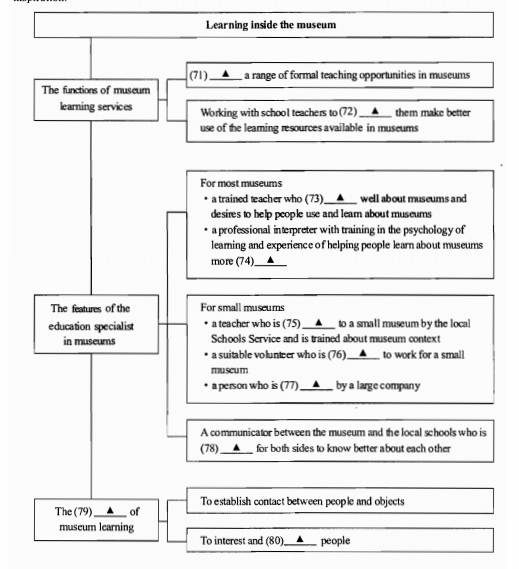
           Learning inside the museum

        Museums have an important role in providing learning services to users,especially school

    children.Some learning services will provide a range of formal teaching opportunities in the

    museum;others will work closely with school teachers so that these teachers can make better use

    of the learning resources available through displays and exhibitions,databases,handling

      collections and museum staff.

        In an ideal world,every museum would have at least one learning or education specialist.He

    or she would be a trained teacher who also had a good understanding of museums and museum

    collections,and a strong feeling to help people-especially children-use and learn from them.

        A museum education specialist is of great value. For most museums the establishment of

    such a post should be high priority. He or she is the only member of staff with training in the

    psychology of learning,and has considerable experience of analyzing complex concepts and-

    presenting them in a simple way to a non-specialist audience. The education. specialist is,indeed,

    the only professional interpreter in the museum.

          It is clearly reasonable,therefore,for the museum to make full use of the education

    specialist's skills,and to involve him or her in all aspects of interpretation and the planning of

    new displays and exhibitions.Museum learning is not just about teaching children,though

    children may be its principal audience.

        Many small museums tray not be able to employ an education specialist of their own.For

    them,there are other possibilities. One is that the local Schools Service may be able to lend a

    teacher to the museum,perhaps for two or three years,ivho could be trained to apply teaching

    skills to the museum context: Another is that suitable volunteers may be available in the

    community-perhaps retired teacher:,or teachers not presently working-who may be willing to

    give some of their time to the museum. Another possibility is sponsorship:a large company

    might be willing to finance tl-to appointawnt 4 an education、pecialist for a few. years.

        An important part of thu= work for the edUcatiOri specialist in a museum is to establish strong

    links with its local schools.He or she is a communicator who has responsibility for keeping

      contact with the teachers at local schools. He of she should make sure that the schools know

    what is going on at th:nusezim arid how they can make use of it,and that the museum staff

    know about developnww:in the school。‘Above 4.11,it is their responsibility to find out what

    schools want,and to en、ure that the museum does its best to meet those requirements.There

    needs to be a continuing dialogue between teachers and museum:the museum needs to know

what the teachers are teaching;teachers need to learn how the museum could help,and what

resources they could use.

    The look of wonder on a child's face can be the reward for a lifetime's work in museums.

The aims of museum learning are to establish contact between people-whether children or

adults-and objects;and not to teach facts,but to sow(播)a seed of interest,a spark(火花)of

inspiration.

违法和不良信息举报电话:027-86699610 举报邮箱:58377363@163.com

精英家教网