题目内容
A light emitting diode (发光二极管), or L.E.D., is a device that shines when electricity passes through it.But it works differently than traditional kinds of light bulbs.Light emitting diodes use less energy and last much longer than bulbs with a filament (灯丝) inside.L.E.D.’s are also cooler to the touch, and shine a lot brighter than they used to.
Red L.E.D.’s have long been used as signal lights on electronic equipment.But now light emitting diodes also come in blue and other colors.Colored L.E.D.’s are used to show images on everything from wireless phones to huge video signs.And white L.E.D.’s are being used increasingly to replace traditional lighting systems.
But all these require electricity.In poor countries, people often burn fuel to produce light.But the smoke can make people sick.So an electrical engineering professor from Canada started a project to produce L.E.D.lighting systems for the developing world.These lights are powered by batteries that can be recharged with energy from the sun.The batteries can also be charged through other ways, such as wind power and water power.
Professor David Irvine-Halliday tells the story of how he got the idea.In 1997, while climbing in the Annapurna mountains in Nepal, he saw a small school.All the children were outside.He looked through a window and saw that inside the school was dark.The school had a sign that read: "We have no teachers.If you want to stay and teach for a few days, we would be very pleased." Professor Irvine-Halliday says that experience had a big effect on him.Back at the University of Calgary, he was on the Internet one day.He saw a company in Japan selling bright white L.E.D.’s.So he built a light with some.This is how he began the Light Up the World Foundation.
- 1.
Compared with traditional kinds of light bulbs, L.E.D.’S________.
- A.waste a lot of energy
- B.need shorter time to make
- C.shine much brighter
- D.are warmer to touch
- A.
- 2.
According to the passage, we know that L.E.D.’s________.
- A.will replace all the lights
- B.will be more and more popular
- C.will be only colored ones
- D.will be only used in developing countries
- A.
- 3.
According to the passage, we can infer that the purpose of the Light Up the World Foundation is to________.
- A.develop L.E.D.lighting system for the developing world
- B.sell bright white L.E.D.’s
- A.

 七星图书口算速算天天练系列答案
 初中学业考试导与练系列答案
完型填空(共20小题;每小题1。5分,满分30分)
Every human being, 36 what he is doing, gives off body heat. The usual problem is 37 dispose of it. But the designers of the Johnstown campus of the University of Pittsburgh set themselves the 38 problem — how to collect body heat. They have designed a collection system which utilizes 39 body heat, but the heat given off by such objects 40 light bulbs and refrigerators as well. The system works so well 41 no conventional fuel is needed 42 the campus’ six buildings comfortable.
Some parts of most modern buildings — theatres and offices 43 classrooms — are more than amply heated by people and lights and sometimes must be air-conditioned 44 in winter. The technique of 45 heat and redistributing it is 46 “heat recover”. A few modern buildings recover 47 , but the university’s system is the first to recover heat 48 some buildings and re-use it in 49 . Along the way, Pitt has learned a great deal about some of its heat producers. The 50 a student studies, the more heat his body 51 . Male students emit more heat than 52 students, and the larger a student, the more heat he 53 . It is tempting to 54 that the hottest prospect for the Johnstown campus would be a 55 , over-weight male genius.
|
1. |
|
|
2. |
|
|
3. |
|
|
4. |
|
|
5. |
|
|
6. |
|
|
7. |
|
|
8. |
|
|
9. |
|
|
10. |
|
|
11. |
|
|
12. |
|
|
13. |
|
|
14. |
|
|
15. |
|
|
16. |
|
|
17. |
|
|
18. |
|
|
19. |
|
20.A. easy-going . fun-making C.hard-working D. good-for-nothing
|
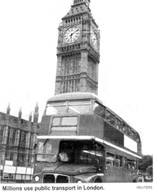 AN upper class British lady once declared: “Anyone seen on a bus
after the age of 30 has been a failure in life.”
AN upper class British lady once declared: “Anyone seen on a bus
after the age of 30 has been a failure in life.”
I guess she meant that if you’re middle aged and don’t have a car then you are a loser. How arrogant (傲慢) and ignorant!
Unfortunately, there are still people who think that way: that somehow public transport is only for the poor. And the rest have a right to their cars. Some wealthy folk in the West look down on buses and boast (吹嘘) about how many years it has been since they last traveled by one.
How sad is that? Our roads are packed with cars and the air is full of the pollution they emit (排放). But still, many car users are unwillingly to get on a bus or a bike or a train to take themselves to work.
It’s convenient to drive, they’ll say. Buses are so unreliable, they’ll claim. And trains are expensive ---- at least in the UK.
It’s an attitude which may have to change. It doesn’t make sense to drive a car in a city where there’s a public transport system. Also, these rush hour commuters (往返上班者) usually travel alone.
As a result, transport authorities in the UK are looking at solutions to city center congestion (拥堵).
One is to increase the number of parking spaces at out-of-town railway stations. More motorists (乘汽车的人) can then leave their cars and travel into the city by train.
Light rail or tramways are another environmentally friendly solution. Many cities across Europe have installed light rail or tramway systems.
The subway in London is used by everyone, rich and poor. It’s the quickest way of getting around the city, whatever your bank balance.
And then there are the cycle hire schemes you find in many modern cities. In London and Paris, you can hire a bike by the hour to get you where you need to go.
While commuters in Beijing abandon their bicycles for cars, cycling to work grows in popularity in the West.
Many cyclists are willing to pay more than 10,000 yuan for their bicycles. Mayor of London, Boris Johnson, is often pictured cycling to work. David Cameron, the British prime minister, cycled to the House of Commons before he became leader. These days he takes the prime ministerial limousine (豪华轿车).
1.. According to the article, some British people, like the upper class woman, think that .
A. buses are inconvenient B. bus services are unnecessary
C. having a car is a sign of success D. only the upper class should have cars
2. Which of the following measures is taken by transport authorities in the UK to solve city center congestion?
A. The development of cycle hire schemes.
B. Increasing the number of parking spaces in the city center.
C. Installing light rail or tramway systems in out-of-town areas.
D. Banning commuters from traveling alone during rush hour.
3.The author mentions the example of Boris Johnson in the last paragraph to .
A. express his respect for the mayor of London
B. point to the growing popularity of cycling to work in the West
C. criticize Beijing commuters for abandoning their bicycles for cars
D. show that cars are still the most common means of transportation for famous people in Britain
4. Which of the following might the writer agree with?
A. The British prime minister should give up his limousine.
B. Beijing commuters should learn from British commuters.
C. British solutions to public transport problems are inadequate.
D. Many car owners need to change their attitudes if the traffic problem is to