题目内容
How do people traditionally manufacture (制造) things? They usually start with a sheet of metal, wood or other material and cut, drill (钻) and shave it to create a desired shape. Sometimes, they use a mold (模具) made of metal or sand, pour liquid plastic or metal into it and let it cool to create a solid part.
Now, a completely different method is gaining popularity.
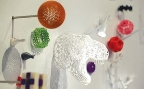
On Oct. 9, 2013, London Science Museum kicked off its new exhibition, 3-D: Printing the Future, with over 600 3-D printed objects on display, including space probes (探测器), toy dolls and even human organs – basically any product you can think of, reported Live Science.
You might find it hard to believe that an object can actually be “printed out” like a picture. But it is not that hard to understand how it works. Just as a traditional printer sprays (喷洒) ink onto paper line by line, modern 3-D printers spread material onto a surface layer by layer, from the bottom to the top, gradually building up a shape.
Instead of ink, the materials the 3-D printer uses are mainly plastic, resin (树脂) and certain metals. The thinner each layer is – from a millimeter to less than the width of a hair – the smoother and finer the object will be. And objects always come out in one piece, sparing you the trouble of putting different parts together afterward.
For example, 10 years ago a desktop 3-D printer might have cost £20,000 (200,000 yuan), while now it costs only about £1,000, according to the BBC. In fact, 3-D printers have been around for some time, but until recently they hadn’t been very popular since few people could afford them. Last year, though, saw a big decrease in the price of 3-D printers.
However, as 3-D printing technology becomes more commonplace, it may trigger certain problems. One of them is piracy (盗版). “Once you can download a coffee maker, or print out a new set of kitchen utensils (餐具) on your personal 3-D printer, who will visit a retail (零售的) store again?” an expert on 3-D printing told Forbes News.
Even more frightening, the world’s first 3-D printed gun was successfully fired in the US in May of this year, which means that 3-D printing could potentially give more people access to weapons.
1.According to the article, in the future, 3-D printing technology will probably ______.
A. change the way people make products
B. be applied as widely in our daily lives as computers
C. forbid many countries to make purchases of weapons
D. take the place of normal printers and save lots of energy
2.What was the big event that happened in the 3-D printing industry last year?
A. Over 600 3-D printed objects were on display in an exhibition.
B. 3-D printing technology came to be used in various fields.
C. The world’s first 3-D printed gun was successfully made.
D. The 3-D printer became more affordable for consumers.
3. What is the author’s attitude toward 3-D printing technology?
A. Amused. B. Objective.
C. Supportive. D. Negative.
1.A
2.D
3.B
【解析】
试题分析:
1. A推理判断题。文章第一段最后一句讲了3-D打印机可以打印出基本上你可以想出的东西。由此可以推断出3-D打印机可以改变人们制造产品的方式。故A正确。由文章第四段倒数第二句but until recently they hadn’t been very popular since few people could afford them.可知很少人能够支付的起3-D打印机。故B错误。C、D文章均没有提及。故选A。
2. D细节理解题。由文章第四段最后一句Last year, though, saw a big decrease in the price of 3-D printers.可知,去年3-D打印机的价格下降很多。D选项意为3-D打印机是很多人能够支付的起的,符合语境。故选D。
3. 观点态度题。本文作者客观的谈及了3-D打印机的好处和坏处。objective,客观的。 故选B。
考点:考查科普类短文阅读

阅读下列材料,从所给的A、B、C、D四个选项中选出符合小题的最佳选项。
Everyone has their own values or beliefs on how to manage their finances(理财). Experts put them in four categories(类别): the ant, the cricket(蟋蟀), the snail and the pig. Read the following descriptions and make the right choice.
| 1. The ant works first. The ant works heart and soul in summer in order to store food for winter but doesn’t care about enjoying the moment. |
| 2. The cricket plays first. The cricket wants to enjoy everything now and doesn’t think too much about the future. It fights to win at any cost. |
| 3. The snail lives under pressure. The snail lives the whole life with a heavy load, which it is not sure it can afford. |
| 4. The pig lives without any future plans. The pig lives without thinking about its future. What it wants is just to sleep well and eat well today. |


A. Jim lives with his parents, no work and of course no money. But he is happy because he can stay long enough in bed and enjoy anything delicious his parents prepare for him every day.
B. Tom will retire from work next year. Over the past few years, he has worked day and night and saved every penny he earned so that he could enjoy life when he gets old and retires.
C. Mike has not much money but wants to live a good life. He takes big long-term loans(贷款)from the bank in order to buy things such as expensive house, car and so on. He is happy to take big loans even though he is not sure if he can afford it.
D. Ann earns a lot but has little savings. She wants to get everything she likes without thinking about the future. She even borrows money when she really wants to get something.
E. Rick likes to make friends a lot. He always visit the English corner so as to gets many foreign friends. In his spare time, he surfs the net and chat with his on-line fellows.