题目内容


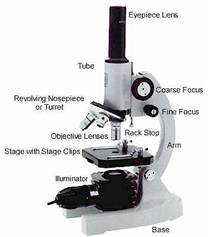
A microscope is a useful instrument for observing small objects. By producing a bigger image, the microscope reveals details that are undetectable to the naked eye(裸眼).
Before using the microscope, please read the instructions below.
CAUTION: Microscopes are both delicate and expensive and must be handled with care.
1. Always carry the microscope with two hands — one supporting the base and the other on the arm.
2. Avoid stretching the wire of the lamp across a walkway.
3. Keep the stage clean and always use a glass slide for specimens(样本).
4. To avoid crushing the glass slide when focusing, begin with the lens close to the specimen and gradually back off to focus.
5. Keep the microscope covered to prevent the dust while it is being stored.
HOW TO USE THE MICROSCOPE:
1. Plug(接通电源) in the lamp.
2. Place a sample of what you wish to observe on a slide.
3. Adjust the mirror so it reflects light from the room up into the objective lens. When the mirror is correctly adjusted, a complete circle of light iwll appear when you look through the eyepiece.
4. Place your slide with the specimen directly over the center of the glass circle on teh stage. If it is a wet slide, be sure the bottom of the slide is dry.
5. With the LOW POWER objective leans placed over the slide, use the coarse focus knob to lower the lens to the lowest point.
6. Look through the eyepiece with one eye while closing the other eye. Slowly raise the lens until teh focus is relatively clear.
7. Use the fine focus knob to fine -tune(微调)the focus.
8. Without changing the focus knobs, switch to the HIGH POWER objective lens. Once you have switched to HIGH POWER, use only the fine focus knob to make the image sharper

  1. 1.

    Which of the following is the correct way to use a microscope according to the text?

    1. A.
      Use one hand to carry the microscope
    2. B.
      Place a sample directly on the clean stage
    3. C.
      When stored, the microscope should be adjusted
    4. D.
      Look through the eyepiece with one eye
  2. 2.

    If you want to observe a thin piece of hair, which of the following should you do first?

    1. A.
      Switch to objective lens
    2. B.
      Adjust the mirror
    3. C.
      Look through the eyepiece
    4. D.
      Place the hair on a glass slide
  3. 3.

    According to the text, you could see a complete circle of light______.

    1. A.
      after correctly adjusting the mirror
    2. B.
      while looking at the specimen on a glass slide
    3. C.
      after slowly raising the objective lens
    4. D.
      before positioning the mirror correctly
DDA
试题分析:本文主要介绍了显微镜的使用注意事项以及具体如何使用的方法。
1.D 细节题。根据第6点Look through the eyepiece with one eye while closing the other eye. Slowly raise the lens until teh focus is relatively clear.说明要用单眼来观察,故D正确。
2.D 细节题。根据第2点Place a sample of what you wish to observe on a slide说明D正确。
3.A 细节题。根据第3点Adjust the mirror so it reflects light from the room up into the objective lens. When the mirror is correctly adjusted, a complete circle of light iwll appear when you look through the eyepiece.说明调整镜子以后就可以看见了一个完整的圆圈了,故A正确。
考点:考查科普类短文阅读
点评:本文主要介绍了显微镜的使用注意事项以及具体如何使用的方法。本文属于科普类短文,此类文章的最大的障碍是词汇以及考生对阅读内容的不熟悉,需要考生在阅读的时候有足够的耐心。要养成在上下文串联中猜测词义的能力,根据上下文中出现的同义词,近义词,反义词,以及词义的解释来理解生词。同时要抓住文章的中心,不要受其他信息的影响。要根据题目及选项以及文章的上下文串联合理的判断推理。
练习册系列答案
相关题目

Today, ultrasonic(超声的) waves are being put to work in laboratories and factories. If an ultrasound generator is placed in a liquid, the waves move the liquid back and forth hundreds of thousands of times each second. This causes materials to mix quickly or to dissolve(使分解,使溶解) in liquids. Paint manufacturers(制造商) use ultrasound to do a better job of blending colors. The companies that make film for your camera find that mixing chemicals by the use of sound waves will produce a more sensitive film.

The new lightweight(轻量的) type of washing machine uses ultrasonic waves to get clothes clean. Its special ultrasound generator is put into a pail of soapy water containing the soiled clothes. The sound waves drive the soapy water back and forth through the cloth so fast that everything is soon clean. There is also a new kind of dishwasher that works in much the same way.

Ultrasonic waves can shake a liquid so fast that tiny holes form all through it. The liquid is actually torn apart by this action. Almost as soon as these holes are made, they fall together again. The result is a powerful pounding action. In the dairy industry this is used for the double purpose of making homogenized(使均匀,使匀质) milk and sterilizing(使无菌) it at the same time. If you look at some raw milk with a microscope, you find that it is made up of little drops of butter fat floating around in a watery liquid. In order to make milk easier to digest, these fat droplets(微粒) may be broken up by forcing the milk through very small openings. The result is called homogenized milk. When the ultrasonic method is used, the sound waves not only break up the droplets but also kill the germs in the milk by pounding them to pieces. (from www.nmet168.com)

1. Why does a paint manufacturer use ultrasound to do a better job of blending colors?

A. Because it is cheap to use ultrasound to blend colors.

B. Because the waves move the liquid so quickly that it can make materials mix quickly or dissolve in liquids.

C. Because they can mix chemicals by the use of sound waves.

D. Because the waves can clean the paint.

2. What properties does ultrasound wave have?

A. Homogenizes and sterilizes the milk.   B. Mix materials and break droplets.

C. Kill germs and sterilize milk.          D. Move liquids quickly.

3. What exists in the raw milk?

A. Little drops of butter fat.       B. Small holes.

C. Fat droplets and germs.        D. Chemicals.

4. Where is ultrasound wave not used?

A. In the paint manufacture.                   B. In the shop mixing bread flour.

C. In the film-making company.       D. In the dairy industry.

I sometimes wonder if old Finchley has the right personality to be a research scientist. He keeps asking when he’ll be coming back. After all, it was his own fault. Nobody tries out what has just been invented on themselves any more but Finchley. Well, he must have pumped about a thousand cubic centimeters into himself before I noticed he was clearly becoming smaller.

  It was funny watching him, because his clothes remained the same in size. They simply piled up around him so that he looked like a small boy in his father’s clothes. But he kept getting smaller and smaller. As my colleague Dawson and I watched him, he disappeared! All we could see was Finchley’s clothes on the floor. They looked so strange, because the lab coat was on top, shirt and trousers inside and, I suppose, underclothes inside again. It gave me a strange feeling, and I think Dawson was a bit shaken, too.

  Dawson was sitting on his chair in front of a microscope he’d been using to examine a family of mites(螨虫). He looked through the scope kind of absently again, and was nearly scared to lose awareness when he found old Finchley waving back from the other end.

  It seems as if Finchley had taken a free ride on a dust mite and landed on the land of the mite family. Of course, we didn’t know till Finchley told us later. But anyhow, as I said, Dawson nearly passed out. He jumped off his chair and pointed at the microscope, too shocked to speak.

Finchley disappeared because ________.

 A. he took something poisonous      

B. he was changed into a dust mite

   C. his father’s clothes totally covered him up

 D. what he and his colleagues invented resulted in his disappearance

It frightened Dawson to see Finchley _______.

 A. got into his scope by accident      B. was waving through his telescope

   C. suddenly got lost in his clothes      D. gradually disappeared in the lab

It can be inferred that Finchley, Dawson and the writer have possibly invented _____.

 A. some kind of medicine               B. a new powerful microscope

   C. a machine to make people small    D. a new way to make a culture of mite

It can probably be concluded that Finchley ________.

   A. passed out there and then         B. is not fit to be a scientist

   C. is a devoted scientist            D. will remain tiny all the time


(D)
Inventor,physicist,surveyor,astronomer,biologist,artist…Robert Hooke was all these and more.Some say he Was the greatest experimental scientist of the 17th century.In the course of his work,he cooperated with famous men of science like Isaac Newton,and the great architect, Chrish@ler Wren.
Hoocke's early education began at home,under the guidance of his father.He entered Westnfinster School at the age of 13,and from there went to Oxford,where he came in contact with some of the best scientists in England.Hooke impressed them with his skills at designing experiments and inventing instruments.In 1662,at the age of 28, he was named Curator of
Experiments at the newly formed Royal Society of London—meaning that he was responsible for demonstrating new experiments at the society’s weekly meetings.Hooke accepted the job,even though he knew that the society had no money to pay him!
Watching living things through a microscope was one of his favorite pastimes.He invented a compound microscope for this purpose.One day while observing a cork(软木塞)under a microscope,he saw honeycomb-like structures.They were cells—the smallest units of life.In fact,it was Hooke who invented the term“cell” as the boxlike ceils of the cork reminded him of the cells of a monastery(修道院).
Another achievement Of Hook’s was his book Micrographi which introduced the.Enormous potential of the microscope.It contains fascinating drawings of the things he saw under the  microscope.The book also includes,among other things,ideas on gravity,light and combustion(燃烧)that may have helped scientists like Newton when they were developing their own theories on these phenomena.
Hooke made valuable contributions to astronomy too.A crater(坑)on the moon is named  after him in appreciation of his services to this branch of science.
68.Why possibly did Hooke accept the job as Curator of Experiments?
A. Because his parents couldn’t afford his education.
B.Because his family needed his support.
C.Because he wanted to please the famous scientists in England.
D.Because he liked designing experiments.
69.The cell got its name because of      .
A.its use    B.its shape    C.Hooke’s favorites D.Hooke’s experiences
70.The last paragraph is to prove that          .
A.Hooke was the greatest experimental scientist of the 17th century
B.Hooke was good at making discoveries
C.Hooke’s contributions were not limited to one field
D.Hooke was one of the greatest astronomers
71.The best title for the text may be          .
A.The Greatest Scientist                B.A Helper of Newtom
C.A Brief Introduction to Hooke          D.Achievements of Hook

I sometimes wonder if old Finchley has the right personality to be a research scientist. He keeps asking when he’ll be coming back. After all, it was his own fault. Nobody tries out what has just been invented on themselves any more but Finchley. Well, he must have pumped about a thousand cc into himself before I noticed he was clearly becoming smaller.
It was funny watching him, because his clothes remained the same in size. They simply piled up around him so that he looked like a small boy in his father’s clothes. But he kept getting smaller and smaller. As my colleague Dawson and I watched him, he disappeared! All we could see was Finchley’s clothes on the floor. They looked so strange, because the lab coat was on top, shirt and trousers inside and, I suppose, underclothes inside again. It gave me a strange feeling, and I think Dawson was a bit shaken, too.
Dawson was sitting on his chair in front of a microscope he’d been using to examine a family of mites(螨). He looked through the scope kind of absently again, and was nearly scared to lose awareness when he found old Finchley waving back from the other end.
It seems as if Finchley had taken a free ride on a dust mite and landed on the land of the mite family. Of course, we didn’t know till Finchley told us later. But anyhow, as I said, Dawson nearly passed out. He jumped off his chair and pointed at the microscope, too shocked to speak.
【小题1】It can be inferred that Finchley, Dawson and the writer have possible invented      .

A.a machine to make people smallB.a new way to study the family of mites
C.a new powerful microscopeD.some kind of medicine
【小题2】Finchley disappeared because      .
A.he tried out what has just invented on himself
B.his father’s clothes totally covered him up
C.he took something poisonous
D.he was changed into a dust mite
【小题3】It can probably be concluded that Finchley       .
A.will remain tiny all the timeB.is a devoted scientist
C.is not fit to be a scientistD.passed out there and then
【小题4】It frightened Dawson to see Fincley         .
A.got out of his scope by accidentB.was waving through his scope
C.suddenly got lost in his clothesD.gradually disappeared in the lad

违法和不良信息举报电话:027-86699610 举报邮箱:58377363@163.com

精英家教网