题目内容
16.在△ABC中,边AC长为$\sqrt{5}$,|${\overrightarrow{CA}$+$\overrightarrow{CB}}$|=2$\sqrt{5}$,D是BC边上的点,且$\overrightarrow{BD}$=2$\overrightarrow{DC}$,$\overrightarrow{AD}$•$\overrightarrow{BC}$=0,则cos∠BAC=( )| A. | $\frac{{\sqrt{5}}}{10}$ | B. | $\frac{{\sqrt{5}}}{5}$ | C. | $\frac{{\sqrt{10}}}{5}$ | D. | $\frac{{\sqrt{10}}}{10}$ |
分析 △ABC中,设E为边AB的中点,由$|{\overrightarrow{CA}+\overrightarrow{CB}}|=2\sqrt{5}$,可得CE=$\sqrt{5}$.D是BC边上的点,且$\overrightarrow{BD}=2\overrightarrow{DC}$,$\overrightarrow{AD}•\overrightarrow{BC}=0$,可得AD⊥BC.设DC=x,则BD=2x.设AE=EB=y,由中线长定理可得:$(\sqrt{5})^{2}$+(3x)2=2y2+2×$(\sqrt{5})^{2}$,由勾股定理可得:4y2-4x2=$(\sqrt{5})^{2}-{x}^{2}$,联立解出,再利用余弦定理即可得出.
解答 解:△ABC中,设E为边AB的中点,∵$|{\overrightarrow{CA}+\overrightarrow{CB}}|=2\sqrt{5}$,∴CE=$\sqrt{5}$.
D是BC边上的点,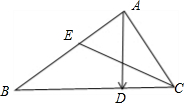 且$\overrightarrow{BD}=2\overrightarrow{DC}$,$\overrightarrow{AD}•\overrightarrow{BC}=0$,∴AD⊥BC.
设DC=x,则BD=2x.设AE=EB=y,
由中线长定理可得:$(\sqrt{5})^{2}$+(3x)2=2y2+2×$(\sqrt{5})^{2}$,化为9x2-2y2=5.
由勾股定理可得:4y2-4x2=$(\sqrt{5})^{2}-{x}^{2}$,化为:3x2+5=4y2.
联立解得:x=1,y=$\sqrt{2}$.
AB=2$\sqrt{2}$,BC=3.
则cos∠BAC=$\frac{(2\sqrt{2})^{2}+(\sqrt{5})^{2}-{3}^{2}}{2×2\sqrt{2}×\sqrt{5}}$=$\frac{\sqrt{10}}{10}$.
故选:D.
点评 本题考查了中线长公式和勾股定理、数量积运算性质、向量平行四边形法则,考查了推理能力与计算能力,属于中档题.

 快捷英语周周练系列答案
| A. | 4 | B. | -4 | C. | -2 | D. | -3 |
| A. | 2对 | B. | 4对 | C. | 6对 | D. | 3对 |
| A. | y=±$\frac{a}{2}$x | B. | y=±$\frac{\sqrt{3}}{2}$x | C. | y=±$\frac{\sqrt{3}}{3}$x | D. | y=±$\sqrt{3}$x |
| A. | $\frac{32π}{3}$ | B. | 4π | C. | 2π | D. | $\frac{4π}{3}$ |
| A. | $({0,\sqrt{3}})$ | B. | (0,2) | C. | $({0,\sqrt{2}})$ | D. | (0,1) |