题目内容
17.在△ABC中,$AC=1,BC=\sqrt{3}$,点M,N是线段AB上的动点,则$\overrightarrow{CM}•\overrightarrow{CN}$的最大值为3.分析 由题意可得,$\overrightarrow{CM}•\overrightarrow{CN}$=CM•CN•cos<$\overrightarrow{CM}$ $\overrightarrow{CN}$>≤$\overrightarrow{CB}$•$\overrightarrow{CB}$=3.
解答 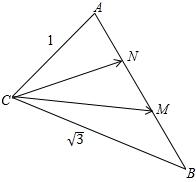 解:在△ABC中,$AC=1,BC=\sqrt{3}$,点M,N是线段AB上的动点,
则$\overrightarrow{CM}•\overrightarrow{CN}$=CM•CN•cos<$\overrightarrow{CM}$ $\overrightarrow{CN}$>≤$\overrightarrow{CB}$•$\overrightarrow{CB}$=3,
故答案为:3.
点评 本题主要考查两个向量的加减法的法则,以及其几何意义,两个向量的数量积的定义,属于中档题.

练习册系列答案
 特高级教师点拨系列答案
相关题目
12.复数(1+i)(1+ai)是实数,则实数a等于( )
| A. | 2 | B. | 1 | C. | 0 | D. | -1 |
9.已知函数$f(x)=\left\{\begin{array}{l}x,|x|≤1\\ sin\frac{π}{2}x,|x|>1\end{array}\right.$则下列结论正确的是( )
| A. | ?x0∈R,f(-x0)≠-f(x0) | B. | ?x∈R,f(-x)≠f(x) | ||
| C. | 函数f(x)在$[-\frac{π}{2},\frac{π}{2}]$上单调递增 | D. | 函数f(x)的值域是[-1,1] |