Tom and Mike are good friends. _____ often help each others.
| A.They | B.Them | C.Their | D.Theirs |
The population of the Earth is growing faster. It is important that we look after the Earth. We need it!
The Earth gives us a lot of things. We also give the Earth a lot, but some of the things are not good.
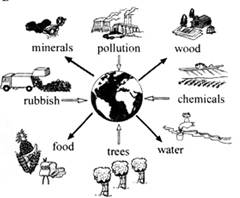

In nature, when something dies, other animals and plants get food from it. Every animal or plant gives food for other animals or plants. However, animals can’t get food from many of the things that we ‘give’ the Earth. Animals and plants can’t eat metal, plastic and glass. These things will stay in the ground for many, many years.
Some rubbish is very dangerous for plants and animals. In some places, many animals live together. One animal makes food for many more animals. If we put rubbish and chemicals in the water, the plankton(浮游生物) can die. If there isn’t any plankton, many animals have nothing to eat.
So what can we do? Don’t leave any rubbish in the countryside! Don’t make so much rubbish!
【小题1】 The Earth gives us ___________.
【小题2】 When something dies in nature, _________.
【小题3】 We must _______ to look after the Earth.
The Earth gives us a lot of things. We also give the Earth a lot, but some of the things are not good.

In nature, when something dies, other animals and plants get food from it. Every animal or plant gives food for other animals or plants. However, animals can’t get food from many of the things that we ‘give’ the Earth. Animals and plants can’t eat metal, plastic and glass. These things will stay in the ground for many, many years.
Some rubbish is very dangerous for plants and animals. In some places, many animals live together. One animal makes food for many more animals. If we put rubbish and chemicals in the water, the plankton(浮游生物) can die. If there isn’t any plankton, many animals have nothing to eat.
So what can we do? Don’t leave any rubbish in the countryside! Don’t make so much rubbish!
【小题1】 The Earth gives us ___________.
| A.food | B.rubbish | C.chemicals | D.pollution |
| A.water and grass are polluted | B.plastic and wood become food |
| C.other animals and plants get food | D.metal and glass stay in the ground |
| A.put metal in the ground | B.use more wood |
| C.keep frogs in the water | D.make less rubbish |
Many textbooks are not written in the kind of English that we speak every day. In fact, sometimes the reading is so difficult that it almost seems like a foreign language. In a way, it is—the language of science. You should not expect to be able to read a difficult science passage the same way you read an interesting story; you should not expect to read it easily and all at once. Instead, you may have to read it several times through, catching on the meaning of difficult words, going back over difficult sentences, and finally putting the whole thing together. Do not be discourages if the whole passage don’t make sense to you at first. You need to pick it apart patiently until you can understand it.
These are the steps to follow when you are reading something difficult:
² 1. Start to read normally until you run into a sentence that doesn’t make sense to you.
² 2. When a sentence doesn’t make sense, go back and read it again more slowly.
² 3. Look for any word you don’t know in the sentence. Try to understand their meanings using word parts and context clues(上下文线索). If necessary, look them up in the dictionary.
² 4. Look at the next few sentences to see if they explain more about the sentence you are working on. Do not read very much farther ahead until you understand what is being said.
² 5. Finally, read the sentence again. Try to put it into simpler words.
² 6. Read through the passage once. Try to understand all the hard parts well. Then read the whole passage once more at a usual speed. This helps you to put all ides together.
The stops sound a lot harder than they are. It is really just the normal way good readers understand anything that is difficult to read. After you have done the best you can this way, you should always feel free to ask for help from your teacher, if you have one.
【小题1】 The underlined phrase “run into” means ___________.
【小题2】 From the passage, we can know _________.
【小题3】 The massage is mainly about _________.
These are the steps to follow when you are reading something difficult:
² 1. Start to read normally until you run into a sentence that doesn’t make sense to you.
² 2. When a sentence doesn’t make sense, go back and read it again more slowly.
² 3. Look for any word you don’t know in the sentence. Try to understand their meanings using word parts and context clues(上下文线索). If necessary, look them up in the dictionary.
² 4. Look at the next few sentences to see if they explain more about the sentence you are working on. Do not read very much farther ahead until you understand what is being said.
² 5. Finally, read the sentence again. Try to put it into simpler words.
² 6. Read through the passage once. Try to understand all the hard parts well. Then read the whole passage once more at a usual speed. This helps you to put all ides together.
The stops sound a lot harder than they are. It is really just the normal way good readers understand anything that is difficult to read. After you have done the best you can this way, you should always feel free to ask for help from your teacher, if you have one.
【小题1】 The underlined phrase “run into” means ___________.
| A.work out | B.come across | C.look into | D.pass by |
| A.we should look up new words before reading |
| B.it is sometimes difficult to read a science passage |
| C.the six steps are helpful in learning spoken English |
| D.interesting stories help readers to improve their English |
| A.steps of studying science | B.difficulties in reading science |
| C.ways of reading science passages | D.researches on science and English |
In the West, some people believe that personality can be predicted according to the time of the year the person was bor. From China comes the belief that the year of birth influences one’s personality. In the past century, a new belief ahs arisen: the idea that personality is related to one’s ABO blood type. People with blood type A, for example, are considered more likely to be serious, hard-working, and quiet, while people with blood type O are likely to be popular and outgoing, yet often unable to finish what they start. Though this belief continues to be strong, some people question whether it is true.
The blood-type personality theory(理论) started in Japan in 1927 when Furukawa Takehi noticed personality similarities and differences among his workers. This idea soon went out of fashion, but was brought back by a Japanese television host named Toshitaka Nomi in the 1970s. The belief is still strong in Japan and is increasingly popular in neighboring countries. Some young Koreans have taken to the theory. A recent study showed 76 percent of Koreans aged between13 and 64 believing in the blood-type personality connection. Though most Asians might believe in the blood-type theory, for many it seems harmless and not something to be taken too seriously.
Is the belief true? The scientists in Asia largely dismiss the belief as a modern-day superstition(迷信). Most studies have failed to find any strong connection between blood and personality. Generally, scientists warn against making predictions or important decisions based on this questionable theory.
【小题1】 The writer uses blood type A and O as an example to explain ________.
【小题2】What does the underlined sentence in Paragraph 2 mean?
【小题3】 Which of the following is true according to the passage?
【小题4】 What is the best title for the passage?
The blood-type personality theory(理论) started in Japan in 1927 when Furukawa Takehi noticed personality similarities and differences among his workers. This idea soon went out of fashion, but was brought back by a Japanese television host named Toshitaka Nomi in the 1970s. The belief is still strong in Japan and is increasingly popular in neighboring countries. Some young Koreans have taken to the theory. A recent study showed 76 percent of Koreans aged between13 and 64 believing in the blood-type personality connection. Though most Asians might believe in the blood-type theory, for many it seems harmless and not something to be taken too seriously.
Is the belief true? The scientists in Asia largely dismiss the belief as a modern-day superstition(迷信). Most studies have failed to find any strong connection between blood and personality. Generally, scientists warn against making predictions or important decisions based on this questionable theory.
【小题1】 The writer uses blood type A and O as an example to explain ________.
| A.the difference between to two blood types |
| B.the relationship between the two blood types |
| C.the influence of blood type on one’s behavior |
| D.the connection between personality and blood type |
| A.It was lightly believed. | B.It was brought to them. |
| C.They liked and accepted it. | D.They stole the idea from others |
| A.Most scientists in Asia don’t believe in the theory. |
| B.The blood-type theory began in Japan in the 1970s. |
| C.The blood-type personality theory is about blood type. |
| D.People don’t change their personality to match the theory. |
| A.Is the blood-type theory poplar? | B.Is the personality changeable? |
| C.Is it in your blood? | D.Is it in you mind? |
A funny thing happened to my sister Tina last month. She lives in Japan and teaches English. In Japan, people don’t usually wear their outdoor shoes in the house or in school, and a lot of buildings have places for shoes. So her school ahs a special place for shoes. 【小题1】
Tina teaches English in the evening. One Friday, she went to school, and she put her shoes in the shoe box—as usual. Then she had an interesting spoken English class with her students. 【小题2】 But to her surprise, her shoes weren’t in the box. There was only one pair of those there, and they weren’t her hoes! She had to get home in a hurry. 【小题3】
On Monday, at her next English class, her shoes were in a shopping bag on her desk! There was a note that said, “I’m so sorry. I took your shoes by mistake!” 【小题4】 Somebody felt a lot of shame!
Tina teaches English in the evening. One Friday, she went to school, and she put her shoes in the shoe box—as usual. Then she had an interesting spoken English class with her students. 【小题2】 But to her surprise, her shoes weren’t in the box. There was only one pair of those there, and they weren’t her hoes! She had to get home in a hurry. 【小题3】
On Monday, at her next English class, her shoes were in a shopping bag on her desk! There was a note that said, “I’m so sorry. I took your shoes by mistake!” 【小题4】 Somebody felt a lot of shame!
|
假设你叫刘京,是美国中学生托尼的笔友,你收到他的来信。请给托尼写一封回信,回答他的问题,介绍北京良好的公交服务,并谈谈你的感受。
0 23055 23063 23069 23073 23079 23081 23085 23091 23093 23099 23105 23109 23111 23115 23121 23123 23129 23133 23135 23139 23141 23145 23147 23149 23150 23151 23153 23154 23155 23157 23159 23163 23165 23169 23171 23175 23181 23183 23189 23193 23195 23199 23205 23211 23213 23219 23223 23225 23231 23235 23241 23249 159627
| Hi! Liu Jing, My grandpa is going to Beijing next month because he ahs heard a lot about the city and he would like to see it himself. He says the bus service in Beijing is very good now, and people can to anywhere by bus. Is he right? Can you tell me something more about it? I’m looking forward to hearing from you soon. Yours, Tony |
| Hi! Tony, I’m glad to know your grandpa is coming to Beijing. ____________________ ____________________________________________________________________ If you have more questions, please ask me. Yours, Liu Jing |