
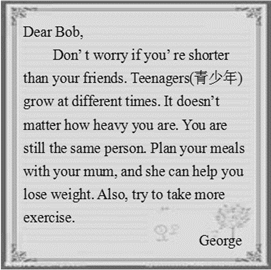


配对阅读。左栏是对五种意外事故的描述,右栏是七个对意外事故的处理方法。请为左栏中的每个意外事故选择恰当的处理方法。其中两项是多余的。
1.If the person has stopped breathing, you must try to start his/her breathing at once. 2.If the person is bleeding(流血) badly, you must try to stop the bleeding. 3.If you are bitten(被咬) by an animal, you must do something to stop it. The cold running water is the best. 4.If you are burnt (hurt by fire or something very hot), deal with the burnt part at once. The cool water is better. 5.If there is a fire in a building, stairs are safe and lift is dangerous. | A. Don’t use lift. The lift may get trapped(被困) between floors. Use the stairs and leave the building at once. B. Use hot water. Use hot water to clean the cut. Then go to see a doctor. C. Wash the cut. Wash the cut under running water. Cover the broken part, if there is any, with a piece of clean cloth. Then see a doctor as soon as possible. D. Press hard. You should press on the bleeding point with a piece of clean cloth and hold up the part to the body which is bleeding. E. Mouth to mouth. You should lay the person on his/her back and breathe into his/her mouth. F. Use the lift. Lift is convenient. Take the lift to the first floor and you can go to see the doctor quickly. G. Cool the burnt. Run cool(not cold) water over the burnt part until it is less painful. Put a piece of dry clean cloth over the burnt part. |
下面是一篇摘自有关London Canal Museum的网页消息。请仔细阅读该消息,按信息表中项目要求在答题卷的指定位置填写信息。
 Online bookings: www.canalmuseum.org.uk/book
More into: www.canalmuseum.org.uk/whatson
London Canal Museum
12-13 New Wharf Road, London NI 9RT, the UK
www.canalmuseum.org.uk www.canalmuseum.mobi
Tel: 020 7713 0836
Monthly Talks at London Canal Museum
Our monthly talks start at 19:30 on the first Thursday of each month except August. Tickets are at normal prices and you don’t have to book. They end around 21:00.
November 7th
The Canal Pioneers, by Chris Lewis. James Brindley is regarded as one of the leading early canal(运河) engineers. He was also an important player in training others in the art of canal planning and building. Chris Lewis will explain how much Brindley did for the education of that group of early canal engineers.
December 5th
Ice for the Metropolis, by Malcolm Tucker. Well before fridges coming, there was a need for ice for food keeping. Malcolm will explain the history of importing natural ice and the technology of building ice wells, and how London’s ice trade grew.
February 6th
An Update on the Cotswold Canals, by Liz Payne. The Stroudwater Canal is moving towards reopening. The Thames and Severn Canal will take a little longer. We will have a report on the present state of development.
March 6th
Eyots and Aits --- Thames Islands, by Miranda Vickers. The Thames had many islands. Miranda has studied of all of them. She will tell us about those of greatest interest.
Information Card
The country which the museum is in | 1. |
The time monthly talks end | 2. |
The person who educated the early canal engineers | 3. |
The canal which is soon to be reopened | 4. |
The date on which Miranda’s talk happens | 5. |
 B.
B.  C.
C. 