题目内容

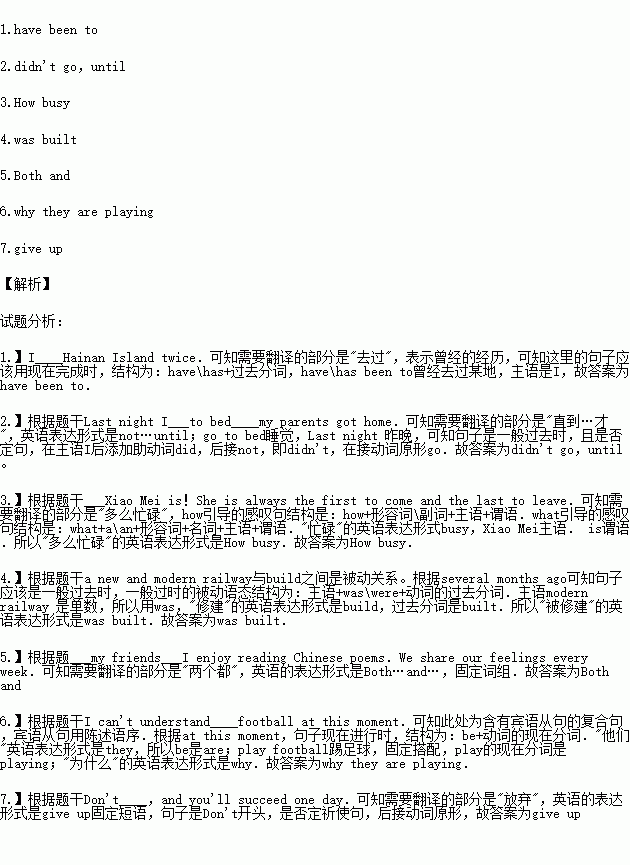
1.我去过海南岛两次了。 I ________ ________ ________ Hainan Island twice.

2.昨晚我直到爸妈回家才睡觉。Last night I ________ ________ to bed ________my parents got home..

3.小梅多么忙碌!她总是第一个来,最后一个走。

________ ________ Xiao Mei is!She is always the first to come and the last to leave.

4.在中国人民的帮助下,肯尼亚在几个月前建成了一条新的现代化铁路。

With the help of the Chinese people, a new and modern railway in Kenya ________ ________ several months ago.

5.我和朋友都喜爱诵读中国诗词。我们每周都分享感受。

________ my friends ________ I enjoy reading Chinese poems. We share our feelings every week.

6.我不明白为什么他们在这个时候踢足球。

I can’t understand ________ ________ ________ ________ football at this moment.

7.不要放弃,终有一天你会成功。 Don’t ________ ________, and you’ll succeed one day.
练习册系列答案
相关题目

Tim Berners-Lee is not the most famous inventor in the world. However, his invention has changed

our lives.

He was born in London, England in 1955. When he was a small boy, Tim was interested in

playing with electrical things. He studied science at Oxford University. He made his first computer

from an old television at the age of 21.

Tim started working on early computers. At that time, they were much bigger than now. He worked in England then Switzerland. Tim was really interested in two things, computers and how the brain

works. How could the brain connect so many facts so quickly? He had to work with people all

over the world. They shared information about computers. It was hard to manage all the information. He answered the same questions again and again. took a lot of time. It was even difficult for computers in the same office in Switzerland to share information. Tim also forgot things easily. Could a computer work like a brain? Could it “talk” to other computers?

There was an Internet already but it was difficult to use. In 1989, Tim Berners-Lee invented the World Wide Web (WWW) all by himself. This had a special language that helped computers talk to each other on the Internet. When people wanted to share information with others, they used the World Wide Web. The Internet grew quickly after that.

Tim Berners-Lee doesn’t think he did anything special. He says that all of the ideas about the Internet were already there. All he did was to put them together. He says that many other people worked together to make the Internet what it is today.

Most inventors want to become rich. But Tim gave away the World Wide Web for nothing. He now works in America. He helps people share technology and wants the Internet to be free for everyone to use. Maybe he is the most important but least famous inventor in the world today!

1.What was Tim Berners-Lee interested in?

A. Looking for jobs in different cities. B. Talking to people around the world.

C. Studying how to connect computers. D. Exploring how to improve memory.

2.The underlined word “It” in Paragraph 3 refers to “__________”.

A. Working on early computers B. Connecting different facts together

C. Travelling to the office in Switzerland D. Repeating the answers to the same questions

3.Why is Tim Berners-Lee one of the most important men in the world?

A. He made information sharing on the Internet possible.

B. He made the first computer when he was 21 years old.

C. He helped people understand better how the brain works.

D. He invented the Internet and made it free for everyone to use.

4.In what order did the following events take place?

a. Tim worked in England. b. Tim worked in Switzerland. c. Tim made his first computer.

d. Tim invented the World Wide Web. e. Tim studied science at Oxford University.[来源:学。科。网Z。XA. c – e – d – a - b B. e – b – a – c - d C. c – d – a – e - b D. e – c – a – b - d

5.What does the writer think of Tim Berners-Lee?

A. He is not famous because he is not rich. B. He has changed our lives and he is great.

C. He did nothing special but make people a good life. D. He has made great achievements in memory research.

Kaitlin Riffel’s dream to end poverty(贫困) started when she was visiting her father, who worked for the homeless.

“I never realized there were people in the world who didn’t have a home or food before,” said Kaitlin, who is now sixteen. “I knew there was something I had to do about that.”

At age eight, she started raising money to build a playground. "It took me two years," Kaitlin said. "We started small. We wanted to do something to make a difference.”

In 2014, When Kaitlin was thirteen, she visited Central America, and saw people going hungry and families living in houses made of cardboard. That year, we set Kids on a Mission, which has helped hundreds of people there.

“The rooms were smaller than my bedroom, but there would be eight people living in each one," Kaitlin said. “We also got to see the dirty rivers that those people were drinking out of.”

Providing clean drinking water, food and clothes for people living in poverty is now an important task for Kids on a Mission. “This young lady is changing the hearts of people, and also changing the world," said the headmaster of Kaitlin's school.

1. The job of Kaitlin's father was to__________

A. sell foods B. build playgrounds

C. visit schools D. help homeless people

2. When did Kaitlin set Kids on a Mission?

A. In 2009. B. In 2011. C. In 2014. D. In 2017.

3. What was people's life like in Central America according to Kaitlin?

A. They lived in strong houses. B. Their drinking water was dirty.

C. Their bedrooms were very big. D. They had enough food and clothes.

4.What can we infer from the headmaster's words?

A. Kaitlin is always ready to give and help. B. Kaitlin has many chances to travel around.

C. Kaitlin often changes schools for her study. D. Kaitlin has a serious problem with her heart.

5.What might be the best title for the text?

A. School life in America B. Gift from a headmaster

C. Father’s duty in the family D. Girl's dream to end poverty

The Silk Road is the name of different roads that long ago connected Europe, Africa and Asia. People reached these different places along these roads. Scientists believe people began to travel the Silk Road about 3000 years ago. By the time the Chinese silk trade became important in the world, the Silk Road covered almost 6500 kilometers. It spread from Rome to China, which is from the West to the Far East.

Traders travelling along the Silk Road carried silk, of course. They also carried and traded spices(香料),cloth, valuable stones and gold.

There is a famous old story along the old road. It is said that Roman soldiers(士兵)travelled through central Asia. They started to live somewhere near the ancient Chinese village of Liqian. Some of these Romans married local Chinese women and the story of blue-eyed villages of China was started.

During its busiest period, the Silk Road allowed people from many different cultures and countries to meet each other and mix. The Silk Road allowed the sharing of valuable goods and new ideas. These included people and trading goods from the Mediterranean, Persian, Magyar, Armenian, Bactrian, Indian and Chinese areas. All these peoples travelled the Silk Road, and they shared goods, stories, languages, and cultures.

In modern times, the old Silk Road routes(路线)are still used, but now they are crossed by trains instead of camels and horses. There is even a Silk Route Museum in Jiuquan in China. It has over 35,000 objects from all along the Silk Road. In this way, China protects the history of many countries and peoples.

1.How many kilometers did the Silk Road cover?

A. About 3000. B. Nearly 6500. C. Almost 2000 D. Over 35,000

2.Traders carried all kinds of goods along the Silk Road. Which of the following is not mentioned in the passage?

A. Silk B. Cloth. C. Gold. D. Tea.

3.Who married ancient Chinese women in the story of blue-eyed villages of China?

A. Asian soldiers. B. African soldiers. C. European soldiers. D. American soldiers.

4.What can we infer(推断)from the passage?

A. Valuable things could not be sold along the Silk Road.

B. The Silk Road allowed people from different countries to mix.

C. Ancient Chinese along the Slik Road may be able to speak different languages.

D. The objects in the museum in Jiuquan in China are from all along the Silk Road.

5.Which part of a magazine can this passage come from?

A. History and Geography. B. Sports World. C. Man and Animals. D. Popular Science.

违法和不良信息举报电话:027-86699610 举报邮箱:58377363@163.com

精英家教网