题目内容

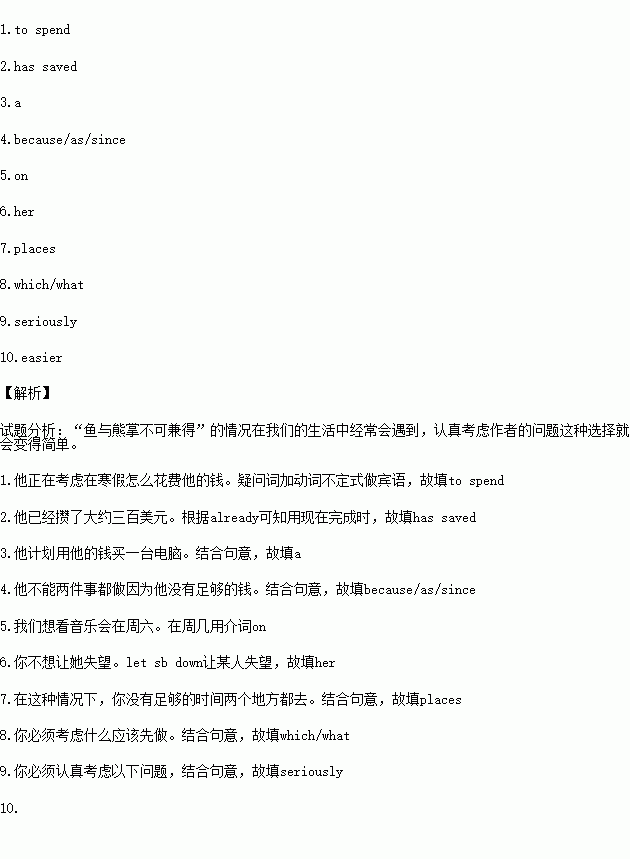
Justin is a 16-year-old boy. He is thinking about how 1. (spend) his money during winter vacation. He 2. (save) up about 300 dollars already. He plans to buy 3. computer with his money but he also wants to go skating with his friends. He can’t do both 4. he doesn’t have enough money. What should Justin do?

We are often in these kinds of situations. You want to see a concert 5. Saturday, but it is also your mother’s birthday and you do not want to let 6. (she) down. In this case, you don’t have enough time to go to both 7. (place). You must make a decision. You must think about

8. should be done first. You must consider the following questions 9. (serious).

? Which is more important?

? Which decision needs my attention more?

? Which choice would satisfy me more?

After you’ve answered these questions, it may be much 10. (easy) for you to decide what to do. So the next time you must make a decision, remember to prioritize(优先考虑).
练习册系列答案
相关题目

World’s history in one place

Is it possible to put millions of years of t he world’s history into one building? The British Museum seems to think so. "

A history of the World in 100 Objects", an exhibition about rare and ancient objects from the world, has made it a success.

The British Museum says it owns at least 8 million historical objects. But why choose these 100 objects to tel stories of our world's history?

It all started with a challenge(挑战).

Neil MacGregor, who was once director of the British Museum, was asked by BBC to choose 100 objects from the museum's huge collection. The objects had to include things from the beginning of human history about 2 million years ago to the present day.

MacGregor accepted, and took four years to choose each object himself.

In 2010, MacGregor appeared on BBC radio, giving a detailed(详细的)explanation of each object. The show was a big hit and all these 100 objects were shown in the British Museum. A book with photos of each object soon followed.

"The objects had to cover the whole world, from a cooking pot to a golden galleon, from a Stone Age tool to a credit card." MacGregor wrote.

The collection includes many important objects from China. There is a banknote from the Ming Dynasty, showing China as the first country to use paper money.

But it’s not just ancient things that are shown. Among them are some modern things like a solar-powered lamp and even a throne made of weapons created by an African artist.

“Of course, the collection could only be ‘a’ history of the world. But it is still a history that people in the present world need to know.” MacGregor wrote.

1. “A history of the World in 100 Objects” is a(n) ________.

A. TV programme about Africa B. challenge of scientific research

C. book about modern development D. exhibition of the world’s history

2. We can learn that the BBC programme by Neil MacGregor was _______.

A. successful B. expensive C. regular D. traditional

3.Which of the following is TRUE according to the passage?

A. The objects shown cover half of the world.

B. Neil MacGregor used to be director of BBC.

C. China was the first country to use paper money.

D. The British Museum owns 2 million historical objects.

Around the world, there are about 7,000 National Parks. Most of them cover huge areas of land where nobody lives. However, the National Parks in England include places where people live and work, as well as wild areas where there are few human activities.

The National Parks in England are called “England’s Breathing Spaces” because they are places where people can go to be in the open air, away from the dirt and noise of cities. They provide wonderful scenes of mountains, woods, grasslands and wetlands. And there are plenty of activities to do in all of the National Parks in England. Visitors can walk or ride bikes for fun. Many of the parks put on activities for families.

Every year there are about 110 million visitors to the parks, bringing many benefits(益处) to the areas. At the same time, it creates problems too. First, life can be difficult for local people. Car parks and roads are too crowded. Gift shops and cafes take the place of many everyday shops. Even house prices in some areas can become too high. Besides, country roads can be damaged, for too many people walk, cycle or ride horses on them. Roads can be rebuilt, but then they look less natural. Another big problem to the National Parks is litter. In the parks it is a danger to wild animals. Broken glass can also cause fires by focusing the rays of the sun. Such fires in wild places can be out of control.

? All National Parks in England are making more rules, which tell people how to take good care of their environment. If these rules are followed, the National Parks will be well kept and continue to give pleasure to many people for a very long time.

1.Visitors to the National Parks in England can .

A.give food to wild animals B. drive cars on the grasslands

C. enjoy fresh air and peaceful time D. have fun farming with local people

2.The third paragraph mainly tells us .

A.the problems of the National Parks B. the pollution caused by visitors

C. the development of the National Parks D. the benefits brought by visitors

3.Which of the following is the best sentence to fill in the blank in Paragraph 4?

A.What can people get B. How can people help

C. What are the National Parks like D. How are the National Parks set up

4.The passage is probably taken from the part of a magazine.

A.transport B. wildlife C. history D. geography

Many people thought a computer wasn’t supposed to be able to beat a top master at the ancient Chinese game, Weiqi, for at least another 10 years. But AlphaGo, an artificially intelligent system(人工智能系统 ) designed by Google, made it. It easily beat Lee Sedol last year, one of the best players in the world. It challenged the world’s top players to show how much progress it had made over the past few years.

In the late of May, 2017, AlphaGo appeared in China and played against 19-year-old Ke Jie in Wuzhen, China. He is No. 1 player now in the world. However, the result wasn’t out of people’s expectation. He lost the matches. Though Ke Jie tried his best and he once saw the victory just a step away, he lost his best chance when he became excited.

At the press conference(新闻发布会) after the match, Ke Jie was interviewed by the reporters. He said he had realized how powerful AlphaGo was, and it was getting perfect. When a Chinese reporter asked him in English, the reporter spoke so fast that the interpreter(口译员) couldn’t catch him. Ke Jie got kind of angry and told him that it was unnecessary for two Chinese to speak English. The reporter apologized to him and offered to ask him for a coffee.

The cat and mouse game is over, but the challenge between man and robots will still go on.

1.Which was the most probable date when Ke Jie played against AlphaGo?

A. May 5. B. May 23. C. May 18. D. May Day.

2.Why did Ke Jie get angry at the press conference?

A. Because he lost the game.

B. Because the reporter couldn’t catch the interpreter.

C. Because the reporter asked him in English.

D. Because the reporter wasn’t able to speak Chinese well.

3.According to the passage, which of the following statements is True?

A. People thought a computer could beat humans many years ago.

B. Ke Jie was expected to lose the matches.

C. Ke Jie asked the reporter for a coffee.

D. AlphaGo had great trouble winning the game last year.

4.AlphaGo is ______.

A. Ke Jie B. Lee Sedol C. a Weiqi match D. an artificially intelligent system

违法和不良信息举报电话:027-86699610 举报邮箱:58377363@163.com

精英家教网
