题目内容

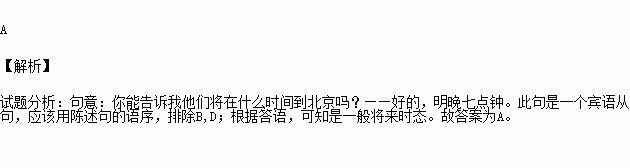
— Can you tell me in Beijing?

— Yes. At 7 o’clock tomorrow evening.

A.when they will arrive

B.when will they arrive

C.when they arrived

D.when did they arrive
练习册系列答案
相关题目

How could we tell time if there were no watches or clocks anywhere in the world?

The sun was probably the world's first "clock", except in the far north, where the Eskimos (爱斯基摩人) live. There, it's dark most of the winter, and light most of the summer. But in most of the world, people have used the sun for a clock. Even today, if you don't have a clock, you still know that when the sun shines, it's day, and when it's dark, it's night. The sun can also tell you if it's morning, noon, or afternoon.

People who live near the sea can tell time from the tides. In the daytime, for about six hours, the water rises higher and higher on the beach. And then it goes down and down for about six hours. The same thing happens again at night. There are two high tides and two low tides every 24 hours.

Seamen on a ship learn how to tell time by looking at the moon and the stars. The whole sky is their clock.

In some places in the world the wind comes up at about the same time every day or changes direction or stops blowing. In these places the wind can be the clock.

A sand clock is an even better clock. If you had fine dry sand in a glass shaped like the one in the picture, you would have what is called an hourglass. The sand in the hourglass goes from the top part to the bottom part in exactly one hour. When the hourglass is turned over, the sand will take another hour to go back again.

1.According to the passage, there are ______ ways to tell time besides the clock and watch.

A. 3 B. 4 C. 5 D. 7

2.The Eskimos in the far north can't use the sun for a clock because ______.

A. they know very little about the sun

B. the sun there never goes down in winter

C. it's too cold for them to go out to watch the sun

D. it has long dark winters and long light summers

3.The underlined word "tides" in the passage means ______.

A. 洋流 B. 潮汐 C. 海啸 D. 波浪

4.In which page of a newspaper can you most probably read this passage?

A. News. B. Science.

C. Business. D. Advertisement

5.What’s the best title for the passage?

A. Different Ways to Tell Time

B. Useful Machines to Tell Time

C. The History of the Clock

D. The Development of the Clock

Extracurricular(课外的) School Activities

Many schools today provide various extracurricular activities. Some activities are before school, some are after school, and a few may even take place on weekends. Many parents like their children to take part in these activities. Yet some parents are still a little dubious about it. Actually, these activities have many advantages for students. It is a wise choice for parents to allow students to get involved in extracurricular activities at school. It can help students to develop many working skills, people skills, and more.

When students get involved in extracurricular activities, they get involved in different interests. These activities allow them to develop various interests that they may have.

It also helps to raise the self-esteem(自尊) of students. Many students feel worthless or there is nothing they are good at. Everyone wants to find something that they are really good at, and extracurricular activities provide the opportunity for them.

Students can also learn relationship skills. They need to get involved in social activities and learn how to act properly in social situations. These activities give them a chance outside of school to do this, while they are still supervised(监督) by adults.

Of course, while there are many excellent benefits of extracurricular activities for students, you need to consider how much is too much. It can be a great choice to get involved in a few different activities, but too many activities can have negative(消极的) effects. If students take part in too many activities, they often have problems in their studies. They may not get enough rest. They may not have time to relax. It’s important for students to set some limits to extracurricular activities. Students can pick out a couple of their favorites and make sure they can handle(处理) them. Some kids feel like they have to take part in many activities to be a success, and this is not good to them.

When students get involved in extracurricular activities, there are certainly excellent benefits that they’ll enjoy. They are doing it for their future success. It’s important that students don’t try to “do it all”.

1.The underlined part “dubious about” in Paragraph 1 probably means “______”.

A.crazy about B. interested in

C.doubtful about D.confident in

2.From the passage we can learn that ______.

A.most extracurricular activities take place on weekends

B.extracurricular activities help students have same interests

C.students feel worthless in extracurricular activities

D.extracurricular activities are supervised by adults

3.The writer may agree that ______.

A.extracurricular activities are bad for students’ studies

B.extracurricular activities help students get enough rest

C.students should have a few different extracurricular activities

D.students have to take part in many activities to be successful

阅读短文,根据短文内容回答问题。

Creator of e-mail makes use of ‘@’ sign

Does your class use e-mail? Have you ever tried to write a story for our newspaper and send it in by e-mail? E-mail is used for everything, and it makes life easier. But do you know where e-mail came from?

The man who invented it was Ray Tomlinson, a US engineer. He died early last month at the age of 74.

Back in 1971, Tomlinson was working on something that could send messages from one computer to another. Tomlinson tried to find a way to separate users’ name from the names of their computers. He needed some kind of symbol (符号). However, it couldn’t be a popular one, and it couldn’t be one that computers might know in a different context (语境). It also needed to be on keyboard at the same time. The “@” sign was there, and pretty much no one used it. It was perfect.

“The ‘@’ sign made the most sense,” he told Wired in 2012. “It said where the user was…at.” For example, by writing “Alex at 21st Century Teens” you can send a message to somebody named Alex who works at 21st Century Teens. This was the early form of email.

The interesting thing is that Tomlinson didn’t remember what the very first test message he sent was. “Probably the first message was QWERTYUIOP or something like that,” Yahoo reported, guessing the first row of letters on the keyboard.

Tomlinson, the father of e-mail, changed the way the world communicates and more importantly saved the symbol “@”.

Today, the “@” symbol is finding new life outside of our inboxes (收件箱). Most famously, social media like Weibo and Wechat use it at the beginning of user names. So even if we don’t use e-mail some day, Tomlinson’s contribution (贡献) will certainly live on.

1.Who invented the e-mail?

2.When did he invent the e-mail?

3.Why did he choose the symbol “@”?

4.What does “@” sign tell us?

5.What’s the passage mainly about?

违法和不良信息举报电话:027-86699610 举报邮箱:58377363@163.com

精英家教网