题目内容
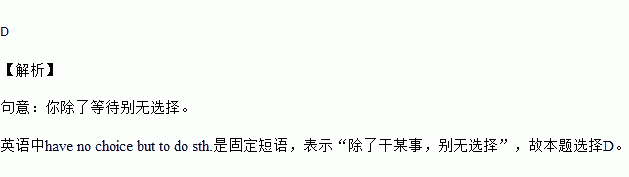
You have no choice but ______.
A.wait B.waits C.waiting D.to wait
— I hear________your grandpa________your grandma like watching Beijing Opera.
— Right, just as many old people do in our city.
A.both; and B.either; or
C.neither; nor D.not only; but also
You see, Kevin is writing ______ his left hand.
A. at B. as
C. for D. with
Whenever I mention _____ football, he says he’s too busy.
A.play B.played C.to play D.playing
If you watch the film, it will make you_____.
A.laugh B.to laugh C.laughing D.laughed
第四节 阅读表达
In Chinese, the phrase “daomei’’ is often used to describe bad luck. Where did “daomei” come from? It is said that daomei comes from Zhejiang during the Ming Dynasty (朝代). It has something to do with the keju testing system that were given in ancient China.
At the time, there were no entrance examinations for colleges and universities like today. If someone wanted to become an officer, that person would need to take the keju tests. The keju testing system consisted of several tests at different levels. Through the highest-level tests, called dianshi, the best candidates (候选人) were chosen by the emperor.
The keju tests were hard and competition was fierce(激烈的). During the Ming Dynasty, candidates in Zhejiang would put up a flagpole in front of the gate to their home, wishing for good luck on the tests. Local people called the flagpole “mei” (楣) at the time. If someone passed a test, the flagpole would be kept up. If they failed, the flagpole would be removed, which was called “daomei”, meaning “the flagpole falls”.
As time passed, daomei came to refer not only to “failing a test”, but also to describe being unlucky in general. The Chinese character for mei was also changed from“楣” to today’s “霉”, since the two have the same pronunciation.
1.Which province did the term “daomei” come from?
_________________________________________________________________
2.Were there any college entrance examinations in ancient China?
3.According to the story, what did “mei” refer to (指的是) during the Ming Dynasty?
4.Who chose the best candidates?
5.How do you like the keju tests?
—Do you know ________ for the picnic?
—I’m not sure. Maybe she bought some drinks and snacks.
A.when is she leaving B.what she has prepared C.why she bought so little food
If you want to learn English better,you can make friends with American students and often talk to .
A.their B.theirs C.they D.them
补全对话 选择正确的句子完成对话,有两个选项是多余的。
A: Can I help you?
B: 1. I want a sweater for my son.
A: We have sweaters in red and yellow. 2.
B: Yellow.
A: Here you are.
B: Oh, this sweater is too small. 3.
A: Yes. What about this one?
B: It’s very nice. 4.
A: It’s ten dollars.
B: OK. I’ll take it. 5.
A: You’re welcome.
A. Thank you.
B. How much is it?
C. What color do you want?
D. Do you have a big one?
E. Yes, please.
F. I think he’ll like it.
G. What do you want to buy?

 阅读快车系列答案阅读快车系列答案