题目内容
【题目】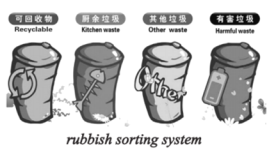
A new rubbish sorting system has been put into use in Fangchengyuan Community in Beijing. Local people not only sort their rubbish, but also put QR codes(二维码)on it.
"When the rubbish is collected and the codes are seen, I will get small gifts and even some money," one of the local people told reporters.
"It's really creative and encouraging. "
About 350 communities have carried out this smart system in Beijing. The capital of China has joined a list of cities in the country that take action to support rubbish sorting. For example, Shenzhen and Shanghai have made laws to punish people and organizations for not sorting rubbish correctly.
China produces quite a lot of rubbish every year. Much of the rubbish is buried(填埋)in soil or burned without being sorted. Landfills(填埋场)take up a lot of land and have a risk of polluting the soil and water nearby. And burning rubbish can produce harmful gases.
Through rubbish sorting, we can reduce(减少)the use of landfills and air pollution. What's more, rubbish sorting saves resources, which could bring economic(经济的) benefits. For example, a ton of waste paper can be reused to make about 850 kg of paper, saving 17 trees and 50% of water. Because of their benefits, some countries have developed successful sorting systems.
Japan has a strict and detailed system. When people throw away a water bottle, the cap, the waste paper and the bottle itself have to go into three different bins(垃圾箱).
Every year, families receive special rubbish sorting timetables and directions from their local governments. They are advised to follow the timetables and directions when they throw away rubbish.
In Australia, every family is provided with three rubbish bins—the red lid(盖子)bin for "general waste" like food and plastic bags, the yellow lid bin for "recycling" like steel are glass, and the green lid bin for "green waste "such as grass and leaves. On the streets, the bins are printed with pictures of the things that are allowed inside. It makes recycling quite easy.
【1】What will people get if they sort their rubbish in Fangchengyuan Community?
【2】How many communities have carried out this smart system in Beijing?
【3】What do families in Japan receive from their local governments every year?
【4】What is the green lid bin for in Australia?
【5】What are the benefits of rubbish sorting?
【答案】
【1】Small gifts and some money.
【2】About 350 communities.
【3】Special rubbish sorting timetables and directions.
【4】“Green waste” such as grass and leaves.
【5】We can reduce the use of landfills and air pollution and save resources.
【解析】
本文主要讲述垃圾分类,在中国上海,北京等地都已实施垃圾分类。在国外,比如日本和澳大利亚也有相关的垃圾分类的政策。通过垃圾分类,我们可以保护环境,带来经济效益。
【1】细节理解题。根据文章内容“When the rubbish is collected and the codes are seen, I will get small gifts and even some money,”可知,可以得到小礼物,甚至是钱。故填Small gifts and some money.
【2】细节理解题。根据文章内容“About 350 communities have carried out this smart system in Beijing.”可知,大约350个社区使用了这种系统,故填About 350 communities.
【3】细节理解题。根据文章内容“Every year, families receive special rubbish sorting timetables and directions from their local governments.”可知,他们每年会收到“特殊垃圾分类时间表和指示”。故填Special rubbish sorting timetables and directions.
【4】细节理解题。根据文章内容“the green lid bin for "green waste "such as grass and leaves.”可知,绿色的是“草和树叶”,故填 “Green waste” such as grass and leaves.
【5】细节理解题。根据文章内容“Through rubbish sorting, we can reduce(减少)the use of landfills and air pollution. What's more, rubbish sorting saves resources, which could bring economic(经济的) benefits.”可知,通过垃圾分类,可以减少垃圾填埋场的使用,减少空气污染,节约资源,带来经济效益。故填We can reduce the use of landfills and air pollution and save resources.