题目内容

Look!The dolphins _________ in the water.

A.is swimming      B.are swimming

C.swim            D.are swiming

答案:B
解析:

B 标志词“Look表明句子要用现在进行时态;主语“The dolphins”为复数形式。口诀:Look!Listen!在句头,动词要用进行时。


练习册系列答案
相关题目

My earliest memory of dad is grabbing (抓住) his hand while we walked together. As I    older, I remembered my father and I listened to many basketball games on the radio. I always fell asleep    the game was over. When I woke up in the morning, the score sheet (计分表) with the    score on it would be lying next to me. I’ll always remember that.

On cold mornings my father would drive his bread truck by the house. I used to ride on the floor of that bread truck as he delivered (分送) the bread to the stores. The   and the warmth from the bread made me hungry and kept me warm. I’ll always remember that.

My father would attend all my games. One night before an important game my father told me    that he wouldn’t be able to watch the game because he had to deliver the bread and it was a three-hour    from his route. The next day as the game time drew near, I thought about my dad. I happened to look across the field and   saw his bread truck pulling into the stadium (体育场). He tried to make the game. I’ll always remember that.

Years later I became a teacher. I’ll never forget the voice on the phone early one morning telling me dad had just been killed in a traffic accident. I could hear my heart beat in my ears. I    up the phone and went back to my bedroom. After that nothing was very important to me. One day I was on the playground when a little boy walked up to me and grabbed my hand. His hand held mine the    way I used to hold my father’s by the last two fingers. At that moment I found my    in life again. You see even though my father was gone, he left something with me. He left me his smile, spirit and touch. My purpose was to use those gifts as he did. From that day I started. I’ll always remember that!

1.A. went                    B. changed                  C. turned                     D. grew

2.A. when                   B. although                 C. because                  D. before

3.A. public         B. final                        C. official            D. lucky

4.A. smell                    B. color                        C. taste                        D. shape

5.A. happily                B. sadly               C. slowly             D. simply

6.A. ride                      B. walk                         C. race                         D. drive

7.A. successfully        B. peacefully              C. surprisingly            D. unusually

8.A. set                       B. picked                    C. put                 D. hung

9.A. strange            B. safe         C. same                 D. special

10.A. pleasure           B. purpose                  C. problem        D. progress


A greeting is a way of saying "Hello" to someone. People in different countries greet each other in different ways. Here are some.
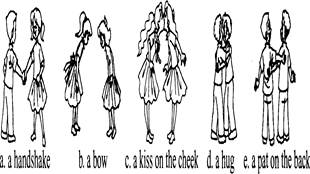
World Greetings

Philippine

The everyday greeting for friends is a handshake for both men and women. Men some­times pat each other on the back.

Japan

When people meet for the first time, they usually bow. In business, people also shake hands.

In formal situations, people often exchange business cards. When you give a business card, give it with two hands. This is polite.

Special note: In Japan, a smile can have different meanings. It usually means that the person is happy, or that the person thinks something is funny. But it can also mean that the person is embarrassed.

New Zealand

Usually, both men and women shake hands when they meet someone for the first time.

Fun fact: If you see two people pressing their noses together, they are probably Maori. The Maori are the native people of New Zealand. This is their traditional greeting.

Brazil

Men often shake hands when they meet for the first time.

When women meet, they kiss each other on the cheek. Women also kiss male friends to say hello.

When you shake hands, look at the person in the eyes. This shows interest and friendliness.

1.In this passage, which of the following is NOT mentioned?

A.Kisses.            B.Hugs.             C.Bows.            D.Handshakes.

2.Of the five pictures above (a, b, c, d and e), which is the same way to greet each other in the four countries?

A.a                B.b                C.c                D.d

3.Which of the following is TRUE according to the passage?

A.Both men and women shake hands in Brazil when they meet.

B.Japanese won't smile until they feel very happy.

C.The Maori often press their noses together to greet each other.

D.In Philippine, people shake hands only when they meet for the first time.


I am sure you have a mobile phone. Now functions (功能) of the mobile phones have greatly expanded (扩张). Maybe your mobile phone can take photos1.________  Mine can get online or get on QQ. So the mobile phone not only can make telephone calls. You can do a lot of things with the mobile phones, Such as sending and receiving messages, listening to the music and playing games.

Now the 3G mobile phones become popular in our country2.        After January 2009, people can use their 3G mobile phones in many cities of our country. They can send and receive pictures while they are talking on the mobile phones. Look at the picture. It is a 3G mobile phone. You can take more good pictures with this kind. If you can't go home to watch TV, you can turn on your 3G mobile phone and watch CCTV news3.        You can also play games just like on computer on the Internet.

The important thing is that many companies said your phone fee won't go up although you can do all these things4.         It is reported that about two years later, all of the 3G mobile phones will be used in any part of our country.

A. His mobile phone can play MP3 or MP4.

B. You can also watch movies on this kind of mobile phone.

C. So many people hope they can use 3G mobile phones at once.

D. Our government allows three companies to support 3G mobile phones.

5.This passage mainly tells us something about __

A.mobile phones                         B.the fee of the mobile phones

C.3G mobile phones                       D.the functions of the mobile phones


Edith Cavell was born in a little English village. She was a clever, hard-working girl and did well at school, especially in music and French. After she left school, her first job was to take care of the children of a rich family in Belgium(比利时). The language they spoke was French, so she found that her school studies were useful. She could understand them easily, at the same time she taught the children to speak English and play the piano.

After hearing that her father was seriously ill, Edith returned home to look after him. She then decided to become a nurse. Afterwards for five years she worked in an English hospital where she proved to be highly professional at her job. A Belgian doctor was so impressed(印象深的)that he invited her to his country to organize a training school for nurses. The First World War broke out in 1914 and Edith Cavell’s school of nursing became a hospital. She stayed there to look after the sick and wounded soldiers . Edith treated them with kindness. Between November 1914 and August 1915 she secretly helped about 200 wounded soldiers and prisoners (囚犯) escape from the Germans. Later the German army found out what Edith had done and they arrested her. Finally, the Germans killed her, but they could not kill her memory. A tall statue(雕塑)has been built in Trafalgar Square, London, in honor(纪念)of the brave English nurse.

1.Edith Cavell’s first job was to __________.

A.teach French                          B.look after the children of a rich family

C.teach English                           D.look after the sick and wounded soldiers

2.Why did Edith return home from Belgium?

A.Because she found work in an English hospital.

B.Because she organized a training school for nurses.

C.Because the First World War broke out.

D.Because her father was seriously ill.

3.What’s the Chinese meaning of “kill her memory” in this passage?

A.杀死她           B.使她失去记忆      C.抹去对她的记忆    D.摧残她

4.According to the passage, which of the following is TRUE?

A.Edith was good at music and German at school.

B.Edith was a highly professional doctor.

C.Edith was invited to her country to organize a training school for nurses.

D.People have built a tall statue in honor of Edith.


违法和不良信息举报电话:027-86699610 举报邮箱:58377363@163.com

精英家教网