题目内容

任务型阅读=

Do you want to travel the countries in Asia? You don't have to travel very far. Follow us, you can find these Asian adventures(探险).

Cycling in Guilin, China

Get around the city by cycling through Guilin, in the Guangxi province of China. Mountains rise straight up, creating the only beauty. Bike paths take you past the villages and farms. Enjoy this beautiful views from your bike, or stop and talk with one of the villagers working in his field.

Adventure advice: When your feet are tired, take a boat trip along the beautiful and famous Li River.

White-water rafting in Nepal

In Nepal, you can experience thrilling rapids(湍流) and the beauty of the Himalayas at the same time. Take a white-water rafting trip down the Sun Koki River, world-renowned for its powerful rapids. At night you'll camp beside the river on white water, enjoy the quiet, lonely Nepalese countryside.=

Adventure advice: Don’t go rafting in summer. High water levels make it dangerous.

Scuba diving in Malaysia

Go diving in the clear waters around Spaded, an island in Malaysia, and discover an underwater world. You'll see large sea animals swimming along. The colorful coral along the reefs hides tiny fish. The wide kind of tropical life found around Spaded makes it famous worldwide for diving.

Adventure advice: You can dive at Spaded, but you can't sleep there. The island is a protected park, but you can stay on one of the nearby islands.

Three Asian Adventures

Countries

Adventures

Advice

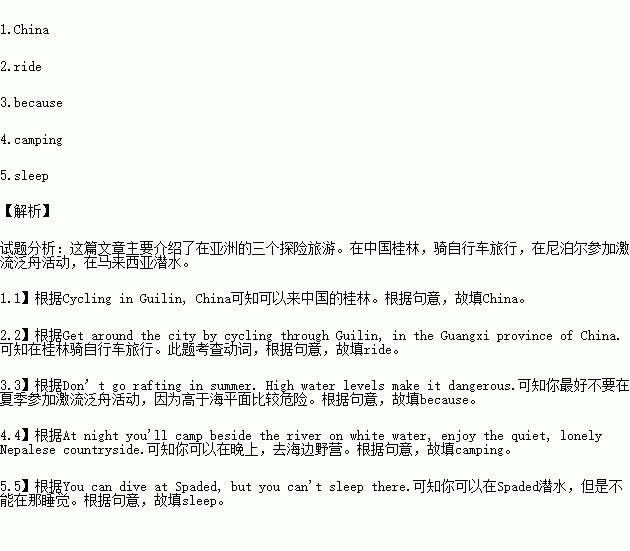
1.

You can 2. a bike to travel around Guilin and enjoy the beautiful natural views.

When your feet are tired, take a boat trip.

Nepal

You can experience thrilling rapids and the beauty of the Himalayas at the same time.

Take a white-water rafting trip down the Sun Kosi River

At night you can go 3. beside the river.

You’d better not go rafting b_4.__of the high water level.

Malaysia

Go scuba diving in the clear waters around Spaded, a famous Island is famous for diving.

You can dive but can’t 5. there.

练习册系列答案
相关题目

Do you feel lonely when your best friend isn’t around? Here’s our advice to you-- and to all kids who feel lonely sometimes.

It’ s hard when a best friend isn’t around—maybe because he or she moved to a different school or a different class. You may feel left out at break or lunchtime. You want to have new friends, but how do you make them? Maybe it seems like everybody else already has his or her friends. But remember, there’s always room for more friends.

Start by looking around your classroom—think about which kids you’d like to play with at break. Look for chances to say hi to them, smile, and be friendly. Offer to share something or express your appreciation (欣赏) to them. Invite someone to play with you or say “Do you want to sit here?” in the lunchroom. When you’re at break, walk over to kids you want to play with, act friendly, and say “Hi, can I play, too?” or just join in.

If you have trouble doing this or if you’re feeling shy, ask your teacher to help you make new friends. Teachers are usually pretty good at matching up friends. The best way to make friends is to be a friend. Be kind, be friendly, share, say nice things, offer to help—and pretty soon, you’ll have one, or two, or even more new friends.

You might still miss that special best friend. But when you see each other, you can share something you didn’t have before he or she left: You can introduce him or her to your new friends!

1.Which of the following can explain the expression “feel left out”?

A.Feel homesick. B.Feel lonely.

C.Leave home alone. D.Be hungry.

2.According to the writer, some kids feel lonely at break because they .

A.have trouble with their studies

B.don’t have their best friends around

C.need their parents to be with them

D.are too young to look after themselves

3.The underline word “this” in Paragraph 4 means .

A.sharing your ideas

B.talking in front of many people

C.studying better at school

D.developing new friendship

4.Some kids need help from teachers to make friends because .

A.they miss their old friends a lot

B.they have no time to stay with others

C.teachers know who wants a new friend

D.they are shy or not good at making friends

We are always using body language in our daily life. When we have a conversation with someone, we may be using more body language than words. However, the same body language may mean different things in different countries. That’s why people sometimes do not understand each other correctly. Pointing to one part of the body can mean differently in different cultures. For example, in the USA people point to their heads when they think someone is clever. However, in Europe(欧洲) it means ‘He or she is stupid or something is wrong with his or her head’. In our Chinese culture, nodding our head up and down means ‘yes’ and shaking our head from side to side means ‘no’. However, in parts of India, Greece and Turkey, it means just the opposite(相反). In England or the USA, when you raise your hand and make a circle with the thumb and the second finger, it means ‘You’re all right or Everything is OK’. However, if we do this in France or Belgium, it means ‘You’re worth zero’. In Greece or Turkey, we should not make this gesture(手势). Or we are thought to be very rude.

The meaning of gestures can also change over time. In the 1960s, the V sign meant ‘peace’. However, during World War II, it meant ‘victory’. In Greece, it is a very insulting(污辱性)sign. Though the meaning of body language is different, there are some expressions having the same meaning throughout the world, such as smiling and crying.

1.In England, if people point to their heads it means they think someone is _________.

A. clever B. stupid C. headache D. angry

2.In India, if one nods his head up and down, it means he ______.

A. doesn't agree B. agree C. is happy D. is sad

3.In France, if you raise your hand and make a circle with the thumb and the second finger, it means ________.

A. you are clever B. everything is OK

C. it is true D. you are worth nothing

4.Which country's body language is most different from our usual thinking?

A. France B. England C. Greece D. India

5.V sign meant _______________ about fifty years ago.

A. victory B. killing C. festival D. peace

It was the Greek shopkeeper who taught me about the power of being kind.

In 2008, I left Spain to study alone in London. My parents had to bring up(养育) my three younger sisters and two younger brothers, so I found three part-time jobs to pay for my studies. I worked early mornings and late nights, so I was tired, really tired, all the time.

Unluckily, I got a cold and had a very high fever. Because I was new in London, I had no friends. Besides, I was too shy to talk with others and ask others for help. After sleeping on the bed for two days, I went out to get some food. Usually, I went to the supermarket, but this time I went into the Greek shop, a small corner shop, because it was closer.

I picked up some food and gave it to the shopkeeper, who asked me, ‘You look terrible, my boy! You are not feeling well, right?’

I said YES in a low voice.

She pointed at the salami (腊肠) and bread I was buying and offered, ‘I can make you a sandwich, so you don’t have to do it yourself.’

I nodded without saying a word.

So, she made the sandwich and asked me to wait a moment. She went into the back room and came again with a bowl of hot soup.

‘It will warm you up,’ she said with a friendly smile.

What really warmed me up was not the soup. It was her smile that told me she cared me. Her kindness(善良) made me think of my mother.

I was quite shy, but from that day on, I did not let shyness stop me from talking with and being kind to others. Now I work in a children’s hospital in Africa. I love my work and people around me. I always bring my smile and kindness to them.

1.When did the writer leave for London?

A. In 2003. B. In 2009.

C. In 2008. D. 10 years ago.

2.What can we learn about the writer and his family?

A. His parents could not pay for his studies.

B. There are five kids in his family.

C. The writer is the youngest child in the family.

D. In 2008 the writer left London to study in Spain.

3.What happened to the writer?

A. He lost his part-time jobs.

B. He had a talk with his friends.

C. He got a cold and had a very high fever

D. He was not popular at his school.

4. What did not the shopkeeper do for the writer?

A. She made the sandwich.

B. She cooked a bowl of hot soup.

C. She made some bread.

D. She sold him some salami.

5.Which of the following words can’t describe(描述) the Greek shopkeeper?

A. Friendly. B. Shy. C. Nice. D. Kind.

违法和不良信息举报电话:027-86699610 举报邮箱:58377363@163.com

精英家教网