题目内容

---Did you hear that water in Tai Lake smelled terrible?

--- Yes.It ___________ because of people and factories.

A. polluted B. was polluted C.has polluted


B

【解析】

试题分析: be+动词的过去分词构成被动语态,其过去时为were/was+动词的过去分词。句意:你听说太湖的水闻起来非常糟糕了吗?是的,因为水被人类和工厂污染了。问句是过去时,主语又是it,故选B。

考点:考查被动语态的用法。


练习册系列答案
相关题目

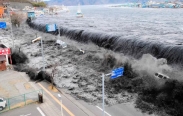
A tsunami(海啸) is a series of(一系列) huge waves that can cause great destruction(毁灭) when they hit a beach. Most tsunamis are caused by underwater earthquakes, but not all underwater earthquakes cause tsunamis. About 90 percent of all tsunamis take place in the Pacific Ocean, most of them are in Japan. A strong earthquake in the ocean near Japan caused a deadly tsunami on March 11,2011. As of April 25, the number of death had been raised to 14,133, and more than 13,346 people were listed as missing. The word “tsunami” comes from the Japanese word.

Many tsunamis could be found before they hit land with the use of modern technology. If you see the water drawback (后退) quickly and unexpectedly from a beach, run toward higher ground or inland -- there may be a tsunami coming. Also, if you are on the beach and there is an earthquake, it may have caused a tsunami, so run toward higher ground or inland. The first wave in a tsunami is often not the largest; if you experience one unusually-huge wave, go inland quickly -- even bigger waves could be coming soon. 
Do you know the story of the "angel(天使) of the beach"? Tilly, A 10-year-old English schoolgirl who saved the lives of hundreds of people in Phuket,Thailand in the Asian Tsunami of 2004 , by warning them a wall of water was about to strike(袭击), after learning about tsunamis in geography class. “Last term geography teacher Andrew Kearney taught us about earthquakes and how they can cause tsunamis,” Tilly said to the reporter.“I was on the beach and the water started to go funny. There were bubbles and the water went out all of a sudden. I recognised what was happening and had a feeling there was going to be a tsunami. I told mummy.”

1.An earthquake may cause a tsunami.

A. in the city B. in the country C. under the water

2.When the tsunami is coming, we should .

A. run towards the higher place or inland

B. run to the playground

C.run into a house

3.Tilly saved hundreds of people’s life in .

A. Japan B. Tailand C. the United Kingdom

4.Tilly recognised there would be a tsunami because .

A. her geography teacher told her.

B. she found the water drawback unusually quickly

C. she had a feeling about the earthquake

5.Which of the following statement is TRUE according to the passage?

A. The word “tsunami” is from Japanese because most recorded tsunamis in the world took place in Japan

B. Tsunami can only be found by modern technology before it hit the land.

C. Tsunami only happens in the Pacific Ocean


He was a single father, raising a 5-year-old boy alone. He worried about his son growing up without a mother to care for him.

One day he went away on business, leaving the child alone. He was worried about the child all the way, not knowing if he had eaten. But his child always told him not to worry. He went home quickly after finishing his work.

When he got home, the child was deep asleep. He was tired out. When he was about to sleep himself, he was surprised to find an overturned bowl of noodles under the quilt. He spanked his sleeping son angrily: "Why are you so naughty, making the quilt dirty? Who will wash it?" It was the first time that he had hit his boy after his wife's death.

"I haven't," the boy explained with tears in his eyes. "This is your supper, Daddy." In order to let his father eat dinner as soon as he got home, the boy cooked two bowls of noodles: one for himself, the other one for his father. He was afraid his father's noodles would get cold, so he placed them under the quilt to keep them hot.

Hearing this, the father hugged his boy tightly without saying a word.

1.According to the passage we know the boy only had _________.

A. a grandfather B. a mother C. a father D. a grandmother

2.The single father was always worried about ______.

A. his work B. his money C. his son D . his quilt

3.When the father got home , __________________________

A. His son wasn't at home. B. He was tired out

C. His son was doing his homework D. He was very happy.

4.When the father knew the truth, _________.

A. He hit his son B. He was very upset.

C. He hugged his son tightly. D. He went outside.

5.Which of the following is wrong?

A.The father worried about his son when he was on business.

B.The child was sleeping when his father got home.

C.The father often hit his son after his wife’s death.

D.The child cooked noodles for himself and his father.


违法和不良信息举报电话:027-86699610 举报邮箱:58377363@163.com

精英家教网