ÌâÄ¿ÄÚÈÝ
In the rectangular coordinates£¬abscissa and ordinate of the intersection point of the lines y=x-k and y=kx+2 are integers for imteger k£¬then the number of the possible values of k is
£¨Ó¢ººÐ¡´Êµä£ºabscissaºá×ø±ê£»ordinate×Ý×ø±ê£»intersectionpoint½»µã£»integerÕûÊý£©
- A.4
- B.5
- C.6
- D.7
A
·ÖÎö£ºÈÃÖ±Ïßy=x-k£¬y=kx+2×é³É·½³Ì×飬ÏûÈ¥y£¬¸ù¾Ýx£¬k¾ùΪÕûÊýÇóµÃk¿ÉÄܵÄÕûÊý½âµÄ¸öÊý¼´¿É£®
½â´ð£º £¬
£¬
x-k=kx+2£¬
£¨x+1£©k=x-2£¬
k=1+ £¬
£¬
¡ßx+1¿ÉÈ¡¡À1£¬¡À3¹²4¸öÊý£¬
¡àÏà¶ÔÓ¦µÄkµÄÖµÒ²ÒªÓÐ4¸ö£®
¹ÊÑ¡A£®
µãÆÀ£º±¾Ì⿼²éÁËÖ±ÏßµÄÏཻÎÊÌ⣻×é³É·½³Ì×éÏûÈ¥Ò»¸öδ֪ÊýÊǽâ¾ö±¾ÌâµÄÍ»ÆƵ㣻ÕÒÏàÓ¦µÄÕûÊý½âÊǽâ¾ö±¾ÌâµÄÄѵ㣮
·ÖÎö£ºÈÃÖ±Ïßy=x-k£¬y=kx+2×é³É·½³Ì×飬ÏûÈ¥y£¬¸ù¾Ýx£¬k¾ùΪÕûÊýÇóµÃk¿ÉÄܵÄÕûÊý½âµÄ¸öÊý¼´¿É£®
½â´ð£º
 £¬
£¬x-k=kx+2£¬
£¨x+1£©k=x-2£¬
k=1+
 £¬
£¬¡ßx+1¿ÉÈ¡¡À1£¬¡À3¹²4¸öÊý£¬
¡àÏà¶ÔÓ¦µÄkµÄÖµÒ²ÒªÓÐ4¸ö£®
¹ÊÑ¡A£®
µãÆÀ£º±¾Ì⿼²éÁËÖ±ÏßµÄÏཻÎÊÌ⣻×é³É·½³Ì×éÏûÈ¥Ò»¸öδ֪ÊýÊǽâ¾ö±¾ÌâµÄÍ»ÆƵ㣻ÕÒÏàÓ¦µÄÕûÊý½âÊǽâ¾ö±¾ÌâµÄÄѵ㣮

Á·Ï°²áϵÁдð°¸
 µÚ1¾íµ¥ÔªÔ¿¼ÆÚÖÐÆÚĩϵÁдð°¸
Ïà¹ØÌâÄ¿
¸ù¾Ý¶Ô»°ÄÚÈÝ£¬´Ó¶Ô»°ºóµÄÑ¡ÏîÖÐÑ¡³öÄÜÌîÈë¿Õ°×´¦µÄ×î¼ÑÑ¡ÏѡÏîÖÐÓÐÁ½ÏîΪ¶àÓàÑ¡Ïî¡£
¡ª Hello, Mr. Black. 1
¡ª Yes, that¡¯s right. Tomas, I counted the workbooks. 2
¡ª Err, Mr. Black. I think I forgot¡
¡ª Forgot? Students should know what they should do.
¡ª 3 I swear I won¡¯t make this happen again, Mr. Black.
¡ª Are you sure? I¡¯d like to believe you once. 4
¡ª Yes, I know. I will make up my undone assignment and submit it to you.
¡ª 5 Remember to hand in your assignment punctually.
¡ª Hello, Mr. Black. 1
¡ª Yes, that¡¯s right. Tomas, I counted the workbooks. 2
¡ª Err, Mr. Black. I think I forgot¡
¡ª Forgot? Students should know what they should do.
¡ª 3 I swear I won¡¯t make this happen again, Mr. Black.
¡ª Are you sure? I¡¯d like to believe you once. 4
¡ª Yes, I know. I will make up my undone assignment and submit it to you.
¡ª 5 Remember to hand in your assignment punctually.
| A. That will be fine. B. I am so sorry for that. C. Then do you know what you should do next? D. Are you looking for me? E. Why don¡¯t you hand in your assignment on time? F. All are here except yours. G. May I come in? |
Grown-ups know that people and objects are solid. At the movies, we know that if we reach out to touch Tom Cruise, all we will feel is air. But does a baby have this understanding?
To see whether babies know objects are solid. T. Bower designed a method for projecting an optical illusion (ÊÓ¾õÓ°Ïñ) of a hanging ball. His plan was to first give babies a real ball, one they could be expected to show surprised in their faces and movements. All the 16 to 24-week-old babies tested were surprised when they reached for the illusion and found that the ball was not there.
Grown-ups also have a sense of object permanence. We know that if we put a box in a room and lock the door, the box will still be there when we come back. But does a baby realize that a ball that rolls under a chair does not disappear and go to never-never land?
Experiments done by Bower suggest that babies develop a sense of object permanence when they are about 18 weeks old. In his experiments, Bower used a toy train that went behind a screen. When 16-week-old and 22-week-old babies watched the toy train disappear behind the left side of the screen, they looked to the right, expecting it to re-appear. If the experiment took the train off the table and lifted the screen, all the babies seemed surprised not to see the train. This seems to show that all the babies had a sense of object permanence. But the second part of the experiment showed that this was not really the case. The researcher substituted (Ìæ»») a ball for the train when it went behind the screen. The 22-week-old babies seemed surprised and looked back to the left side for the train. But the 16-week-old babies did not seem to notice the switch (¸ü»»). Thus, the 16-week-old babies seemed to have a sense of ¡°something permanence,¡± while the 22-week-old babies had a sense of object permanence related to a particular object.
¡¾Ð¡Ìâ1¡¿The passage is mainly about .
¡¾Ð¡Ìâ2¡¿In Paragraph 3, ¡°object permanence¡± means that when out of sight, an object .
¡¾Ð¡Ìâ3¡¿What did Bower use in his experiments?
¡¾Ð¡Ìâ4¡¿Which of the following statements is true?
To see whether babies know objects are solid. T. Bower designed a method for projecting an optical illusion (ÊÓ¾õÓ°Ïñ) of a hanging ball. His plan was to first give babies a real ball, one they could be expected to show surprised in their faces and movements. All the 16 to 24-week-old babies tested were surprised when they reached for the illusion and found that the ball was not there.
Grown-ups also have a sense of object permanence. We know that if we put a box in a room and lock the door, the box will still be there when we come back. But does a baby realize that a ball that rolls under a chair does not disappear and go to never-never land?
Experiments done by Bower suggest that babies develop a sense of object permanence when they are about 18 weeks old. In his experiments, Bower used a toy train that went behind a screen. When 16-week-old and 22-week-old babies watched the toy train disappear behind the left side of the screen, they looked to the right, expecting it to re-appear. If the experiment took the train off the table and lifted the screen, all the babies seemed surprised not to see the train. This seems to show that all the babies had a sense of object permanence. But the second part of the experiment showed that this was not really the case. The researcher substituted (Ìæ»») a ball for the train when it went behind the screen. The 22-week-old babies seemed surprised and looked back to the left side for the train. But the 16-week-old babies did not seem to notice the switch (¸ü»»). Thus, the 16-week-old babies seemed to have a sense of ¡°something permanence,¡± while the 22-week-old babies had a sense of object permanence related to a particular object.
¡¾Ð¡Ìâ1¡¿The passage is mainly about .
| A£®babies¡¯ sense of sight | B£®effects of experiments on babies |
| C£®babies¡¯ understanding of objects | D£®different tests on babies¡¯ feelings |
| A£®still exists | B£®keeps its shape | C£®still stays solid | D£®is beyond reach |
| A£®A chair | B£®A screen | C£®A film | D£®A box |
| A£®The babies didn¡¯t have a sense of direction. |
| B£®The older babies preferred toy trains to balls. |
| C£®The younger babies liked looking for missing objects |
| D£®The babies couldn¡¯t tell a ball from its optical illusion. |
 The radius of the four circles is one in the figure£¬then the area of the shade part is________
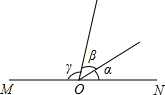 In the figure 5£¬MON is a atyaight line£¬If the angles ¦Á¡¢¦Âand¦Ã£¬satisfy ¦Â£º¦Á=2£º1£¬and¦Ã£º¦Â=3£º1£¬then the angle ¦Â=________£®£¨Ó¢ººÐ¡´Êµä£ºatraight lineÖ±Ïߣ¬angle½Ç£¬satisfyÂú×㣩