题目内容
Imagine the situation. You are driving along in a desert or on a mountain. You have no idea where you are. You passed the last house two hours ago. Then your car breaks down. It is night and it is cold. You have no mobile phone. What do you do? Well, next time take a GPS with you. This invention may be able to help you. It is a device(装置) which uses satellites to find the user’s position. It can find your position to within 20 meters. A GPS cannot start your car, but at least you will know where you are.
GPS, which means Global Positioning System(系统), is a small radio receiver. It looks like a mobile phone. You can hold it in your hand, or put in you pocket. It is sometimes put into a watch or a telephone. We also find GPS devices in cars, planes, or boats. Some of these devices have electronic (电子的)maps, so you know where you are. For example, in a city they can tell you the name of the street.
There are three parts to the Global Positioning System. The first part is the receiver. You can hold it in your hand, or have it fixed into your car, plane, etc. the second part is a group of satellites(卫星) orbiting the Earth. The receiver contacts(联系) at least four of the satellites and calculates(计算) its position. The third part of the system is a network of ground stations. They are all over the world. They control (控制)the satellites and make sure they are working well.
Some people think that in the future the GPS will be as common as the mobile. They are becoming cheaper and more and more accurate(精确的). There are also new uses for the GPS. Perhaps they will become like watches. Everyone will have one and you will never be lost again.
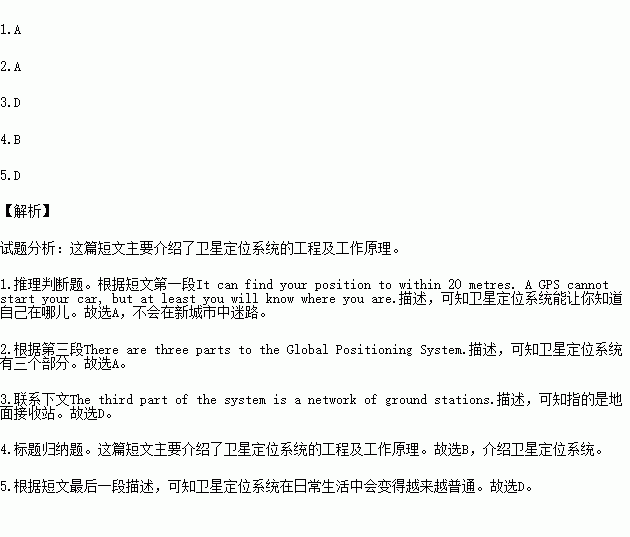
1..According to the passage, with the help of the GPS, people _________.
A. can’t be lost in a new city
B. can’t find their way in different counties
C. can learn about the culture of an unknown place
D. can spend the least time getting to another place
2.We can learn from the passage that ___________.
A. there are three parts to the GPS
B. a GPS can’t be put into a watch
C. a GPS can help you start your car
D. the GPS are becoming more and more expensive
3.The underlined word “They” in paragraph 3 means “__________”.
A. Receivers B. GPS devices
C. Satellites D. Ground stations
4.The passage is mainly about ____________.
A. the history of the GPS
B. the introduction of GPS
C. the shape of the GPS
D. the three parts of the GPS
5.What can we infer(推断)from the passage?
A. All GPS devices have electronic maps.
B. People in many countries will use the GPS for free.
C. The receiver of the GPS contacts at least five of the satellites.
D. The GPS will become more and more common in everyday life.

书面表达
根据下面的表格简单的介绍你的朋友Wang Lin过去和现在的不同,可适当发挥。
要求字迹工整,卷面干净。运用表格内的信息。80词左右。
In the past | Now | |
Appearance (外貌) | short, thin | tall, strong |
Personality (性格) | shy | outgoing |
Hobbies | play computer games | make sky lanterns |
Other things | ... | ... |
书面表达
某中学生英文报正在开展关于家乡生活变化的征文活动,请你根据下表提示,以 “Changes in Our Hometown”为题,用英语为该报写一篇稿件,简述在过去的20中,我的家乡在社会、家庭、学校及个人生活中的若干变化,展望未来生活及该如何为此努力。
变化 | 道路 | 小路→宽阔的公路 |
生活 | 步行、骑车→乘公共汽车、自驾 | |
学校 | 旧房→新教学楼 | |
学生 | 通过书本学习→通过网络学习 | |
愿望 | 更加美好的生活(或自拟一些内容,说明自己的理想生活) | |
打算 | 自拟一至两点内容,说明将如何为实现自己的愿望而努力 | |
要求:
1.内容充实,语句通顺,逻辑连贯。
2.表达中必须包含所给的要点,可以适当发挥,不要简单翻译。
3.80词左右。
________________________________________________________________
________________________________________________________________
________________________________________________________________
________________________________________________________________
________________________________________________________________
________________________________________________________________