题目内容
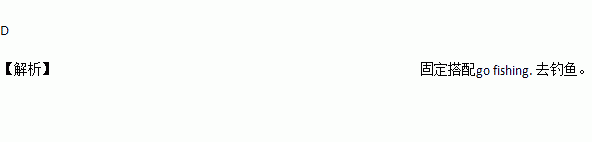
What about going _________ with us?
A. fish B. fishes C. fished D. fishing
Our English teacher is very nice. We _____ friends since three years ago.
A. were B. became C. have been D. have made
--- __________ ? --- I'd like gongbao chicken and some mapo tofu.
A. Can I take your order B. What do you like
C. Do you like something to eat D. Would you like some juice
Dear Diary,
I am an eleven-year-old boy. I am in Class 3, Grade 7.I like math very much. I went to the bookshop to buy a math book this afternoon. It was raining on my way to the bookshop. So I stopped. I ran to my school. My classmates were there, too. I was very happy. I saw my watch. It was a quarter past three. I wanted to play games. I played ping-pong with my classmates in school’s ping-pong room. At half past four, the rain stopped. I went to the bookshop.
Zhang Xin
1.Zhang Xin wanted to buy____________book.
A. a Chinese B. a math C. an English D. a story
2.What was the weather like?
A. It was sunny. B. It was windy. C. It was snowy. D. It was rainy.
3.Zhang Xin went to__________because it rained.
A. the post office B. his school C. his home D. the shop
4.It was___________when Zhang Xin got to the school.
A. a quarter to three B. a quarter past three
C. half past three D. twenty past three
5.Zhang Xin played___________with his classmates.
A. chess B. football C. basketball D. ping-pong
The show wasn't __________.I wasn't __________ in it at all.
A. interesting;interesting B. interesting;interested
C. interested;interested D. interested;interesting
“没有规矩,不成方圆。”为了孩子的身体健康及学习成功,每个家庭都会有这样或那样的家庭规矩。请你结合家庭的实际情况,根据下面的提示和要求,以“My Family Rules”为题,写一篇短文。
提示:1.不准玩电脑游戏; 2.做一些家务劳动; 3.及时完成家庭作业;
4.对家规的感受; 5.对父母的建议。
要求:1.必须包括提示内容,可以适当发挥;
2.词数:80个左右;
3.文中不得出现真实的地名和人名。
My Family Rules
____________________________________________________________________________________________________________________________________________________________________ __________________________________________________________________________________
__________________________________________________________________________________
In most parts of the world, many students help their school make less pollution. They join “environment clubs”. In an environment club, people work together to make our environment clean.
Here are the things students often do.
No-garbage lunches! How much do you throw away after lunch? Environment clubs ask students to bring their lunches in bags that can be used again. Every week they will choose the class that makes the least garbage and report it to the whole school!
No-car day! On a no-car day, nobody comes to school in a car, not only the students but the teachers as well! Cars give pollution to our air, so remember to do such things: walk, jump, bike or run! Use your legs! It’s very fun.
Turn off the water! Do you know that some toilets can waste twenty to forty tons of water an hour? In a year, that would fill a small river! In environment clubs, students mend those broken toilets.
We love our environment. Let’s work together to make it clean!
This is the end of our radio programme. Wish you have a good night. This is Grace Brown.
1.Where is the passage from?
A. A newspaper. B. A radio programme.
C. A TV programme. D. A magazine.
2.Every week they will report the class that ___________ to the whole school.
A. makes the least garbage B. makes the most garbage
C. throws away garbage D. Brings lunches in a bag
3.On a no-car day,__________ don’t drive cars to school.
A. the students B. the teachers C. nobody D. Both A and B
4.How much water can some toilets waste half an hour?
A. A small river. B. Twenty to forty tons.
C. Ten to twenty tons. D. Half a small river.
5.Why did Grace Brown read this passage?
A. To use his legs to walk, jump bike and run.
B. To fill a small river.
C. To ask students to make less pollution.
D. To have fun.
—Why not buy a radio and learn English on the radio?
—_____
A. Sounds like a good idea! B. It doesn’t matter.
C. Thanks for your help. D. Sorry to hear that.
Charles _______on his new model car from seven to eight yesterday evening .
A. was working B. worked C. has worked D. had worked

 浙江之星学业水平测试系列答案
 高效智能课时作业系列答案浙江之星学业水平测试系列答案高效智能课时作业系列答案