题目内容

When I was in primary school, I got into a big argument(争吵)with a boy in my class. I forgot what the argument was about, but I will never forget the lesson I learned that day.

I thought that I was right and he was wrong -and he thought that I was wrong and he was right. The teacher decided to teach us a lesson.

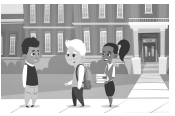
She brought us to the front of the class and asked him to stand on one side of her desk and me on the other. In the middle of her desk was a large,: round ball. I could clearly see that it was black. She asked the boy what color the, ball was. "White,” he answered.

I couldn't believe he said the ball was white, when it was obviously(明显地)black!

Another argument started between us, this time about the color of the ball.

The teacher told us to change places and then asked me what color the ball was. I had to answer "White". It was a ball with two differently colored sides, and from his side it was white.

From my side it was black.

Sometimes we need to look at problems from the other person's view in order to truly understand his or her ideas.

1.Who taught the writer a lesson?

A.The boy B.She herself C.Her teacher D.Her mother

2.How did the writer feel when the boy said the ball was white?

A.Surprised B.Worried C.Happy D.Scared

3.When in the boy's place, the writer changed her answer because ____________·

A.the boy changed his answer too B.she wanted to say sorry to the boy

C.the teacher said the boy was right D.the ball had two differently colored sides

4.What lesson can we learn from the story?

A.Seeing is believing. B.Every dog has its day.

C.Put yourself into others' shoes. D.Actions speak louder than words.
练习册系列答案
相关题目

Small talk

Americans often have short conversations, called small talk, about unimportant things with strangers or people they know but not very well. They may have small talk at parties, while waiting in line at the store, at family events or work. It's a way to say hi and express friendliness.

Small talk is very useful. It can avoid uncomfortable silences and build stronger relationships. For example, when you first meet someone or talk to someone you don't know well, you can break the ice by making small talk. Small talk with a colleague(同事) about his child may help you to understand more of his life outside the office.

In 2013 , researchers from the University of Essex asked some people to make small talk in a study. They found small talk can make people happier. People who talked briefly(短暂地) with a waiter in a coffee shop felt happier than those who simply went in ,ordered and left.

However some people are not good at small talk. Here are some tips to improve your small-talking ability.

Firstly, find common ground. When you have something similar with your speaking partner, that means you have something to talk about.

Secondly, ask open-ended questions. They are suitable(合适的) for small talk. For example, if you ask visitors whether they like your city, they may simply say "Yes. "But if you ask "What do you think of our city," they will have more freedom in how they answer.

Thirdly, become a student. Nobody knows everything. So, as someone is answering one of your open-ended questions, they bring up something about which you know nothing. So, tell them! This lets the other person become the teacher. They feel good about sharing their knowledge and you get to learn something. It's a win-win situation.

Finally, practice makes perfect. Like anything, getting good at making small talk takes practice.

If you make small talk in your native language, you might become happier. If you are making small talk using English, you will most surely improve your speaking and listening skills.

1.Do Americans often have small talk?

2.Why is small talk useful?

3.What did some researchers from the University of Essex find in 2013?

4.What kind of questions are suitable for small talk?

5.What does the writer tell us about small talk in the passage?

阅读短文,按要求回答何题。

You must think a computer is the best thing in the world, right? You must think it works at a super speed and can do everything? Well, it's not! In fact, the brain is much more powerful than any super computer! Think about when a glass is just about to fall off the table. Your brain controls everything that you need to do to save that glass from falling. First your eyes check out what's going on, then tell your brain, `and your brain decides how quickly you need to react, and then your muscles go into action. This is just from your brain. No computer could ever come close to that!

The brain weighs just 3 pounds; but is controls everything you do from thinking, learning, feeling even to breathing and your heart beating. Even though the brain is just 2% of your body weight, it uses around 20% of all your energy in your body. That is a lot for such a small organ (器官),There are about 100 billion tiny, tiny little cells(细胞)in your brain. There are so many that it would take you over 3,000 years to count them all!

Your brain stops growing when you're -18, but it actually keeps on developing and learning new things. So your parents are really super smart! You' won't be able to fool them! Believe it or not, your brain NEVER stops working. Even during sleep,the brain works for long-term memory establishment(建立). It is realized that the brain is the second organ in the body as the heart that never stops during human live.

So everyone should be proud of such a gift of nature.

1.Is super computer much more powerful than the brain?

2.What can check out what's going on when the glass is about to fall off the table?

3.How much does the brain weigh?

4.What does the underlined word "That" refer to in Paragraph 2?

5.When will your brain stop growing?

违法和不良信息举报电话:027-86699610 举报邮箱:58377363@163.com

精英家教网