ÌâÄ¿ÄÚÈÝ

ÍêÐÎÌî¿Õ

ÔĶÁÏÂÃæµÄ¶ÌÎÄ£¬ÕÆÎÕÆä´óÒ⣬Ȼºó´Ó¶ÌÎĺó¸÷ÌâËù¸øµÄA¡¢B¡¢C¡¢DËĸöÑ¡ÏîÖУ¬Ñ¡Ôñ×î¼ÑÑ¡Ïî¡£

The Magic Window

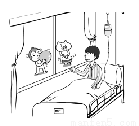
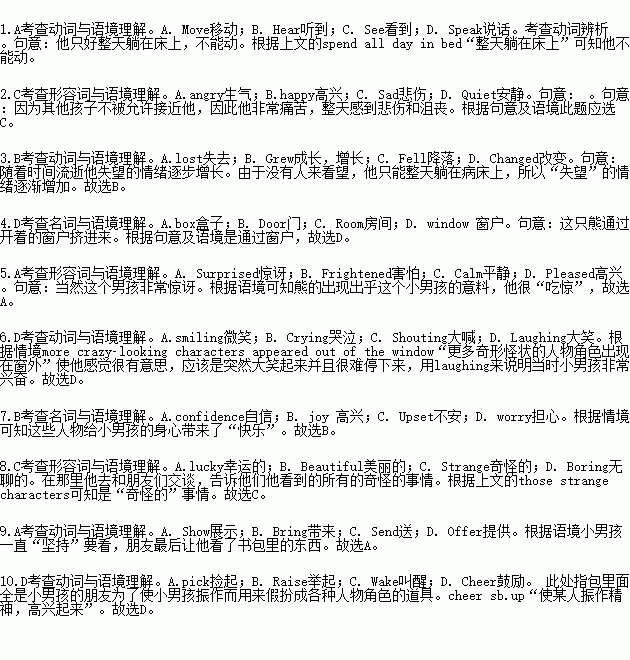
Once upon a time there was a little boy who became very ill. He had to spend all day in bed, unable to ______. Because other children weren¡¯t allowed to come near him, he suffered greatly, and spent his days feeling ______and blue.

There wasn¡¯t much he could do except lookingout of the window. Time passed, and his feeling of hopelessness just ______. Until one day he saw a strange shape in the window. It was a tiny bear eating a sausage sandwich. The bear squeezed(¼·½ø) in through the open ______, said ¡°good afternoon¡± to the boy, turned around, and left.

Of course, the boy was very ______. He was still trying to work out what had happened, when outside his window he saw a monkey in a suit, busy blowing up a balloon. At first the boy asked himself what that could possibly be, but after a while, as more and more crazy-looking characters appeared out the window, he started ______suddenly and found it hard to stop.

Anyone who wanted to stop laughing would never be helped by seeing a pig playing a drum, an elephant jumping on a sofa, or a dog wearing a pair of glasses and talking about nothing except politics. The little boy didn¡¯t tell anyone about this because no one would believe him. Even so, those strange characters ended up putting ______back in his heart, and in his body. Before long, his health had improved so much that he was able to go back to school again.

There he got to talk to his friends, and tell them all the ______things he had seen. While he was talking to his best friend, he saw something jumping out of his friend¡¯s school bag. The boy asked his friend what it was, and he insisted and finally his friend had to ______him what was in the bag:There, inside, were all the fancy-dress suits that his best friend had been using to try to ______the little boy up!

And from that day on, the little boy always did his best to make sure that no one felt sad and

alone.
1.A. move B. hear C. see D. speak

2.A.angry B.happy C. sad D. quiet

3.A.lost B. grew C. fell D. changed

4.A.box B. door C. room D. window

5.A. surprised B. frightened C. calm D. pleased

6.A.smiling B. crying C. shouting D. laughing

7.A.confidence B. joy C. upset D. worry

8.A.lucky B. beautiful C. strange D. boring

9.A. show B. bring C. send D. offer

10.A.pick B. raise C. wake D. cheer
Á·Ï°²áϵÁдð°¸
Ïà¹ØÌâÄ¿

Traveling to every part of the world gets easier, but how well do we know and understand each other. Here¡¯s a simple test. Imagine you are planning to hold a meeting at four o¡¯clock. What time should you expect your foreign business friends to arrive? If they are Germans, they¡¯ll arrive on time. If they are Americans, they¡¯ll probably be 15 minutes early. If they are Englishmen, they¡¯ll be 15 minutes late, and you should allow up to an hour for the Italians.

The British seemed to think since the English language was widely used in the world, people would always understand what they do. However, they found they were completely wrong. For example, the British are happy to have a business lunch and discuss business matters and have a drink during the meal. The Japanese prefer not to work while eating. Lunch is a time for them to relax and get to know each other and they don¡¯t drink at lunchtime. The Germans like to talk business before dinner. The French like to eat first and talk afterwards. They have to be well fed and watered before they discuss anything.

1.What do the Germans prefer when they go to a meeting?

A. They prefer to be on time.

B. They prefer to arrive very early.

C. They prefer to arrive very late.

D. They prefer to arrive a little late.

2.According to the text, if a group of Englishmen, Americans and Italians hold a meeting, who will be the last to arrive?

A. The Englishmen.

B. The Americans.

C. The Italians.

D. Both the Englishmen and the Italians.

3.What do the Japanese like to do at lunchtime?

A. To drink.

B. To get to know each other.

C. To talk business.

D. To eat only.

4.According to the writer, the British like to ________.

A. arrive on time and talk business during the meal

B. arrive earliest and hate talking business at a meal

C. arrive 15 minutes late and talk business after the meal

D. arrive a few minutes late and discuss business during the meal

5.By giving us the two examples, the writer means to show us that _______.

A. different countries have different cultures in different parts of the world

B. the Germans are more serious and have good living habits

C. the Italians are careless people and they are never on time for everything

D. the French people are very lazy. They prefer eating and drinking more

ÔĶÁ¶ÌÎÄ£¬¸ù¾Ý¶ÌÎÄÄÚÈÝ£¬´Ó¶ÌÎĺóµÄÎå¸öÑ¡ÏîÖÐÑ¡³öÄÜÌîÈë¿Õ°×´¦µÄ×î¼ÑÑ¡Ïÿ¸öÑ¡ÏîÖ»ÄÜÓÃÒ»´Î¡££¨¹²10·Ö£¬Ã¿Ð¡Ìâ2·Ö£©

Eating habits

Eating habits are different in different countries. The Chinese have a saying ¡°1. , eat a big meal for lunch, but eat less at dinner.¡± Many Britishagree that one should start theday with a good breakfast, but their ideas about lunch and dinner are different.

People in UK do not usually have rice or noodles for breakfast. 2. . Hot tea, coffee and milk are their usual breakfast drinks.

Most Britishpeople only give themselves a short time for lunch. 3. . Lunch is taken later in UK, at about 1 p.m. While Chinese people like a hot, filling lunch, many Britishpeoplemay just have a sandwich. There are also differences in the way schoolchildren eat lunch. In the past, British children ate hot lunches at school, as most children in China do now, although the food was different. Today, British schoolchildren bring their own lunches to school. They usually eat a sandwich and a piece of fruit.

The evening meal is the most important meal in both countries. 4. , and so do many people in UK. After work theywill have more time to eat a big dinner. In most families in UK,thereis meat with two or three vegetables and then something sweet. But in China people often have more dishes, and usually with some soup.

And of course, in both countries people look forward to their most important festivals: Christmas in UK, and the Spring Festival in China. 5. ,there is one thing in common ¨Cthe happiness of being with their families and loved ones.

A. In China people have dinner at about 6 p.m.

B. Although the food they eat is different

C. Eat good things forbreakfast

D. So they eat a small lunch

E. They eat bread instead

Î¥·¨ºÍ²»Á¼ÐÅÏ¢¾Ù±¨µç»°£º027-86699610 ¾Ù±¨ÓÊÏ䣺58377363@163.com

¾«Ó¢¼Ò½ÌÍø