题目内容

The beach is not as ________ as it used to be. Let’s collect the rubbish.

A. clean B. cleaner

C. cleanest D. the cleanest


A

【解析】

试题分析:句意:这片海滩不如以前干净了。让我们去捡垃圾吧。分析:考查固定句型not as……as……表示:不如……一样,中间接形容词或副词的原级;联系下文体现为去捡垃圾,因此是不如以前干净了,所以选择clean的原级。故选 A

考点:考查形容词的用法。


练习册系列答案
相关题目

Speaking English is not only about using proper grammar, but also about understanding the culture. Here is some important advice to remember when speaking English in the United States.

Americans have difficulties understanding foreign accents. Many Americans are not used to foreign accents. This requires patience from both of you.

Talk about places: Americans love to talk about places. When speaking to a stranger, ask them where they come from and then say something about that place. For example: “Oh, I have a friend who worked in Los Angeles. He says it’s a beautiful place to live in.” Most Americans will then willingly talk about their experiences of living in or visiting that city or place.

Talk about work: It is common for Americans to ask “What do you do?” It’s not considered impolite as in some countries and is a popular topic of discussion between strangers.

Talk about sports: Americans love sports! However, they love American sports. When speaking about football, most Americans understand “American football”, not soccer.

Be careful when expressing ideas about race, religion or other sensitive(敏感的)topics:The United States is a society with different cultures. Americans are very sensitive to other cultures and ideas.

1.For Americans, the question “what do you do?” is ________.

A. common B. impolite C. boring D. surprising

2. What can we learn about Americans?

A. They like to learn foreign accents.

B. They are willing to talk about places.

C. They prefer soccer to American football.

D. They accept other ideas and cultures easily.

3.The writer gives some advice mainly on ________.

A. talking with Americans

B. working with Americans

C. speaking American English

D. understanding American society


Christmas Love

Each December, I promised to make Christmas a relaxed and peaceful experience. I didn’t spend too much time on card writing, endless cooking and decorating. Yet still, I found myself tired, unable to enjoy the valuable family moments, and of course, to understand the true meaning of .

Christmas came again. My son, Nicholas, was in primary school that year. It was a very season for a six-year-old. For weeks, he’d been memorizing songs for his school’s “Winter Celebration.” All the parents were invited to be present at their show.

I didn’t have the heart to tell him I’d be working. Unwilling to his shining moment, I spoke with his teacher. She told me there’d be a dress rehearsal(彩排) the morning of the presentation. All unable to be present that evening were welcome to come then.

So, on the of the dress rehearsal, I arrived ten minutes early. Around the room, I saw several other parents. Because the public school system had long stopped referring to the holiday as “Christmas”, I didn’t anything other than fun. So, when my son’s class rose to sing “Christmas Love”, I was a little bit surprised by its title.

Nicholas was excited, as were all of his classmates. Those in the front row held up large letters, one by one, to out the title of the song. As the class would sing “C is for Christmas,” a child would hold up the letter C. Then, “H is for Happy,” and on and on all the children presented the complete message “Christmas Love”.

The show was going smoothly, until suddenly, a small, quiet, girl in the front row held the letter “M” upside down — totally not knowing her letter “M” appeared as a “W”. The audience(观众) laughed at this little girl’s . But she had no idea why they were laughing at her, so she stood tall, holding her “W”. The laughter continued until the last letter was raised, and we all saw it together. A sudden came over the audience and eyes began to widen. At that moment, we understood why we were there and why we the holiday.

For when the last letter was held high, the message read loud and clear: “CHRIST WAS LOVE”.

1.A. familyB. loveC. ChristmasD. school

2.A. freshB. excitingC. successful D. golden

3.A. missB. wasteC. forget D. change

4.A. officersB. childrenC. teachersD. parents

5.A. morningB. noonC. afternoonD. evening
6.A. enjoyB. expect C. findD. have

7.A. spell B. pick C. checkD. carry

8.A. sinceB. before C. untilD. when

9.A. letterB. mistakeC. appearance D. gesture

10.A. politelyB. honestlyC. quietly D. proudly

11.A. cryB. angerC. silence D. sadness

12.A. celebratedB. rememberedC. inventedD. recorded


American Table Manners

Table manners are different in different countries. What is polite in China may not be polite in the Unite States. These basic rules will help you enjoy western food with your American friends.

When you sit down at the table, always put the napkin on your lap first.

When eating something in a bowl, do not leave the spoon in the bowl. Put it on the plate under the bowl. When you have had your meal, place your knife and fork on the side of your plate.

During the meal, the hostess will offer you a second helping of food. Sometimes she will ask you to help yourself. When she offers you food, give her a direct answer. If you refuse the first time, she might not ask you again.

At the table, ask others to pass you dishes that are out of your reach. Good expressions to know are: “Please pass me the ...” or “Could you hand me the -please?”

The best way to learn good manners is to watch others. Observe (察) the way your western friends eat. This is the best way to avoid making mistakes when you are unsure of what to do.
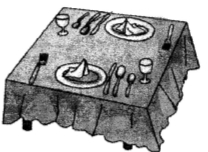
 

The Basic Rules of Table Manners in America

Before the meal

You should put the napkin on your 1. first.

During the meal

If the hostess offers you food, you' d better answer her 2. . She might ask you just once.

You can ask others for help when the dishes are 3. your reach.

After the meal

After you have the meal, you should put the 4. on the side of your plate.

The best way

If you don't know how to behave well at table, just 5. . It works well.


违法和不良信息举报电话:027-86699610 举报邮箱:58377363@163.com

精英家教网