ÌâÄ¿ÄÚÈÝ

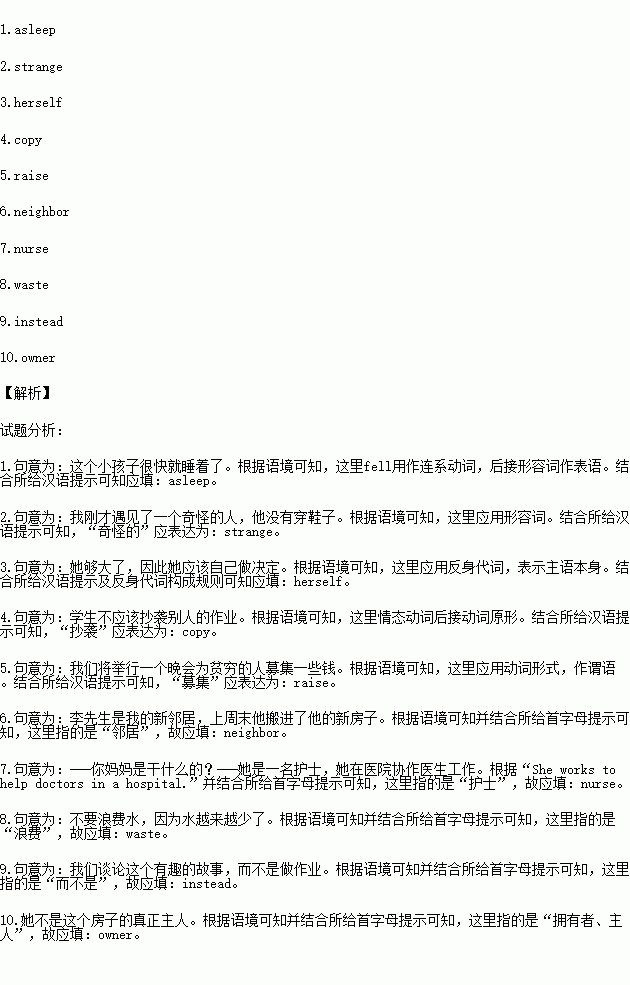
¸ù¾ÝººÓïÒâ˼д³öµ¥´ÊµÄÕýÈ·ÐÎʽ

1.The little baby fell (˯×Å) quickly.

2.I met a (Ææ¹ÖµÄ) man just now. He didn¡¯t wear shoes.

3.She is old enough. So she should make a decision by (Ëý×Ô¼º).

4.A student shouldn¡¯t (³­Ï®) other¡¯s homework.[À´Ô´:ѧ¿Æ

5.We will have a party and (=) some money for the poor man.

6.Mr. Li is my new n . He moved in his new house last weekend.

7.¡ª What does your mother do?

¡ª She is a n . She works to help doctors in a hospital.

8.Don¡¯t w any water because it¡¯s getting less and less.

9.We talk about the interesting story i of doing our homework.

10.She is not the true o of this house.
Á·Ï°²áϵÁдð°¸
Ïà¹ØÌâÄ¿

ÔĶÁÀí½â¡£

We know good manners are important. Today I am going to tell you something about manners in different countries. I think you already know that people in different countries usually have different ways of doing things.

Something that is rude in one country may be quite polite in another. For example, in Britain you mustn¡¯t lift your bowl to your mouth when you are having liquid food(Á÷ÖÊʳÎï). That is considered bad manners in Britain. But in Japan you needn¡¯t worry about making a noise when you drink something. It shows that you are enjoying it. In Britain we try not to put our hands on the table at all during a meal. In Mexico, however, guests are expected to keep their hands on the table throughout a meal. In Arabic countries we must be careful with our hands. You see, in Arabic countries you mustn¡¯t eat with your left hand. This is considered to be very impolite. So, what should you do if you visit a foreign country?

Well, you needn¡¯t worry. You can ask the natives(±¾µØÈË) there to help you and you can just watch carefully and try to do what they do.

1.It is polite to make a noise when you drink something in .

A. Britain B. Japan

C. Mexico D. Arabia

2.In Britain we try not to put our hands during a meal.

A. on the table B. around the bowl

C. on the desk D . in the pocket

3.In Arabic countries you must be careful with your .

A. noise B. mouth

C. food D. hands

4.If you visit a foreign country, you should .

A. do as you like B. try to do what the natives do

C. do as the British do D. eat with your right hand

ÍêÐÍÌî¿Õ

Emma liked to help Grandma in her garden (Ô°ÆÔ). She was _________ in all the things in the garden and always had lots of questions to ask.

¡°Why do you have big rocks in your garden, Grandma?¡± Emma asked _________ she was watering lettuce. Grandma was doing some digging. ¡°Keep your eyes open,¡± she said, ¡°One day you will see why.¡±

Emma looked at the rocks every time she went into Grandma¡¯s garden. They just sat there, as if (ËÆºõ) they were waiting _________her to find out their secret.(ÃØÃÜ).

One morning Emma went into Grandma¡¯s garden to _________ tomatoes. It had rained the night before, so it was a bit _________ . But now the sun was shining warmly. _________ Emma stopped and looked. On a big rock near her sat two beautiful yellow ¨Cand-black butterflies (ºûµû). As Emma watched, the butterflies were ready to fly, soon they flew away. Emma looked closely at the rocks. But they looked _________ special. Emma touched one. She smiled. She picked the tomatoes quickly and ran back into Grandma¡¯s house.

¡°I know why you have big rocks in your garden, Grandma!¡± she called. Grandma laughed. ¡°This cool morning gave you the answer, _________ it?¡± She said. ¡°Yes,¡± said Emma. ¡°I saw butterflies sitting on the rocks, warming themselves so they could fly.¡± ¡°That¡¯s it,¡± said Grandma. ¡°They can¡¯t fly when their bodies are cold.¡± ¡°I wonder how they know the sun warms the rocks,¡± said Emily. ¡° _________ mystery (°ÂÃØ)!¡± said Grandma.

Emma laughed. ¡°I¡¯ll have to work on that one,¡± she said. ¡°But I know one thing, Grandma. When I grow up, I¡¯m going to have a garden just like _________ . And it will have lots and lots of butterfly rocks!¡±

1.A. interest B. interests C. interested D. interesting

2.A. who B. what C. where D. while

3.A. for B. with C. of D. on

4.A. look B. pick C. grow D. water

5.A. strong B. hot C. cold D. warm

6.A. Finally B. Always C. Usually D. Suddenly

7.A. nothing B. anything C. something D. everything

8.A. does B. did C. didn¡¯t D. doesn¡¯t

9.A. Other B. Others C. The other D. Another

10.A. you B. yours C. their D. theirs

Î¥·¨ºÍ²»Á¼ÐÅÏ¢¾Ù±¨µç»°£º027-86699610 ¾Ù±¨ÓÊÏ䣺58377363@163.com

¾«Ó¢¼Ò½ÌÍø