ÌâÄ¿ÄÚÈÝ

ÊéÃæ±í´ï

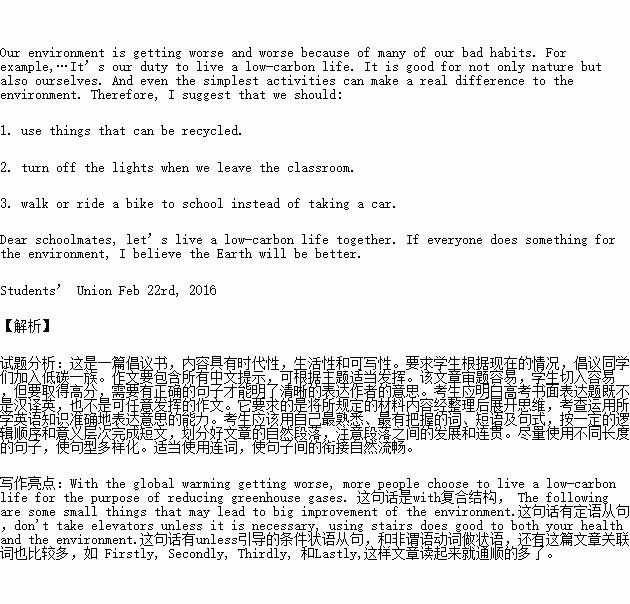
Ëæ×ÅÈ«Çò»·¾³µÄ¶ñ»¯£¬Ô½À´Ô½¶àµÄÈËÑ¡Ôñ¹ý¡°µÍ̼Éú»î(low-carbon life)¡±£¬¼´¼õÉÙ¶þÑõ»¯Ì¼µÄÅÅ·Å£¬µÍÄÜÁ¿¡¢µÍÏûºÄ¡¢µÍ¿ªÖ§µÄÉú»î¡£ÇëдһƪӢÎij«ÒéÊ飬³«ÒéÄãµÄͬѧÃǼÓÈë¡°µÍ̼һ×塱£¬Îª»·±£×ö³ö¹±Ïס£ÌáʾҪµãÈçÏ£º

1.ÓÃÊÖÏ´Ò·þ£»

2.¶à×ßÂ¥ÌÝ£¬ÉÙÓõçÌÝ£»

3.È¥³¬ÊÐ×Ô±¸¹ºÎï´ü£»

4.²½ÐлòÕ߯ï×ÔÐгµÉÏѧ£»

5¡­¡­.

×¢Ò⣺

1.´ÊÊý£º120-150×óÓÒ¡£

2.¿ÉÊʵ±Ôö¼Óϸ½Ú£¬ÒÔʹÐÐÎÄÁ¬¹á

Á·Ï°²áϵÁдð°¸
Ïà¹ØÌâÄ¿

If you have no special plans for your holidays, why not spend your time helping others?

Don¡¯t listen to people who say the young people today often think only of themselves. It¡¯s not true at all. More and more people in the USA volunteer£¨×ÔÔ¸£©to spend their school holidays working for others. And they don¡¯t do it for money. Here are some of their stories.

Alice Hamilton, 17

I¡¯m going to help the Forest Centre build new hiking paths in the mountains. It¡¯s going to be terrific¡ªI¡¯ll spend the whole summer living in the tent and breathing the clean mountain air. I¡¯m going to sleep under the stars, It¡¯ll be a nice sport, and I¡¯ll be able to do something good at the same time.

Jason Moore, 18

This summer, I¡¯m going to volunteer with Special House Program. They build good, low-cost houses and sell them to families that are not very rich. They¡¯ll teach me what to do, so I¡¯ll help people and also have a chance to learn how to build houses.

Trish Anderson, 16

I¡¯m going to teach kids who have trouble reading. I¡¯ll work for a program called ¡°Reading for Life¡±. Every day, I¡¯m going to help kids choose and read books that they like. I want to be a teacher and I love children and reading, so this is going to be a great experience for me.

1.What does Alice volunteer to do in summer?

A. To breathe the clean mountain air.

B. To spend the whole summer living in the tent.

C. To sleep under the stars.

D. To help build new hiking paths in the mountain.

2. From the passage, we know that Special House Program helps____.

A. children in poor families

B. workers who build houses

C. poor families that can¡¯t afford(¸ºµ£µÃÆð)houses

D. build hiking paths

3. Which is the most possible title for this passage?

A. Reading for Life B. Special House Program

C. The Forest Centre D. Young American volunteers

Do you feel lonely when your best friend isn¡¯t around? Here¡¯s our advice to you-- and to all kids who feel lonely sometimes.

It¡¯ s hard when a best friend isn¡¯t around¡ªmaybe because he or she moved to a different school or a different class. You may feel left out at break or lunchtime. You want to have new friends, but how do you make them? Maybe it seems like everybody else already has his or her friends. But remember, there¡¯s always room for more friends.

Start by looking around your classroom¡ªthink about which kids you¡¯d like to play with at break. Look for chances to say hi to them, smile, and be friendly. Offer to share something or express your appreciation (ÐÀÉÍ) to them. Invite someone to play with you or say ¡°Do you want to sit here?¡± in the lunchroom. When you¡¯re at break, walk over to kids you want to play with, act friendly, and say ¡°Hi, can I play, too?¡± or just join in.

If you have trouble doing this or if you¡¯re feeling shy, ask your teacher to help you make new friends. Teachers are usually pretty good at matching up friends. The best way to make friends is to be a friend. Be kind, be friendly, share, say nice things, offer to help¡ªand pretty soon, you¡¯ll have one, or two, or even more new friends.

You might still miss that special best friend. But when you see each other, you can share something you didn¡¯t have before he or she left: You can introduce him or her to your new friends!

1.Which of the following can explain the expression ¡°feel left out¡±?

A£®Feel homesick. B£®Feel lonely.

C£®Leave home alone. D£®Be hungry.

2.According to the writer, some kids feel lonely at break because they .

A£®have trouble with their studies

B£®don¡¯t have their best friends around

C£®need their parents to be with them

D£®are too young to look after themselves

3.The underline word ¡°this¡± in Paragraph 4 means .

A£®sharing your ideas

B£®talking in front of many people

C£®studying better at school

D£®developing new friendship

4.Some kids need help from teachers to make friends because .

A£®they miss their old friends a lot

B£®they have no time to stay with others

C£®teachers know who wants a new friend

D£®they are shy or not good at making friends

An old man walked slowly into a restaurant with his cane(¹ÕÕÈ). His old jacket and shoes made him unusual that day.

A young waitress named Mary watched him move towards a table by the window. She ran over to him, and said with a smile, ¡°Here, sir. Let me give you a hand.¡±

Without saying a word, he gave her a smile. She pulled the chair away from the table and helped him sit down. Then she put his cane against the table so that he could reach it. In a soft, clear voice, he said, ¡°Thank you, miss.¡±

¡°You¡¯re welcome, sir,¡± she replied. ¡°I¡¯ll be back in a moment, and if you need anything, just wave at me!¡±

After he had finished a good meal. Mary brought him the change. She handed him his cane, and walked with him to the front door. Holding the door open for him, she said, ¡°Come back and see us, sir!¡± The old man turned around and smiled.

When Mary went to clean his table, she was shocked. Under the plate, she found a business card, a 100-dollar bill and a note. The note said, ¡°Dear Mary, I respect(×ð¾´) you very much, and you respect yourself, too. It shows the way you treat others. You have found the secret of happiness.¡±

In fact, the old man was the owner of the restaurant. That was the first time that she, or any of his waitresses, had seen him.

1.The old man looked __________

A. young B. handsome C. unusual D. common

2.As soon as the old man entered the restaurant, Mary greeted him_______.

A. slowly B.politely C. sadly D. angrily

3.Mary told the old man to _______ when he needed something.

A. ring the bell B. wave at her

C. shout at her D. phone her

4.Mary was shocked when she found a business card, a 100-dollar bill and a note _______.

A. on the chair B. on the ground

C. under the bowl D. on the plate

5.The old man was ______.

A. Mary¡¯s father

B. Mary¡¯s neighbour

C. the boss of the restaurant

D. a waiter of the restaurant

Î¥·¨ºÍ²»Á¼ÐÅÏ¢¾Ù±¨µç»°£º027-86699610 ¾Ù±¨ÓÊÏ䣺58377363@163.com

¾«Ó¢¼Ò½ÌÍø