题目内容
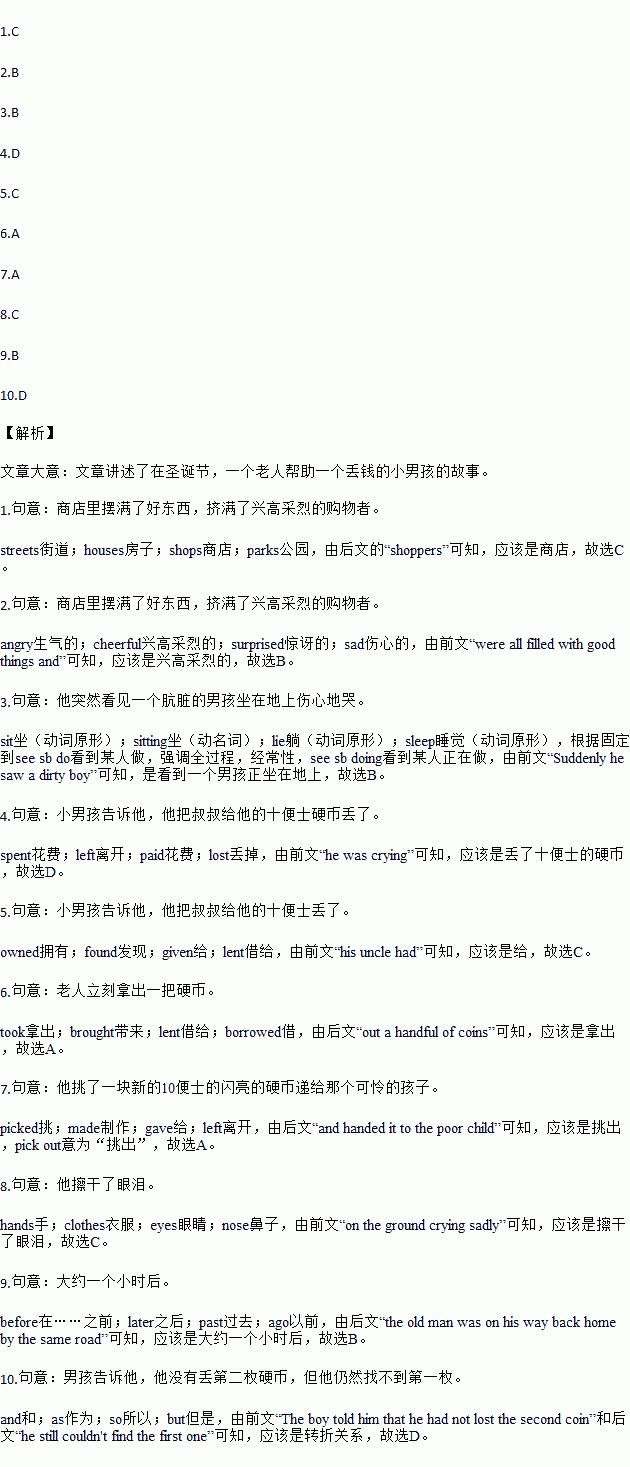
One afternoon just before Christmas an old man was walking through the city center.The _______ were all filled with good things and crowded with _______ shoppers. Suddenly he saw a dirty boy_______ on the ground crying sadly. When the kind old man asked him why he was crying, the little boy told him that he had _______ the ten-penny (便士) piece that his uncle had _______ him. At once the old man_________ out a handful of coins. He _______ out a shining new ten-penny piece and handed it to the poor child."Thank you very much," said the little boy, drying his _____________ He cheered up at once.
About an hour ___________, the old man was on his way back home by the same road. To his surprise he saw the dirty boy in the same place, crying sadly as before . He went up to the boy and asked him if he had lost ten-penny piece he had just given him . The boy told him that he had not lost the second coin ________ he still couldn't find the first one. "If I could find my own piece," he cried, "I would have twenty pennies now."
1.A.streets B.houses C.shops D.parks
2.A.angry B.cheerful C.surprised D.sad
3.A.sit B.sitting C.lie D.sleep
4.A.spent B.left C.paid D.lost
5.A.owned B.found C.given D.lent
6.A.took B.brought C.lent D.borrowed
7.A.picked B.made C.gave D.left
8.A.hands B.clothes C.eyes D.nose
9.A.before B.later C.past D.ago
10.A.and B.as C.so D.but

 名校课堂系列答案
One cannot discuss Chinese music without mentioning the Chinese seven - string zither(七弦琴), also known as the guqin, one of the four arts — along with go, calligraphy and painting. It first appeared over 3,000 years ago and represents China’s solo musical instrument tradition.
At first, the guqin had only five strings, representing the five elements of metal, wood, water, fire and earth. Later, in the Zhou dynasty, King Wen of Zhou added a sixth string for his son. King Wu of Zhou, added a seventh string to encourage his army to fight with the Shang.
Ambience(环境气氛) was important in playing the Chinese zither. Usually, it was practiced in quiet setting and never for public performance.
Ancient artists enjoyed performing by a stream in the mountains. The sound of the guqin mixed with the echoes(回音) from the mountains, until the musician found himself at one with nature. Playing it in snow was also a favorite pastime for ancient artists, who believed the instrument was the purest of its kind in the world. Also, a night with moonlight was considered ideal for playing the guqin. Wang Wei(701-761), a highly talented man of the Tang dynasty, liked playing it in a bamboo forest on nights with moonlight most.
Guqin pieces are usually around three to eight minutes long, with the longest being Guangling Verse, which is 22 minutes long. Other famous pieces include Plum Blossoms in Three Movements, Wild Geese Landing on the Sandbank and Eighteen Songs of a Nomad Flute.
Now, there are fewer than one thousand well - trained guqin players and perhaps no more than fifty living masters. The original number of several thousand pieces has greatly reduced to only a hundred works by today. The guqin and its music was added to the list of the Intangible Cultural Heritage of Humanity(人类非物质文化遗产) in 2003.
Title: The Guqin and Its Music | |
Main Parts | Detailed Information |
An 1. to the guqin | As one of the four arts, it has a 2. of 3,000 years and represents China’s solo musical instrument tradition. |
The strings | At first, there were five strings, which 3. five elements. Later, kings in the Zhou dynasty added 4. more strings to them. |
The ambience | In quiet setting, not for public performance. 1. By a stream in the mountains. The 5. sound of the guqin and its echoes could make musicians find 6. at one with nature. 2. In snow. It was believed to be the purest instrument in the world. 3. On a night with moonlight, Wang Wei’s 7. was to play the guqin in a bamboo forest on a night full of moonlight. |
The present 8. | Not many players, masters and works are alive at 9.. The guqin and its music 10. the list of the Intangible Cultural Heritage of Humanity in 2003. |