题目内容
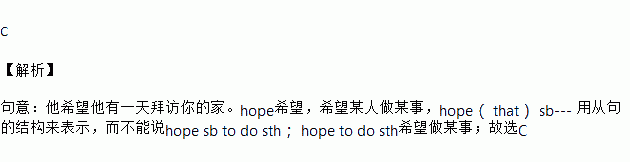
He hopes _______ your home some day.
A. he visit B. him to visit C. to visit D. he to visit
Tom didn't listen to the teacher carefully. _______, he did badly int the exam.
A. In a word B. As a result
C. In fact
----- Can you sing _________ dance? ----- I can sing.
A. but B. and C. or D. then
The book ________BetweenaRockandaHardPlaceis very useful to the mountain climbers.
A. calls B. calling C. called D. call
Where do you like to live? For this question, different people have different answers. Some people like to live in a city because there are many shops and supermarkets. They think it is convenient(方便的) to buy things. But some people think it is good to live in a quiet town because they don’t like the dirty air in the big city. They dislike pollution in the city.
Today, some people like travelling, so they would like to buy house cars. House car is both a house and a car. You can’t buy it with a little money. There is a driving area in the car. You can do lots of things in the car. There is a bed and a lamp in the bedroom. You can make dinner in the kitchen. You can also find a fridge and a sink in it. You can listen to music and watch TV in the sitting room. If you are tired, you can have a shower or a bath in the bathroom. You can do most things you want to do. Life is travelling. Do you want to live in this kind of car?
1.Why do some people like to live in the city?
A. Because it is a quiet place. B. Because there are many people.
C. Because there are many cars and buses. D. Because it is convenient to live there.
2.What’s the advantage(优点) of living in the town?
A. There are no cars and buses. B. There isn’t much pollution.
C. There aren’t any places to buy things. D. The air is dirty there.
3.What can’t you do in the house car?
A. Have a shower. B. Make dinner. C. Buy some food. D. Listen to music.
4.How much do you need to pay for the house car?
A. Much money. B. Little money. C. A little money. D. Lot of money.
5.From the passage, what can you know?
A. You can’t have a comfortable life in the town.
B. You can do anything you like in the house car.
C. It is difficult to buy all the things in the city.
D. Different people like to live in different places.
— Can you cook eggs with tomatoes?
— Yes, of course. _______ can do it. It’s so easy.
A. Someone B. Anyone C. No one D. Anything
Next year Tom will go to _____school. He wants to be ____ engineer like his father.
A. a; a B. The; an C. / ; an D. / ; a
Some scientists think that it may take_____ years to make robots walk
A. hundreds of B. two hundreds of C. two hundreds D. two hundred of
Do you like traveling? How can you make your trip interesting? Here’s some advice.
Read!
Before you leave, you should find some information about the place, such as its geography, history and people. You can introduce that place better by reading.
Take photos!
If you want to take some photos, remember to choose the most special sights. Don’t choose the sight you can see in other places. For example, Qingdao and Ningbo are coastal cities, so don’t only take photos of the sea. You should take photos of something else, too.
Taste!
You’d better taste some specials(特产) in the area. Food in some places is very delicious. So why not taste it? Maybe you have just one chance to taste it in your life.
Write!
When you visit a place, you should take a pen and a notebook, so you can write down what you see and what you think during the trip.
1.How many pieces of advice about traveling are mentioned(提及) in the passage?
A. Two B. Three C. Four. D. Five
2.Before we travel to a place, we should__________.
A. learn something about it B. decide which hotel to stay at
C. decide when to leave D. Know which bus to take
3.The underlined word “coastal” means_________ in Chinese.
A. 内陆的 B. 新兴的 C. 沿海的 D. 现代的
4.You should_______ during your trip.
A. take no photos B. taste some specials
C. write down what you eat D. read more books
5.What’s the best title(题目) for the passage?
A. How to make your trip interesting B. The most popular way to travel
C. How to make a travel plan D. The best place to travel