题目内容
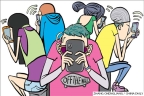
Look around and you’ll see people busy on their smartphones. Smartphones do make our lives easier. But have you ever thought about what they mean to your eyes?
According to a study, half of British people own smartphones and they spend an average(平均) of two hours a day using them. There has been a 35% increase in the number of people in the UK who suffer from shortsightedness(近视) since smartphones were introduced there in 1997.
Staring(盯) at smartphones for long time gives you dry eyes. When looking at something in the distance, your eyes automatically blink(自动眨眼) a certain number of times. However, when you look at things closer to your face, the blinking slows down. This reduces the amount of tears and causes discomfort in your eyes. Another bad habit is using smartphones in dark rooms before going to sleep. If you look at a bright screen while your pupils(瞳孔) become larger, too much light enters your eyes. This can do harm to the eyes and cause a disease called glaucoma(青光眼).
While you’re probably not going to stop using to your smartphone, there are a few things you can do to protect your eyes. Hold your phone at least 30 centimetres away from your eyes when using it. Take a break every hour and try the following: look at something at least five meters from you and then focus on the tip of your nose. Repeat this several times. It should reduce the discomfort in your eyes.
1. The article is mainly about ________.
A. the harm that smartphones do to users’ eyes
B. the rules to obey when using smartphones
C. the reason why teenagers get shortsightedness
D. advantages and disadvantages of smartphones
2. From Paragraph 2, we learn that _______.
A. half of the British people began to smartphones 17years ago
B. each of the British people spends two hours a day on smartphones
C. more British people have got shortsightedness since 1997
D. the number of British people who own smartphones increases by 35%
3. According to Paragragh 3 , using smartphone improperly may cause ____
A. too many blinks B. dry eyes and glaucoma
C. smaller pupils D. more tears in the eyes
4.Which is the follow ing is duggested by the writer?
A. Don't use the phone for over an hour without a break
B. Hold the phone at least half an meter away from the eyes
C. Turn off your phone for a couple of hours every day
D. Look at the tip of your nose for several minutes.
5. This article is written to advise people ____
A.not to buy smartphone
B.to stop using smartphone
C.to make full use of smartphone
D.to use smartphone properly
1.A
2.C
3.B
4.A
5.D
【解析】
试题分析:这篇短文主要介绍了使用智能手机的危害,告诉我长时间使用手机会引起眼睛干涩和青光眼。并建议我们连续使用手机不超过一个小时。
1.主旨大意题。根据短文标题Smartphone ,poor sight及下文描述,可知这篇短文主要讲述的是智能手机对我们眼睛的伤害。故选A。
2.细节理解题。根据There has been a 35% increase in the number of people in the UK who suffer from shortsightedness since smartphones were introduced there in 1997.描述,可知自从1977年以来越来越多的英国人收到了手机的危害。故选C。
3.细节理解题。根据Staring at smartphones for long time gives you dry eyes. 及下文This can do harm to the eyes and cause a disease called glaucoma.描述,可知使用智能手机只要是能引起眼睛干涩和青光眼。故选B。
4.细节理解题。根据短文最后一段Take a break every hour and try the following 描述,可知一生建议我们,每使用手机1小时就休息一下。故选A,使用手机不要不休息地超过一个小时。
5.主旨大意题。阅读短文可知本文主要介绍了使用智能手机的危害,并向人们介绍了如何恰当使用手机的建议。故选D。
考点:健康保健类短文阅读。

 走进文言文系列答案
For Children Museum: Children’s Museum, Sundays, 89 North Street, 67641235 Story time: Children’s Library, 106 Green Street, Wednesdays during 9:30 a.m -5:00p.m. 66599624 Sports: Football Club, Tuesdays and Thursdays, 16 Yangtze Road, 96725643 Basketball Club, Wednesdays and Fridays, 79071632 Cinema: New films for children, 99 Brick Road, 69001354 |
Useful Phone Numbers Fast Food Restaurant: 66387901 Hospital: 68787451 Visitor Information Center: 800-120-9847 Taxi: 79210583 Visitor Hotel Information: 800-739-7302 |
1.It’s Friday afternoon, you can go to_______ .
A. visit the museum B. play football
C. play basketball D. read children’s stories
2.If children want to watch new films, they should go to________.
A. 16 Yangtze Road B. 89 North Main Street
C. 106 Green Street D. 99 Brick Road
3.If you dial (拨号)66387901, you can __________.
A. ask for some hotel information
B. do some shopping
C. have a good story time
D. get fast food in a restaurant
4.You can not get any information about ________ from the two notices.
A. looking for a hotel B. doing eye exercises
C. eating fast food D. taking a taxi