题目内容
We have visited the museum, and we are ____ it.
A. good at B. belonged to C. angry with D. proud of
完形填空
It was my first day at school and I felt nervous and afraid . I went to all my classes alone . I felt like cared. I listened to all the lessons and patiently waited for the lunch break . Then finally the bell rang and it was time to talk and have .
While waiting , I met a new friend who wore a headscarf. We got along , and I was so happy when she said , “ Sit with us at our table .” She pointed to the one next to the door . I agreed, and took my and was about to walk with her the floor, when suddenly I felt someone me . “ Hey, I saw you on the bus ,” said a tall girl in a long skirt. “ I see you wear a Jewish necklace. You sit with us .”
At that moment I and , to my surprise , I found that it was like the nations of the world : the Spanish only sat with the Spanish , the Americans were only with the , the Russians were always with the Russians , and would the Arabs and the Jews sit together .
It was then that I saw the why so many wars begin . Everyone stayed with other people of________ background . The lunchroom was like a map of the world . Why was everyone so blind ?
So I this girl, and returned to the first girl. They were all very friendly. That day I_________ a bridge between two worlds when I sat with those who were different from me .
1.A. everyone B. anyone C. no one D. someone
2.A. fun B. trouble C. supper D. rest
3.A. on line B. in line C. in classroom D. in rain
4.A. good B. bad C. well D. badly
5.A. book B. plate C. picture D. drink
6.A. to B. along C. around D. across
7.A. calling B. noticing C. moving D. touching
8.A. looked around B. look up C. look into D. Look after
9.A. Chinese B American C. Russians D. the Spanish
10.A. once B sometimes C. always D. never
11.A. reason B. story C. matter D. duty
12.A. different B. the opposite C. the same D. closed
13.A. refused B. followed C. listened to D. fought against
14.A. walked B. went C. built D. broke
As a child, I was really afraid of the dark and of getting lost. These fears were very real and caused me some uncomfortable moments.
Maybe it was the strange way things looked and sounded in my own room at night that scared me so much. There was never complete darkness, but always a streetlight or passing car lights, which made clothes on the back of a chair take on the shape of a wild animal. Out of the corner of my eye, I saw the curtains(窗帘) seem to move when there was no wind. A very low sound in the floor would seem a hundred times louder than in the day. My imagination (想象) would run wild, and my heart would beat fast. I would lie very still so that the "enemy(敌人) " would not discover me.
Another of my childhood fears was that I would get lost, especially on the way home from school. Every morning I got on the school bus right near my home. That was no problem. After school, though, when all the buses were lined up along the street, I was afraid that I would get in the wrong one and be taken to some other strange places. On school or family trips to a park or a museum, I wouldn't let the leaders out of my sight.
Perhaps one of the worst fears of all I had as a child was that of not being liked or accepted by others. Being popular was so important to me then, and the fear of not being liked was a serious one.
One of the processes(过程) growing up is being able to realize and overcome our fears. Understanding the things that scared us as children helps us achieve greater success later in life.
1.The author had ________kind(s) of fears when she was a child.
A. one B. two
C. three D. none
2._________ would scare the author at night.
A. Streetlight and car lights
B. Wild animals and enemies
C. Moving curtains and wind
D. Strange sights and sounds
3.When she went to some other places, she would _________.
A. walk away without others
B. take a bus by herself
C. follow others closely
D. make sure not to take a wrong bus
4.Which of the following would be possibly true when she was a child?
A. She was usually popular among people.
B. She was always the leader of the others.
C. She always' got poor grades.
D. She was not at all liked by others.
5.The underlined word "overcome" means "_________" in Chinese.
A. 接受 B. 忍受
C. 信服 D. 克服
补全对话
Tang Jun is chatting (聊天)with his e-pal David on QQ
( D: David T; Tang Jun)
D : Hi, how is it going these days ?
T: Pretty good! We celebrated our Dragon Boat Festival last week.
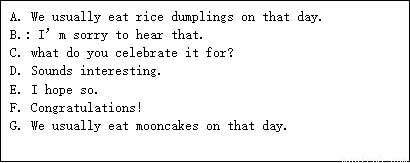
D: Dragon Boat Festival? ___1..
T: To remember an ancient Chinese poet.
D: How do you usually celebrate it?
T: 2. .But this year, we did something more interesting.
D: What did you do?
T: Our school had a Dragon Boat race.
D; 3.. Who won the race?
T: Our class.
D: _4..
T: Thanks a lot. I hope you can come to China sometime.
D: 5. . I’m interested in Chinese tradition. Tell me more about them next time.
T: OK. I will. See you.
D: See you.
----Do you know _____? ----Next Sunday.
A. what will they do
B. where did they go
C. when they will come here
D. who they met
---How long ____the supermarket ____? ---Four years.
A. has, opened
B. has, been opened
C. did; open
D. has, been open
----Can you show me the _____ of your school on the map?
----Sure. It’s here, next to the park.
A. position B. directions C. situation D. Height
--- It’s said that scientists have ________ a way to deal with Influenza A/HiN1.
--- Really? That’s great!
A. caught up with
B. come up with
C. agreed with
D. compared with
根据中文意思,用所给词语写句子。
1.大风过后,天气更冷了。(strong wind, weather, get)
2.及时改正错误是很重要的。(important, correct, in time)
3.我昨天花了一小时帮妈妈网上订票。(take, book tickets, online)