题目内容
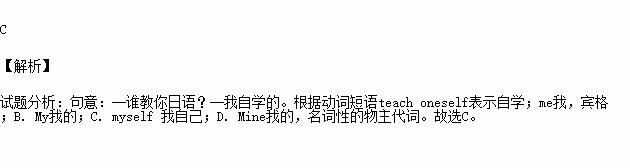
--Who teaches you Japanese?
--I teach _________.
A. me B. my C. myself D. mine
Mr. Dawson is an old man with a bad temper (脾气). Kids were afraid to go into his yard to pick apples.
One day, 12-year-old Janet and her friend Amy had to walk past Mr. Dawson’ s house. When Janet saw him outside, she suggested they cross the street and walk on the other side. But Amy said they didn’t need to.
When Mr. Dawson saw Amy, he smiled and said: “ Hello, Amy! I see you have a new friend with you today.” Amy smiled back. Mr. Dawson was friendly and gave them each a fresh apple.
Later, Janet asked Amy: “ Everyone says he is the most unwelcoming(不受欢迎的) person in town. Why was he kind to us?” Amy explained that when she first walked past his house, she was also afraid of him. But she pretended(假装) there was an invisible(看不见的) smile on his face and started talking to him. At first she only said “hello” but then began talking to him more every time she saw him.
“An invisible smile?” Janet was puzzled (困惑的). “Yes,” answered Amy. “My grandma told me to try that. She says smiles can spread. So if we keep trying to smile at someone, sooner or later they will smile back.”
Amy’s grandma realized most people can’t refuse(拒绝) to smile at a friendly face.
1.People thought that Mr. Dawson was a(n) _______ person.
A. honest B. kind C. welcome D. Unfriendly
2.What did Amy do when she first walked past Mr. Dawson’s house?
A. She went into his yard to pick apples.
B. She was so scared that she went away quickly.
C. She smiled to him and greeted him.
D. She talked with him like old friends.
3.What does the story tell us?
A. It’s important to take others’ advice.
B. Being friendly to others is very important.
C. People with bad temper can also make friends.
D. Smile to the world and it will smile at you back.
The propgram also provide them _____ job training so that they can live a normal life.
A. of B.with C.for D. To
完形填空 阅读短文,从每题所给选项中选出可以填入空白处的最佳选项。(15分)
Students’ life in America
Students in America always have a busy but wonderful school day.
They have classes for five days each week. From to Friday students usually get up at seven. Then they wash their faces and have . They usually have eggs, bacon(熏猪肉), bread, fruit and a glass of milk. After that they go to school on foot or by yellow school .Some students ride bikes. They get to school at about half past eight. Then they put their in their lockers and only one book, a notebook and a pencil to each class. In a middle school, students have for six hours. Their classes are English, Writing, Maths, Music, and so on(等等).
At noon students don’t go home for lunch. They have lunch at school. They often have meat, fruit, , bread and a drink. most students like pizza, hot dogs and hamburgers better. Students don’t have a short .They go back to have classes lunch until three o’clock. Then they go home.
Students don’t do their homework after they get home. They usually play or watch TV before . They have at six in the evening. The supper usually has soup, meat, vegetables, rice or pasta(面食). After supper they do their . Sometimes they play or talk with their parents at home.
1.A. Monday B. Tuesday C. Wednesday D. Thursday
2.A. dinner B.breakfast C. lunch D. supper
3.A. car B. bike C. bus D. plane
4.A. school bags B. clothes C. pencil boxes D. money
5.A. lend B.carry C. borrow D.take
6.A. meals B. a rest C. a talk D. classes
7.A. Chatting B. Sleeping C. Drawing D. Eating
8.A.really B.seldom C.usually D. never
9.A. vegetables B. games C. books D. competitions
10.A. So B. And C. Because D. But
11.A. sleep B. talk C. drink D. holiday
12.A. at B. before C. after D. in
13.A. midnight B. supper C. rest D. work
14.A.supper B.lunch C.breakfast D.nothing
15.A. homework B. housework C. cleaning D. washing
Our teacher told me ______ football in the street.
A. don’t play B. not play
C. not to play D. to not play
—Do you know _________ the meeting?
—Tomorrow morning.
A. when they had
B. when they are going to have
C. when did they have
D. when are they going to have
I have a book. _______ book is in the bookcase.
A. A B. An C. The
— ______ he studies hard every day, ______ he didn’t pass the exam.
— I am sorry to hear that.
A. Because, so B. Although, but
C. Although, / D. Because, /
My friend Jack has _________hair.
A. blonde short curly B. short blonde curly
C. blonde curly shout D. short curly blonde

 阅读快车系列答案阅读快车系列答案