题目内容
Students like the teachers ________ make their classes lively.
A. where B. which C. what D. who
It’s 11 o’clock. Please ________ our lunch.
A. ordering B. order
C. to order D. orders
阅读与表达,阅读短文,根据其内容回答问题。
Body language is one of the most powerful means of communication, often even more powerful than spoken language. People around the world show all kinds of feelings, wishes and attitudes that they might never speak aloud. It is possible to ―read‖ others around us, even if they do not want us to catch their unspoken communication. Of course, body language can be misread, but many gestures and actions are common.
The most common facial expression is, of course, the smile – its function is to show happiness and put people at ease. It does not always mean that we are truly happy, however. Smiles around the world can be false, hiding other feelings like anger, fear or worry. There are unhappy smiles, such as when someone ―loses face‖ and smiles to hide it. However, the general purpose of smiling is to show good feelings.
From the time we are babies, we show unhappiness or anger by frowning (皱眉头). In most places around the world, frowning and turning one’s back to someone shows anger. Making a fist (拳头) and shaking it almost always means that someone is angry.
How about showing that I am bored? Looking away from people or yawning will, in most cases, make me appear to be uninterested. However, if I turn toward and look at someone or something, people from almost every culture will think that I am interested.
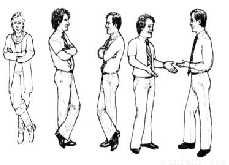
Being respectful to people is subjective, based on each culture, but in general it is probably not a good idea to give a hug to boss or teacher. In almost every culture, it is not usually good to stand too close to someone of a higher rank (等级). Standing at a little distance with open hands will show that I am willing to listen.
With so many cultural differences between people, it is great to have some similarities in body language. We can often be wrong about each other, so it is an amazing thing that we understand each other as well as we do!
1.What is even more powerful than spoken language according to the passage?
2.What is the most common facial expression?
3.How do babies normally show their anger?
4.What is not good to do when you stay with someone of a higher rank?
5.What does the writer mainly want to tell us
书面表达
电视占据了青少年过多的空闲时间,影响着他们的健康成长。某英语杂志开展了“关闭电视一周(TV - Turnoff Week)”的主题征文活动。请你以“My TV - Turnoff Week”为题写一篇文章投稿,谈谈你目前看电视的现状(如节目、时间等),关闭电视后的活动安排以及你这样做的理由.
提示:1. What kind of program do you like?
2. Why do you turn off your TV?
3. What will you do during your TV-Turnoff Week?
要求:1. 文稿须包括所有提示内容,可适当发挥。
2. 文中不得出现真实人名、校名或地名。
3. 条理清楚,意思连贯,语句通顺,标点正确;
4. 字数:60~80个。
5、开头、结尾已给出,不计入总词数。
____________________________________________________________________________
完形填空
阅读下面短文,掌握其大意,然后从各小题所给的四个选项中选出最佳选项。
Have you ever planted a few trees on Tree Planting Day? Each year, millions of people, _______ old and young, plant a lot of trees. But this may not be the best way ______ your home a greener place.
Last week we visited a park in Hebei. We were ______ to find most of the trees had been burned. The workers told us that the trees ______ soon after they were planted because they weren’t watered ______ . So workers burned them and cleaned the place for new trees to ______ this year. On a card found in one of the dead ______ , a student wrote: “ I hope this tree will grow up with me ______ the backbone(栋梁) of our country.” The workers said that the survival(存活)of the trees was really more important than ______ trees were planted.
Some people in Beijing now have a new idea that they can donate some money and let professionals plant and ______ the trees.
1.A. both B. between C. all D. of
2.A. make B. making C. of making D. to making
3.A. happy B. interesting C. pleased D. surprised
4.A. bought B. died C. grew D. planted
5.A. good enough B. enough good C. enough well D. well enough
6.A. plant B. be planted C. are planted D. will plant
7.A. tree B. trees C. cards D. card
8.A. to be B. be C. become D. to make
9.A. how much B. how soon C. how many D. how long
10.A. take care B. take care of C. take away D. take off
—— How long did it ________ you to arrive there?
—— Two hours.
A. pay B. spend C. cost D. take
The story happened ________ a cold morning ________December.
A. on, on B. in, on C. on, in D. in, in
He likes ______my friends.
A. to play with B. to play
C. play with D. play
Tom needs some help ______his homework, can you help ______?
A. to; him B. with; him C. to; his D. with; his