题目内容

In June, 2017, a new Chinese company opened its first self-service store in Shanghai after a few months of testing.

Although small, the BingoBox store keeps hundreds of goods, including some fresh food. The customers have to scan(扫描) the barcode(条形码) on the goods and then pay on their phones, either through WeChat or Alibaba’s mobile wallet App, Alipay.

As you leave the store, in-store cameras will check if you have paid for the things you’re taking out. The cameras use facial recognition (面部识别系统) to check if you are a registered(注册) user and decide if you can go out of the store.

Though there is no shop assistant at each store, a customer’s support line is waiting to help you. If you have some questions, you can communicate with the shop assistant through video link.

Each BingoBox store can be moved, so the franchise owners(经销商) can put it where they like. A human assistant is needed to take care of the store, checking and adding the goods. The company says this can be done in just 20 minutes.

The company is trying to attract franchise owners with the promise that only four staffs are needed to run 40 stores.

1.Which of the following is TRUE about the BingoBox store?

A. It is a very big supermarket in the center of a city.

B. It needs hundreds of shop assistants to take care of it.

C. Customers can use their phones to pay for the goods.

D. Registered users cannot buy things there.

2.The cameras in the store use to check if you have paid for the things.

A. facial recognition B. goods’ barcodes

C. the BingoBox D. WeChat

3.What should a customer do if he has some questions during shopping?

A. He can ask the assistants in the store for information.

B. He should give up the things he has got.

C. He can make a phone call in the store.

D. He should ask a shop assistant through video link.

4.What is the best title of this passage?

A. The First Supermarket in Shanghai

B. Use Your Alipay or WeChat to Pay

C. A Store without Any Shop Assistant

D. Enjoy Your Shopping Here

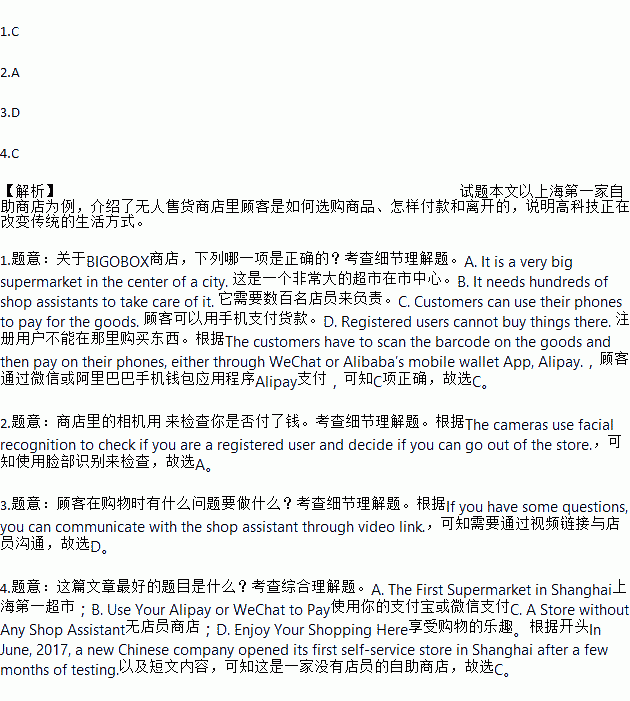
1.C 2.A 3.D 4.C 【解析】试题本文以上海第一家自助商店为例,介绍了无人售货商店里顾客是如何选购商品、怎样付款和离开的,说明高科技正在改变传统的生活方式。 1.题意:关于BIGOBOX商店,下列哪一项是正确的?考查细节理解题。A. It is a very big supermarket in the center of a city. 这是一个非常大的超...
练习册系列答案
相关题目

Could the students from less developed areas in central and western China get the same educational chances as those in big cities in the east Could the children in poor rural (农村) areas develop as well as those in rich cities Maybe the answers were “No” in the past. But now, China is trying to change the situation.

In order to help rural students grow taller and stronger. China’s Nutrition(营养)Improvement Program started in 2011. According to the program, a lot more money was spent improving students’ meals. More than 36 million students from 134,000 primary and junior high schools in poor rural areas have benefited from the program. They are provided with healthy food like eggs and milk from Monday to Friday at school. And the result of a survey shows that the students in those areas are much taller and stronger than before.

It is true that there were differences between less developed areas and developed areas in education before. Recently, The Guideline for Popularizing High School Education(2017-2020) has come out. According to the guideline, above 90%students from all over the country will go to high schools by 2020. What’s more, the schools in central and western areas will get more support to improve their education.

Students from rural and poor areas also get more chances to receive higher education. A special college program makes it possible for more students from those areas to go to key (重点的) colleges and universities. The number will be increased by 10%in 2017.

With the guideline and the programs, we can expect a fairer and more balanced(均衡的) education in the future.

1.The number 134,000 in Paragraph 2 is the number of in poor rural areas.

A. the key high schools

B. the poor students

C. the key colleges and universities

D. the primary and junior high schools

2.The underlined word “benefited” in Paragraph 2 means in Chinese.

A. 逃离 B. 获益 C. 受害 D. 赚钱

3.If we put the passage into three parts, which of the following is the best?

(①=Para.(自然段)1②=Para.2③=Para.3④=Para.4⑤=Para.5)

A. ①②;③④;⑤ B. ①;②③;④⑤

C. ①;②③④;⑤ D. ①②;③;④⑤

4.What can we infer(推断) from this passage?

A. Liu Xi, a student from Chongqing, can go to any high school if she wants to.

B. Li Mei, a student from a western rural school, can get a bag of milk every day.

C. Hu Jia, a 12-year-old rural student, will more easily receive high school education.

D. Han Lei, a student from Beijing, will have few chances to go to key universities.

1.D 2.B 3.C 4.C 【解析】试题本文是一篇议论文。中国政府为改变中西部教育不均的状况,实施了“中国营养改善计划”,出台了普及高中教育(2017年至2020年)的指导方针,让人们能够期待未来更公平、更平衡的教育。 1.题意:第2段的数字134000是 的数量。考查细节理解题。根据More than 36 million students from 134,0...

违法和不良信息举报电话:027-86699610 举报邮箱:58377363@163.com

精英家教网