题目内容

VISIT FOREST ZOO

Come and see the Indian elephants and the new tigers form Northeast of China. The beautiful birds from England are ready to sing songs for you, and the monkeys from Mount Emei will be happy to talk to you. The lovely dogs from Australia want to laugh at you. Sichuan pandas will play balls for you. The giraffes from Africa are waiting to look down on you. Keep the zoo clean. Do not touch, feed or go near to the animals.

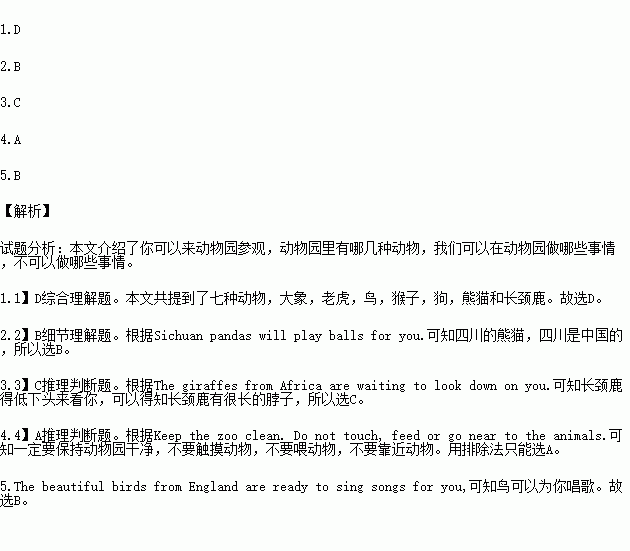
1.How many kinds of animals are mentioned(提及) in the passage?

A. Three. B. Four. C. Five. D. Seven.

2. Where are the pandas from?

A. India. B. China.

C. Africa. D. Australia.

3.From the passage we can infer(推断) that a giraffe _____.

A. isn’t polite and friendly

B. like to stand on a high place

C. has a long neck(颈、脖子)

D. looks at us proudly

4. What can we do in the zoo?

A. To watch the animals do all kinds of things.

B. To give the animals something to eat.

C. To touch the animals you like.

D. To go near to the animals.

5. What kind of things can the birds do from the passage?

A. Talk to you. B. Sing songs.

C. Laugh at you. D. Play balls.
练习册系列答案
相关题目

1. The family planning policy (“计划生育”政策) was introduced in 1979 to solve the population problems. Most couples could have only one child except some special families and those in some special areas.

2. Usually, all around good student, which was called “thrice good”, was given to the students who were virtuous(品德高尚的), talented and good at PE. It was firstly used in to 1950s by Mao to encourage young people to keep fit, study well and work hard.

3. During the early 1990s, state owned company reforms(国有企业改革) were getting tough. The workers were more than the jobs in most of the cities. Many workers were losing their jobs. “Jobless” was a hot topic at that time, so the leaders hoped the laid off workers could find new jobs or start up their own business.

4. One of Deng’s clever ideas, “one country, two systems”, was first performed in 1997. It described Hong Kong and Macao’s situation after they returned to China. This policy would also be suitable for Taiwan. There would be one China, but Hong Kong, Macao and Taiwan could have their own economies and political systems.

5. Lei Feng was a soldier who was happy to help others. He died in an accident in 1962. On March 5th,1963, Mao wrote a piece, “Learn from comrade Lei Feng”, to say the Chinese should help others when necessary. After that, March 5th became a Volunteer Day.

6. The phrase “harmonious society” appeared in 2004, referring to a peaceful society where all people would work together to make the life better. This idea has become the main goal of the Chinese Communist Party now.

1. The first paragraph is mainly talking about .

A. the population of China B. the only child in China

C. the one child family D. the family planning policy

2. Do you know who mentioned “on country, two systems” according to the passage?

A. Deng Xiaoping. B. Hu Jintao.

C. Mao Zedong. D. Jiang Zemin.

3.Please rearrange the events above in the correct order according to the time.

A. 2→1→4→3→5→6 B. 2→5→4→3→1→6

C. 2→5→1→3→4→6 D. 2→1→5→3→6→4

When you are learning English, you find it not clever to put an English sentence, word for word, into your own language. Take the sentence "How do you do?" for example. If you look up each word in the dictionary, one at a time, what is your translation? It must be a wrong sentence in your own language.

Language do not just have different sounds, they are different in many ways. It's important to learn the rules for word order in the study of English, too. If the speakers put words in a wrong order, the listener can't understand the speaker's sentence easily. Sometimes when the order of words in an English sentence is changed, the meaning of the sentence changes. But sometimes the order is changed, the meaning of the sentence doesn't change. Let's see the difference between the two pairs of sentences.
"She only likes apples." "Only she likes apples."

"I have seen the film already." "I have already seen the film."

When you are learning English, you must do your best to get the spirit of the language and use it as the English speaker does.

1.According to the passage we know that _____ when we are learning English.

A. we shouldn't put every word into our own language

B. we should look up every word in the dictionary

C. we need to put every word into our own language

D. we must read word by word

2. What’ s the writer’s opinion in learning English?

A. It’s difficult to understand different sounds.

B. It’s impossible to remember the word order.

C. It’s important to learn the rules in different ways.

D. It’s easy to learn the rules for word order.

3. If the speakers put words in a wrong order, ___________.

A. it must be a right sentence

B. the listener can't understand the speaker's sentence easily

C. the meaning of the sentence always changes

D. the meaning of a sentence must be the same

4.Which of the following sentences has the same meaning as "She only likes apples" ?

A. Only she likes apples.

B. She doesn’t like any fruits but apples.

C. She likes fruit except apples.

D. she doesn't like apples.

5.Which is the best title for this passage?

A. Different Orders, Different Meanings

B. How to Speak English

C. How to Put English into Our Own Language

D. How to Learn English

违法和不良信息举报电话:027-86699610 举报邮箱:58377363@163.com

精英家教网