题目内容
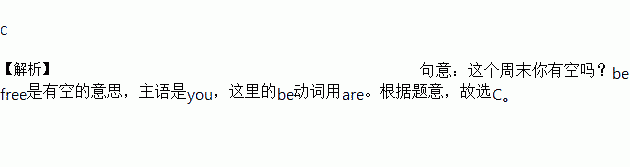
______ you ______this weekend?
A. Do, free B. Are, have time C. Are, free D. Do, be free
—I think Mary has a very sweet _______.
— Yes, I think so. She can sing songs very well.
A. voice
B. sound
C. hearing
My friends are not interested in politics . Which of the following is correct for the underlined letter in the word ?
A. /?/ B. /?/ C. /u/ D. /?/
It’s good for us to do ______every day.
A. eye exercise B. eyes exercise C. eye exercises D. eyes exercises
I sometimes play volleyball ______ half an hour after school.
A. in B. at C. on D. for
As is well known, saying “no” is not easy at all. But sometimes we have to learn to say “no”. To learn to say “no”, we have to first understand what’s stopping us about it. There are some common reasons why people find it hard to say “no”.
You want to help others. You are a kind soul(灵魂) at heart. You don’t want to turn the person away and you want to help when possible, even if it may take up your time.
Afraid of being rude. I was brought up under the idea that saying “no”, especially to people who are older, is rude. This thinking is common in Asian culture, where face-saving is important. It means not making others look bad or lose faces.
Wanting to be agreeable. At times, you find you are not in agreement. You don’t want to keep yourself away from the group, so you agree to do others’ requests(请求).
Fear of conflict(冲突). The person might be angry if you refuse him. This might lead to an ugly conflict. Even if there isn’t, there might be disagreement which might lead to bad effects(影响) in the future.
Fear of losing opportunities(机会). Sometimes, saying “no” means closing doors or losing opportunities. It may make you feel worried. For example, one of my friends was asked to work in another department(部门) in her company(公司). Since she liked her team, she didn’t want to go. However, she didn’t want to say “ no” as she felt it would affect her promotion(晋升) opportunities in the future.
71题完成句子;72~73题回答问题;74题找出并写下全文的主题句;75题将画线句子译成汉语。
1.In Asian culture, it is ______________________________ to say “no” to people who are older.
2.Why do you agree to do others’ requests?
____________________________________________________________________.
3.What does saying “no” mean sometimes?
___________________________________________________________________.
4._________________________________________________________________.
5._________________________________________________________________.
Our foreign teacher, Andy, ________ English since 2001.
A. has taught B. is teaching C. will teach D. teaches
Ctrip now delivers train tickets to even more cities across China!
Click here to see
1.We may read the material above mostly _________.
A. in a train report B. on the Internet C. in a picture book D. on trains or subways
2.This advertisement is probably given by __________.
A. Ctrip Travel Agent B. a train station C. a ticket company D. a delivery agent
3.If a man books two tickets one week in advance and a ticket costs $110, he should pay ____.
A. $110 B. $220 C. $198 D. $22
4.If we book China train tickets with Ctrip, __________.
A. we can`t get information about timetable
B. we can get our tickets at home
C. we can`t get our tickets on time
D. we can choose cities in Australia with home delivery
5.Ctrip Travel Agent services are available _________.
A. across China B. only 7 days in advance
C. in different languages D. at the train station
第二节:汉译英(本题共5小题,每小题1分,计5分)
根据所给的中文意思完成句子,每空一词。
1.我在英语口语方面已经变得好多了。
I’ve become _______ _______ at speaking English.
2.我收到了一个包裹,连同一些花。
I received a parcel _______ _______ some flowers.
3.这个小男孩渴望得到一辆玩具小汽车。
The little boy is _______ _______ a toy car.
4.我是来恭喜你赢得演讲比赛的。
I’m coming to _______ you _______ winning the speech competition.
5.你必须为你自己的决定负责。
You must be _______ _______ your own decisions.