题目内容
Who are these people rushing by you in the street?
More than 215 million now call America “home”, but most of them can trace their families back to other parts of the world.
If you look at the names on shop windows, you will see that Americans come from many different lands. The idea that these people, who once were strangers to the United States, have lost the customs and cultures of their original countries and have become “Americans” is really not true. In fact, what exists in America is more often a kind of “side by side” living in which groups of people from other countries often have kept many of their customs and habits. They join the general American society only in certain areas of their lives ----such as in schools, business, and sports--- but they keep many of their own native customs and manners socially and at home.
This living “side by side” has both advantages and disadvantages. Sometimes it may cause disagreements to develop between groups whose ways of life are very different from one another. However, there are also great advantages that come from the variety of cultures brought by settlers from other lands. There is great freedom of choice among ideas and dress, food, and social customs in America. Everyone can find some part of his or her familiar world in the United States, in churches, music, food, national groups, or newspaper.
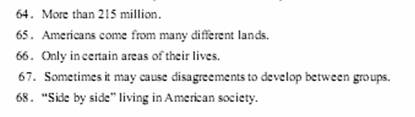
64. How many people call America “home”?
65. What will you see if you look at the names on shop windows?
66. How do the strangers join American society?
67. What are the disadvantages of the “side by side” living?
68. What does the passage mainly tell us about?

 字词句篇与同步作文达标系列答案
| |||||||||||||||||||||||||||||||||||||||||||||||||||||||||||||||||||||||||||||||||||||||
On September 11th, 2001, many police officers and government officials in America worked day and night to save lives from the big fire at the World Trade Centre. And in Japan, after the serious earthquake, a group of workers showed their courage.
The earthquake on March 11th made Fukushima Nuclear Power Plant(福岛核电站) turn off and stop its protective cooling systems. And later, a fire broke out. Workers were told that the plant’s radiation(辐射) could be harmful to human health. Hundreds of workers left the plant quickly. However, a group of workers decided to fight against the fire and the damage, though they knew it could cause very serious health problems. There were 50 workers in all, so they were also named the "Fukushima 50". The workers worked in shifts(轮班).
People knew little about the workers, who were mainly experts (专家) with the skills to control the situation. One woman said that her father had volunteered to stay there. "I heard that he volunteered even though he would retire(退休) in just half a year and my eyes were filled with tears. I am really proud of him. And I pray for his safe return.
【小题1】The passage mainly tells us
| A.what happened in America on September 1l th, 2001 |
| B."Fukushima 50" stayed in the nuclear power plant bravely |
| C.who saved many lives from the big fire at the World Trade Centre |
| D.what Japanese government did after the nuclear power plant was turned off |
| A.there were no heroes there | B.many workers left the plant |
| C.it was destroyed by a big fire | D.the earthquake damaged it heavily |
| A.11 | B.50 | C.100 | D.150 |
| A.The woman learned something about her father. |
| B.A woman’s father who had retired from work still stayed there. |
| C.Little was known about the workers when the passage was written. |
| D.The workers didn’t know staying in the nuclear plant was harmful to their |
【小题5】 The writer thinks
| A.American police officers were very strong |
| B.the nuclear radiation would do no damage to humans |
| C.all the workers who stayed in the plant should return quickly |
| D.all the workers who stayed in the plant are great heroes |
At a nation’s saddest moment, its greatest heroes are born.
On September 11th, 2001, many police officers and government officials in America worked day and night to save lives from the big fire at the World Trade Centre. And in Japan, after the serious earthquake, a group of workers showed their courage.
The earthquake on March 11th made Fukushima Nuclear Power Plant(福岛核电站) turn off and stop its protective cooling systems. And later, a fire broke out. Workers were told that the plant’s radiation(辐射) could be harmful to human health. Hundreds of workers left the plant quickly. However, a group of workers decided to fight against the fire and the damage, though they knew it could cause very serious health problems. There were 50 workers in all, so they were also named the "Fukushima 50". The workers worked in shifts(轮班).
People knew little about the workers, who were mainly experts (专家) with the skills to control the situation. One woman said that her father had volunteered to stay there. "I heard that he volunteered even though he would retire(退休) in just half a year and my eyes were filled with tears. I am really proud of him. And I pray for his safe return.
【小题1】The passage mainly tells us
| A.what happened in America on September 1l th, 2001 |
| B."Fukushima 50" stayed in the nuclear power plant bravely |
| C.who saved many lives from the big fire at the World Trade Centre |
| D.what Japanese government did after the nuclear power plant was turned off |
| A.there were no heroes there | B.many workers left the plant |
| C.it was destroyed by a big fire | D.the earthquake damaged it heavily |
| A.11 | B.50 | C.100 | D.150 |
| A.The woman learned something about her father. |
| B.A woman’s father who had retired from work still stayed there. |
| C.Little was known about the workers when the passage was written. |
| D.The workers didn’t know staying in the nuclear plant was harmful to their |
【小题5】 The writer thinks
| A.American police officers were very strong |
| B.the nuclear radiation would do no damage to humans |
| C.all the workers who stayed in the plant should return quickly |
| D.all the workers who stayed in the plant are great heroes |

 h most money?