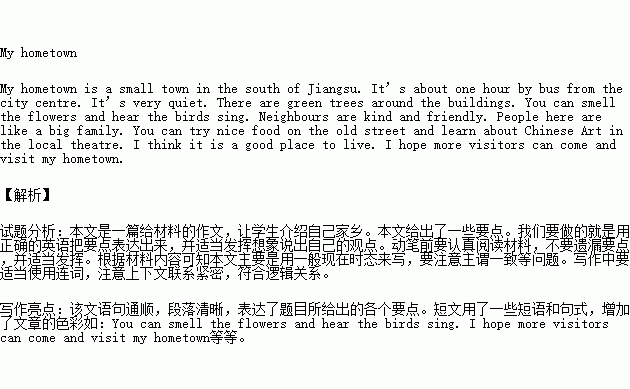
题目内容

学书面表达

校文学社举行英语写作比赛。请根据以下要点,以my hometown 为题写一篇80字左右的文字,请注意适当发挥1-2句。

位置

江苏的南面的一个小镇

交通

离市中心乘公交车大约1小时的车程。

环境

小镇很安静,周围绿树环绕,鸟语花香,邻居们友好善良,大家就像一家人一样

景点

老街品尝美食,当地剧院了解中国艺术

感想

……

练习册系列答案
相关题目

Everyone wants to be perfect. Finding a good way to achieve self-improvement (自我提高) is more and more popular. For this, the beginning of a new year is a great time to think about ways that you can improve in the coming year. Here are some suggestions for New Year’s resolutions(决定).

Firstly, make sure your goal is realistic(现实的). Winning the lottery(彩票), for example, may not come true. Then, describe your resolutions in detail, instead of “I don’t want to be lazy”, “ I want to exercise every day” or “I will cut down on my television watching”. At last, break down large goals into small ones. For example, if you want to lose weight, you can start by joining a gym or improving your eating habits.

Your New Year’s resolutions and goals can be about anything, from saving more money so that you can buy a really cool toy that you like, to making more friends, or to spending more time with your family. Start by writing down some goals on a piece of paper. After you finish, keep the paper somewhere you can see, like on your fridge or a wall in your room. Don’t forget to check the things on the paper that you have completed as some time passes.

1.People find ways to achieve self-improvement for_______________.

A. having more money B. being perfect

C. losing weight D. making more friends

2.Winning the lottery may not come true because_______________.

A. it’s not realistic

B. it’s a very large goal

C. it takes a long time

D. it’s not a New’s Year’s resolution

3.What does the underlined phrase “ in detail” mean in Chinese?

A. 默默地 B. 犹豫地 C. 详细地 D. 激动地

4.What should people do after writing down the goals on a piece of paper?

A. Throw the paper away.

B. Share the goals with others.

C. Put it somewhere they can see.

D. Never mention the goals to others.

5.The writer wants to tell us ______ in the passage.

A. when to make New Year’s resolutions

B. why to make New Year’s resolutions

C. where to make New Year’s resolutions

D. how to make New Year’s resolutions

Did you know that about 55% of communication is unspoken, so in fact, our bodies are actually saying more than our words. I find that the key to a successful conversation in any language is to speak to people not only in their spoken language but also with the body language they know best.

Britain, along with much of Northern Europe, has a non-touch culture, so personal space is very important. In a formal(正式的) situation, we would usually greet each other with a handshake. Informally, but not so often, my British friends and I would greet with a hug. Hardly ever would we greet with a kiss on the cheek, let alone a hug and two kisses on the cheek!

Here in the south of Italy, and in many different parts of the world, both men and women greet with two kisses on the cheek, use a lot of hand signs and often touch each other. In other words, little personal space is left between people when communicating.

At university, I have learnt to successfully communicate in spoken Italian. And since I moved to live with the local people, I have also started to pick up their body language. Sometimes, I find myself not knowing what hand signs to use when expressing myself. However, what I know for sure is that I would miss the opportunity to fully put myself in the Italian culture if I keep my personal space unbroken.

Here are 5 body language tips in Italy;

● Use different signs; head, arms and hands.

● Use facial expressions. Always smile at people! It is said that smiling is the most powerful unspoken way to communicate friendliness.

● Use eye contact , because "the eyes are the window to the soul."

● Don't worry about personal space. Italians are a people who like to use the sense of touch, so moving away or keeping your distance may be considered as being unfriendly.

● Touch. When meeting and leaving, always shake hands.

1. In Britain, people usually greet each other with .

A. a warm hug B. a handshake

C. a kiss on the cheek D. two kisses on the cheek

2. The writer uses Britain and Italy as examples to show .

A. men and women greet in the same way

B. Italians are more friendly than the British people

C. keeping personal space is very important in any country

D. people in different countries use different body language

3. From Paragraph 3, we can learn that the writer .

A. likes to keep his personal space

B. tries to learn Italian body language

C. knows little about Italian hand signs

D. keeps using British body language in Italy

4.What is the most powerful unspoken way to show friendliness in Italy?

A. Hand signs. B. Smiling. C. Eye contact. D. Touch.

In Britain, children go to school from Monday to Friday. School usually starts nine o’clock in the morning and finishes at about three o’clock in the afternoon. Most schools ask their students to wear a school uniform.

School always starts with registration. What is registration? Every child going to school each morning and afternoon is recorded(记录) in a special book. The teacher reads out each child’s name in turn. On hearing his/her name, the child makes a reply(回复) and the teacher writes in the book. From the book, you can see whether(是否) the child is in school or not.

At 9:10, children go to the meeting place. There they sing songs, listen to a story and pray(祈祷).

The first lesson begins at 9:20. They have break time from 10:20 to 10:35. During break time, the children have a snack and play games outdoors. After that, they go back in for another lesson until lunch at 12:00. Afternoon lessons begin at 1:10 and end at 3:15, and children go home. They don’t have a break in the afternoon.

1.How much time does a British student usually spend at school in a week?

A. Around 20 hours. B. Over 40 hours.

C. About 30 hours. D. Only 6 hours.

2.The following things take place in British schools each morning. Which do you think is the right order(顺序)?

① Teachers call over the children’s names.

② Teachers write something in the book.

③ Children answer “Here”.

A. ①②③ B. ①③② C. ②①③ D. ③①②

3.When do the children have a snack?

A. Before they go to school.

B. After they have afternoon lessons.

C. When they finish their outdoor games.

D. At about half past ten in the morning.

4.Which of the following is true?

A. In Britain, most students live at school at night.

B. Students in Britain mustn’t call their teacher’s names.

C. Students in Britain go to school before nine every morning.

D. Students in Britain have a long break between the afternoon lessons.

违法和不良信息举报电话:027-86699610 举报邮箱:58377363@163.com

精英家教网