ÌâÄ¿ÄÚÈÝ

¸ù¾ÝººÓïÒâ˼Íê³É¾ä×Ó

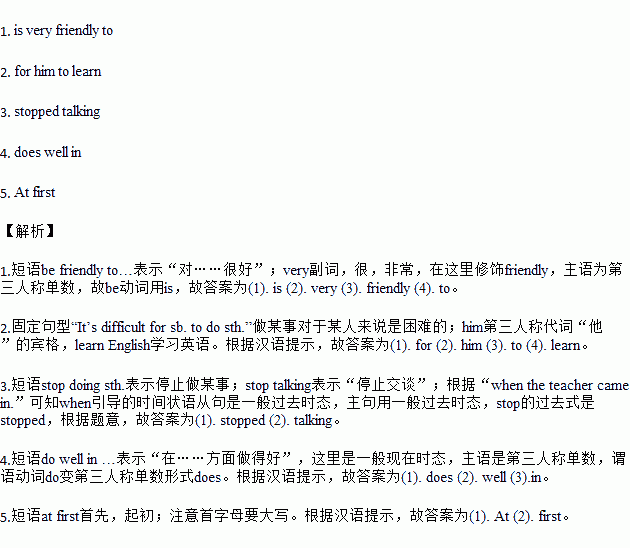
1.Õâ¸öСŮº¢¶Ô¹Ë¿ÍºÜÓѺá£

The girl _________ ________ _________ _________ customers.

2.¶ÔËûÀ´ËµÑ§·¨ÓïÊÇÀ§Äѵġ£

It¡¯s difficult ___________ __________ __________ __________ English.

3.ÀÏʦ½øÀ´µÄʱºò£¬Ñ§ÉúÃÇÍ£Ö¹Á˽²»°¡£

The students __________ __________ when the teacher came in.

4.ËûÓ¢ÓïѧµÃºÃ¡£

He ________ ________ ________ English.

5.Æð³õ£¬ÎÒÓ¢Óï˵µÃ²»ºÃ¡£

_________ ________, I couldn¡¯t speak English well.

Á·Ï°²áϵÁдð°¸
Ïà¹ØÌâÄ¿

Life is not easy, so I¡¯d like to say ¡°When anything happens, believe in yourself.¡± When I was 14, I was _____ nervous to talk to anyone. My classmates often _____ me. I was sad but could do nothing. Later, _____ happened. It changed my life. It was an English speech contest£¨±ÈÈü£©. My mother asked me to take part in it. What a/an ______idea! It meant I had to _____ in front of all the teachers and students of my school! ¡°Come on, boy. Believe in yourself. You are sure to _____.¡± Then, mother and I talked about many different topics £¨ÌâÄ¿£©. At last I _____ the topic ¡°Believe in yourself¡±. I tried my best to _____ all the speech and practised it over 100 times. _____ my mother¡¯s great love, I did well in the contest. I could ______ believe my ears when the news came that I had won the first place. I heard the ______ from the teachers and students. Those ______ who once looked down on £¨ÇƲ»Æð£© me, now all said ¡°Congratulations!¡± to me. My mother hugged me and cried ______. ______ then, everything has changed for me. When I do anything, I try to tell myself to be sure and I will ______ myself. This is true not only for a person but also for a country.

1.A.so B.too C.very D.quite

2.A.made faces at B.looked after C.caught up with D.laughed at

3.A.something B.nothing C.anything D.everything

4.A.interesting B.exciting C.terrible D.wonderful

5.A.write B.speak C.tell D.say

6.A.win B.lose C.beat D.pass

7.A.reached B.brought C.chose D.thought

8.A.remember B.see C.spell D.hear

9.A.At B.To C.With D.As

10.A.almost B.nearly C.ever D.hardly

11.A.cheers B.noises C.thanks D.wishes

12.A.teachers B.classmates C.boys D.girls

13.A.angrily B.sadly C.quietly D.excitedly

14.A.Since B.Except C.From D.Before

15.A.look for B.find C.find out D.look

In the United States alone, over 100 million cell-phones are thrown away each year. Cell-phones are part of a growing mountain of electronic waste like computers and personal digital assistants. The electronic waste stream is increasing three times faster than traditional garbage as a whole.

Electronic devices contain valuable metals such as gold and silver. A Swiss study reported that while the weight of electronic goods represented by precious metals was relatively small in comparison to total waste, the concentration £¨º¬Á¿£© of gold and other precious metals was higher in so-called e-waste than in naturally happening minerals.

Electronic wastes also contain many poisonous metals. Even when the machines are recycled and the harmful metals removed, the recycling process often is carried out in poor countries, in practically uncontrolled ways which allow many poisonous substances (ÎïÖÊ)to escape into the environment.

Creating products out of materials creates much more waste material, up to 100 times more, than the material contained in the finished products. Consider again the cell-phone, and imagine the mines that produced those metals, the factories needed to make the box and packaging it came in. Many wastes produced in the producing process are harmful as well.

The U. S. Environmental Protection Agency notes that most waste is dangerous in that "the production, distribution, and use of products-as well as management of the resulting waste-all result in greenhouse gas release." Individuals can reduce their contribution by creating less waste at the start-for example, buying reusable products and recycling.

In many countries the concept of extended producer responsibility is being considered or has been put in place as an incentive £¨¶¯»ú£© for reducing waste. If producers are required to take back packaging they use to sell their products, would they reduce the packaging in the first place?

Governments' incentive to require producers to take responsibility for the packaging they produce is usually based on money. Why, they ask, should cities or towns be responsible for paying to deal with the bubble wrap £¨ÆøÅݵ棩 that encased your television?

From the governments' point of view, a primary goal of laws requiring extended(À©´óµÄ) producer responsibility is to transfer both the costs and the physical responsibility of waste management from the government and tax-payers back to the producers.

1.By mentioning the Swiss study, the author wants to tell us that ____.

A.the weight of e-goods is rather small

B.E-waste deserves to be made good use of

C.natural minerals contain more precious metals

D.the percentage of precious metals is heavy in e-waste

2.The responsibility of e-waste treatment should be extended _____.

A.from producers to governments B.from governments to producers

C.from individuals to distributors D.from distributors to governments

3.What is the passage mainly about?

A.The increase in e-waste. B.The creation of e-waste.

C.The seriousness of e-waste. D.The management of e-waste.

Î¥·¨ºÍ²»Á¼ÐÅÏ¢¾Ù±¨µç»°£º027-86699610 ¾Ù±¨ÓÊÏ䣺58377363@163.com

¾«Ó¢¼Ò½ÌÍø