题目内容

完成对话。在对话空格中填上适当的单词,使对话完整正确。一空一词(含缩写词)。(共10小题,每小题1分;计10分)

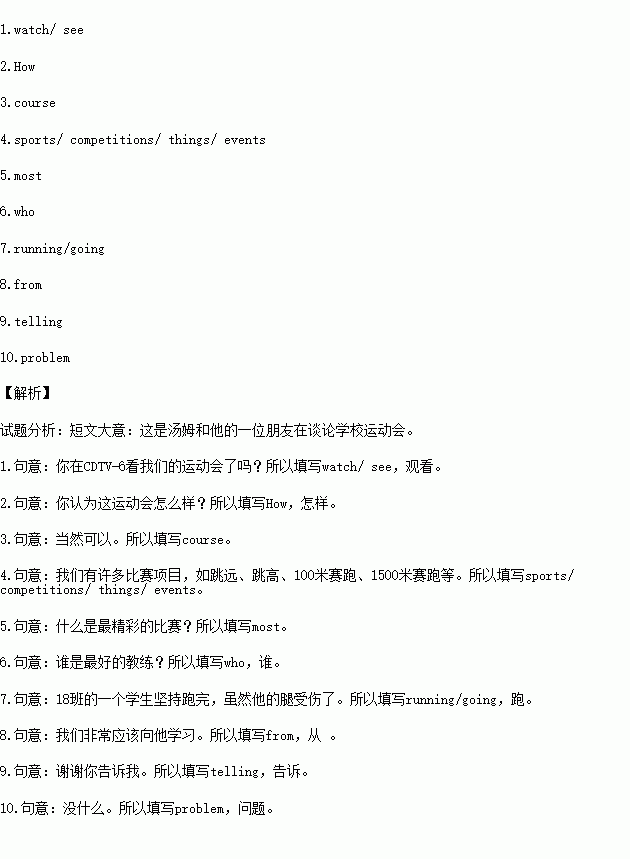
A. Hi, Tom. Did you 1. our sports meeting(运动会) on CDTV-6 ?

B. Yes.

A. 2. do you like the sports meeting?

B. It was fantastic.

A. Can you tell me about it? I want to know more.

B. Of 3. . On the afternoon of October 28th, we had an opening ceremony(开幕式). It lasted for 3days. We had many 4. , such as long jump, high jump, 100-meter race, 1500-meter race and so on.

A. What was the 5. wonderful competition!

B. I think it was the competition of our Grade 8.

A. Oh, 6. was the best coach(教练)?

B. Mr Ye, he spoke on CDTV-6.

A. Well. What was the most educational competiton?

B. It was 1500-meter race. A student from Class 18 kept 7. although his leg got hurt(受伤). We should learn a lot 8. him.

A. Sure, thanks for 9. us.

B. No 10. .
练习册系列答案
相关题目

Children have their own rules in playing games. They seldom need a referee (裁判) and rarely trouble to keep scores. They don’t care much about who wins or loses, and it doesn’t seem to worry them if the game is not finished. Yet, they like games that depend a lot on luck, so that their personal abilities cannot be directly compared. They also enjoy games that move in stages, in which each stage, the choosing of leaders, the picking-up of sides, or the determining of which side shall start, is almost a game in itself.

Grown-ups can hardly find children’s games exciting, and they often feel puzzled at why their kids play such simple games again and again. However, it is found that a child plays games for very important reasons. He can be a good player without having to think whether he is a popular person, and he can find himself being a useful partner to someone of whom he is usually afraid. He becomes a leader when it comes to his turn. He can be confident, too, in particular games, that it is his place to give orders, to pretend to be dead, to throw a ball actually at someone, or to kiss someone he has caught.

It appears to us that when children play a game they imagine a situation under their control. Everyone knows the rules, and more importantly, everyone plays according to the rules. Those rules may be childish, but they make sure that every child has a chance to win.

1.To become a leader in a game the child has to __________.

A. be popular among his playmates B. wait for his turn

C. be confident in himself D. play well

2.What is true about children when they play games?

A. They can stop playing any time they like.

B. They can test their personal abilities.

C. They want to pick a better team

D. They don’t need rules.

3.Why does a child like playing games?

A. Because he likes the place where he plays a game.

B. Because he can become popular among friends.

C. Because he finds he is always lucky in games.

D. Because he can be someone other than himself.

4.What do we know about grown-ups?

A. They are not interested in games.

B. They find children’s games too easy.

C. They don’t understand children’s games.

D. They don’t need a reason to play games.

5.The writer believes that __________.

A. children should make better rules for their games

B. children should invite grown-ups to play with them

C. children’s games can do them a lot of good

D. children play games without reasons

违法和不良信息举报电话:027-86699610 举报邮箱:58377363@163.com

精英家教网