题目内容
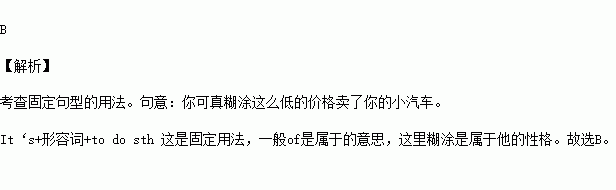
It’s silly you your car at such a low price.
A.for; to sellB.of; to sell
C.for; sellD.of; sell
.--_______ does it take you to get to school ?—About 15 minutes by car .
A. What time B. When C. How far D. How long
A man once visited a temple(寺院) which was being built, where he saw a sculptor (雕塑家) making an idol (神像)of God. Suddenly he noticed a similar idol lying nearby. Surprised, he asked the sculptor,” Do you need two statues of the same idol?”
“ No,” said the sculptor without looking up, “ We need only one, but the first one got damaged during the last stage (时期).”
The gentleman examined the idol and found no damage on the outside. “ Where is the damage?” he asked.
“There is a scratch on the nose of the idol.” said the sculptor , still busy with his work.
“Where are you going to place the idol?” he asked the sculptor .
The sculptor said that it would be put on the top of a pillar(柱子) twenty feet high.
“If the idol is that high up, who is going to know that there is a scratch on the nose?” the gentleman asked.
The sculptor stopped his work, looked up at the gentleman , smiled and said ,“ I will know it.”
The moral of the story: “Excellence” is a desire from inside, not outside. Excellence is not for someone else to notice but for your own satisfaction and efficiency.
根据短文内容判断正,误正确填“A”错误填“B”
1.The sculptor needed either of the two statues of the same idol.
2.Both of the idols were damaged.
3.The sculptor would put the idol up 20 feet high.
4.We can see the sculptor was a very careful and serious man.
5.This story explains that we should be very careful with our work if we want to be satisfied by others.
同意词的应用
He used to play a joke on Jim.
A.take care of
B.play against
C.make fun of
One of my students _______ moved to America .I miss her so much .
A.hasB.haveC.isD.are
Hello!This Chinese boy is Li Lei. He’s 12. He’s in No.3 Middle School. He’s in Class 2,Grade 1. His good friend is Jack. He’s an English boy. He’s in Li Lei’s school. He’s in Class1.Grade2. Mrs Read is an English teacher in their school.She’s an English woman. Jack an Li Lei has a secret(秘密)----Jack is their English teacher’s son.
1.How old is Li Lei?
A. 11 B. 12 C. 13 D. 14
2.What class is Li Lei in?
A. Class1.Grade1 B Class2.Grade1.
C. Class1.Grade2 D. Class2.Grade2
3.What’s Li Lei’s friend’s name?
A. Li Lei B. Read C. Jack D.Green
4.Who’s their English teacher?
A. Li Lei B. Jack C. Mrs Green D. Mrs Read
5.Is Jack Mrs Read’s son?
A. Yes, he is. B. No, he isn’t.
C. Yes, he isn’t. D. No, he is.
完形填空 先通读下面的短文,掌握大意,然后在每小题所给各题的四个选项中,选出
可以填入空白处的最佳选项。(本大题10分,每小题1分)
Once upon a time, there was a little boy named Rakesh, he studied and lived in a boarding school(寄宿学校). Every night he jumped over the wall and played outside. He returned before dawn (黎明) and lay on his bed again, so no one knew that Rakesh went out at .
One night as usual, Rakesh found everyone asleep. He decided to play outside again. He went into his teacher—Mrs. Green’s room and saw her sleeping. Then Rakesh walked out towards the wall. Near the wall, there was a ladder in the bushes, he hid it there. He the ladder and he climbed up it, then jumped over the wall. at that time his teacher was awake and saw him going out. got up and took away the ladder from the wall. A few hours later, Rakesh returned. In the dark, he tried to climb from the wall. Sadly, there was no ladder, instead, Mrs. Green was standing where the ladder was and waited for him. Rakesh was very to be punished (处罚), but to his surprise, she just helped Rakesh to get onto the ground, said, "Rakesh, at least a warm coat with you when you go out at night."
Mrs. Green's kindness made Rakesh know his own faults. He apologized (道歉) and never went out at night again. It is the lesson that he has ever had.
1.A. never B. always C. seldom D. sometimes
2.A. daytime B. weekends C. night D. noon
3.A. loudly B. quietly C. happily D. quickly
4.A. took care of B. took away C. took a look at D. took out
5.A. And B. But C. So D. Because
6.A. He B. They C. She D. It
7.A. up B. down C. out D. in
8.A. afraid B. glad C. sorry D. surprised
9.A. buy B. bring C. take D. borrow
10.A. worst B. best C. farthest D. Smallest
书面表达(本大题共10分)
假如你是Daniel,是九年级的学生,请你写一封信给你的好友Tom,告诉他你有一些问题,并向他请求帮助。
要点如下:1.着迷于网络聊天,不知道如何在学习和兴趣爱好之间获得平衡。
2.在过去的两个月中,我对自己严格要求,并取得了很大进步。
3.不时感到累,因为……
4.想通过穿绿色的衣服来给自己能量,也想通过听音乐和读书使自己放松,但是没有用。
5.希望……
注意:1.第3和第5要点的内容分别发挥1-2句;
2.必须包括所有内容要点,要求语句通顺、意思连贯;
3.词数90个左右,信的开头和结尾均已给出,不计入总词数。
Dear Tom,
I’m a Grade 9 student. I have some problems and I want to get some help from you.
___________________________________________________________________________
Best wishes,
Daniel
Are some people born clever and others born stupid? Or is intelligence (智力) developed by our environment and our experience? Strangely enough, the answer to these questions is yes. In some degree, our intelligence is given to us at birth, and no education can make a genius (天才) out of a child born with low intelligence. On the other hand, a child who lives in a boring environment will develop his intelligence less than one who lives in a rich environment. Therefore, the limits(限度) of a person’s intelligence are fixed at birth, whether or not he reaches those limits will depend on his environment. This point of view is now held by most experts.
It is easy to show that intelligence is something that we are born with. The closer the blood relationship between two people is, the closer their intelligence is likely to be. If we take two strangers by chance from the population, it seems that their degree of intelligence will be completely different. If, on the other hand, we compare two twins, they will very likely be as intelligent as each other. Relatives like brothers and sisters, parents and children, usually have similar intelligence, and this clearly suggests that intelligence depends on birth.
Imagine now that we take two twins and put them in different environments. We might send one, for example, to a university and the other to a factory separately where the work is boring. We would soon find differences in intelligence developing, and this shows that environment as well as birth plays an important part. This result is also suggested by the fact that people who live in close contact with each other, but who are not related at all are likely to have similar degree of intelligence.
1.How is man’s intelligence given?
A.At birth
B.Through education
C.Both at birth and through education
D.Neither at birth nor through education
2.What does the underlined word mean in the first paragraph?
A.稳固 B.确定 C.修理 D.安排
3.According the passage, if a child is born with low intelligence, what might happen to him later?
A.Become a genius.
B.Still become a genius if he should be given special education.
C.Reach his intelligence limits in rich environment.
D.Never reach his intelligence in his life.
4.What can we learn from the example of the twins going to a university and to a factory?
A.The importance of their intelligence.
B.The role of environment on intelligence.
C.The importance of their jobs
D.The part that birth plays