题目内容
—Let’s go fishing this afternoon. ______
A. Good idea. B. Yes, I’d love . C. I like fish a lot.
①Some days, don’t you think, “Wouldn’t it be nice if the clothes just washed itself?” Self-cleaning clothes may sound crazy. But Australian researchers have found a way to make something like this possible!
②A team at RMIT University in Melbourne, Australia, found a way to put special nanostructures (纳米结构) into clothing, which can then clean the clothes. When sunlight hits the nanostructures, they break down the dirt and marks that don’t belong on your clothes.
③The nanostructures don’t break down the real clothing because cotton and the other clothing materials are too strong to break down. According to CNN, the researchers cover the clothing in a solution made of silver and copper(铜) nanostructures. All it takes is 40 minutes of sunlight and your clothes will look as good as new.
④So if you spill on yourself during lunch, you can step outside for a walk, and it will be clean by the time you go inside. It not only makes your life easier, but it can also be good for the environment.
⑤According to the US Department of Energy, washing a piece of clothing uses about 25 gallons of water. Water is a very important resource, so using less of it to wash clothes is better for the environment. But one of the scientists at RMIT University knows more needs to be done.
⑥“There’s more work to do before we can start throwing out our washing machines,” said Dr Rajesh Ramanathan, “but this is a strong foundation(基础).” So what’s the next step? Ramanathan wants to either start selling the solution by itself or asking clothing makers to treat(处理) the clothing with the solution while clothes are being made.
1.According to the first three paragraphs, _____.
A. the self-cleaning clothes are easily worn out
B. the clothes will be covered with silver and copper after self-cleaning
C. people can use the self-cleaning clothes on rainy days
D. the nanostructures can break down dirt and marks on clothes
2.What does the underlined word “solution” in Paragraph 3 mean?
A. 方案 B. 溶液 C. 水盆 D. 模型
3.What do Paragraphs 4 & 5 talk about?
A. How the self-cleaning clothes are made.
B. How the self-cleaning clothes work.
C. What advantages the self-cleaning clothes have.
D. What helps the self-cleaning clothes work.
4.From the passage, we learn that _____.
A. it’s time to throw out our washing machines
B. the solution sells well
C. clothing makers like the solution
D. the solution is not on sale yet
5.We might read the above passage in ________.
A. a fashion book B. a guide book
C. a science magazine D. a newspaper advertisement.
— Nice to meet you. — ________.
A.Thank you B.The same to you
C.Don’t say so D.Nice to meet you,too
—_____ —It’s June 1st.
A. What’s the time now?
B. What’s the date today?
C. What day is it today?
I’m very tired. I would rather ______ than ______ TV.
A.to sleep; watch B.sleep; to watch C.sleep; watch
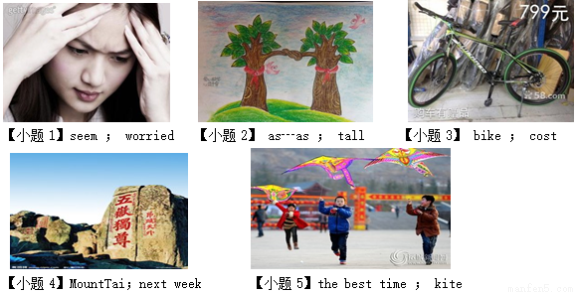
遣词造句:根据提供的图画和提示词,写一个符合图意的完整、正确的句子。
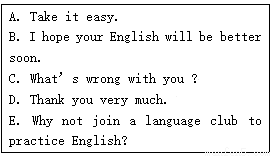
口语运用:根据对话内容,从方框中选出能填入空白处的最佳选项,补全对话。
Mr. Green:Hello, Li Lei! I saw you crying there . 1. Li Lei:It’s about my English. I have trouble learning English.
Mr. Green: 2. . Maybe I can help you .
Li Lei:First, I can’t speak English well.
Mr. Green: 3.
Li Lei:OK, I’ll try it. Also I can’t understand the teacher when she talks to the class.
Mr. Green:Listening to more tapes will help you a lot.
Li Lei: 4. I’ll do that as much as possible.
Mr. Green:You’re welcome. 5.
补全对话
阅读对话,根据横线后所给标点符号的提示,在横线上填写适当的句子,使对话完整。
A: Hi, Tina. You look so sad. What’s the matter?
B: I failed the English exam.
A: 1. . But you don’t need to worry about it all the time.
B: I really don’t know how to study English well. 2. ?
A: I think you’d better study with a group.
B: Oh, that’s a good idea. Could I join your group?
A: Certainly. And we can learn from each other.
B: Sounds good. 3. ?
A: We study in a classroom next to our English teacher’s office.
B: When can I join you?
A: Tomorrow if you like.
B: That’s very kind of you.
A: Not at all.
He managed to become a great inventor________he left school at 16.
A. no matterB. so that
C. even though D. as long as