题目内容
—How many students ______ there in your class?
—Thirty.
A. is B. are C. have D. has
—It’s hot today. How about going swimming after school?
—________.
A、That’s OK B、Good luck C、Good idea
---How often does Dick exercise? --- ____________.
A. Less than three times B. Every week
C. For a week D. two or three hours
文段表达
根据中文和英文提示,用英文写一封意思连贯、符合逻辑、不少于50词的邮件。邮件的开头和结尾已给出,不计入总词数。所给提示词语仅供选用。请不要写出你的校名和姓名。
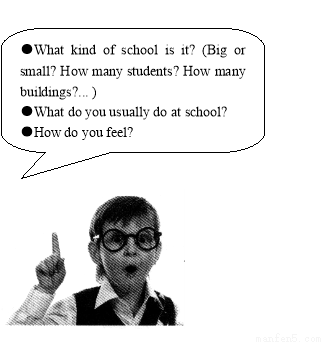
假如你叫李华,你的英国笔友Peter想了解你学校的大致情况,你通常在学校做些什么,以及你在学校学习、生活的感受。请根据他提出的以下问题给他回复一封邮件。
提示词语:library, science, hall, interesting, favourite, play, join, club, enjoy
Dear Peter,
How is everything going? I'm writing to tell you about my new school.
___________________________________________________________________________
Anything new at your school?
Yours,
Li Hua
—______ do the animals in Beijing Zoo come from?
—They come from many different countries.
A. When B. How C. What D. Where
根据要求完成大作文。
现在许多人在讨论“中国梦”(the Chinese dream),我们的祖国如何早日梦想成真,
这需要我们每个中国人的努力,因为我们每个人的小梦想是中国梦的一部分。
请以My Dream为题,谈谈你的梦想。
提示:1、你的梦想是什么?2、你为什么有这样的梦想? 3、你打算怎样
实现你的梦想?
____________________________________________________________________
根据所给中文完成句子翻译。
1.我的观点是你不应该那样做。
____ _____ _____ you should not do that.
2.许多学生盼望着再一次参观长城。
Many students ____ _____ _____ ____ the Great Wall again.
3.昨天老师把她的雨伞借给了我。
My teacher ___ ____ ____ ____ ____ yesterday.
4.用筷子指着别人是不礼貌的。
_____ _____ ______ _______ point to others with your chopsticks.
5.我不喜欢把自己和别人做比较。_____________________________________
6.你能告诉我医院在哪吗? __________________________________________
7.正在干活的人是我的老师___________________________________________
The Dragon Boat Festival is a_______ festival_______ China.
A. tradition; of B. traditional; of
C. tradition; at D. traditional; at
About five hundred years ago, an earthquake (地震) happened in a small village. Luckily for them, nothing was destroyed (毁坏) and no one was hurt. But a huge stone fell from a nearby mountain and stopped in the middle of the road.
When the earthquake stopped, many people came to the road and saw the stone. Some of the strongest men tried to lift the stone out of the road. But they couldn't move it. They tried to push it but failed. They tried to pull it with ropes but nothing worked.
"Well," they said sadly, "there's nothing we can do about it. We'll have to change the way."
At this time a boy about 12 years old said, "I think I can help you to move the stone away.
"You?" they shouted. "What are you talking about?" The men all laughed at the boy.?
The next morning, some people came into the road. One of them shouted, "The stone is gone." More people ran out to see what had happened. It was true. The stone wasn't on the road any longer. It wasn't even near the road.
The boy walked over to where the stone had been and said, "I buried it."
The people looked rather surprised. "You see," he said, "I dug a deep hole next to the stone and I dug a small incline (斜坡) up to the stone and the stone rolled (滚) down into the hole itself. Then I covered it with earth."
The villagers shouted, "Clever boy! Clever boy!" And some of them said, "Why didn't we think out this good idea?"
1.Around 500 years ago, this story happened in a small _____.?
A. town B. village C. city D. country
2.After the earthquake, _____.
A. many people in the village died
B. nothing happened
C. the whole village was covered with big stones
D. a huge stone fell down the mountain and stood in the middle of the road
3.The stone was moved out of the road by _____.
A. an old man B. a young man C. a boy D. a girl
4.In the end, the huge stone was _____.
A. in the earth B. in the house
C. in the river D. on the road side
5.From the passage, we can see that _____.
A. the boy was stronger than the villagers
B. the villagers were very foolish
C. the boy was very bright and good at thinking
D. the villagers were all proud of the boy before the earthquake happened

 阅读快车系列答案阅读快车系列答案