题目内容
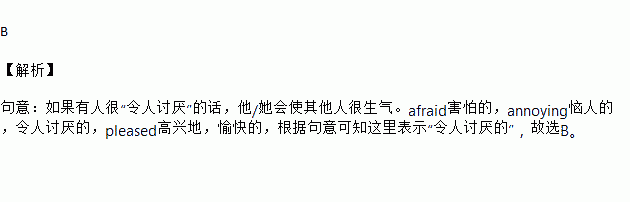
If someone is ______, he or she makes others feel angry.
A. afraid B. annoying C. pleased
阅读下面短文,根据短文内容,从A—E选项中选出能填入空白处的最佳答案。
Does someone in your family drive? Does he or she have road rage(路怒症)? 1. People are turning into monsters when they get behind the wheel of a car. 2. They cut in front of others, run red lights, drive above speed limits and don’t consider other drivers. These kinds of behaviors(行为) can lead to an accident.3. Here are some tips that you can share with those who drive in your family.
•Keep your driving environment calm.
Creating a positive driving environment will help you keep calm and you are more likely to pay no attention to the road rage of others.4..
•Allow yourself a lot of time.
Being late will make you anxious and impatient, so you’ll be more likely to get angry at other drivers or make irresponsible(不负责任的) driving decisions that will make them angry at you. 5.
•Avoid confrontation(对抗).
If an angry driver shouts at you or shares a rude gesture(手势) out of his or her window, don’t make eye contact or shout back. Keep your eyes on the road and ignore the angry driver.
A. So how can we avoid road rage?
B. Road rage is a problem that is getting worse all over the world.
C. They think the road belongs to them.
D. For example, listen to music that makes you happy or that calms you down.
E. Leaving yourself lots of time will help you stay relaxed
I don’t like the game shows. I think they’re __________.
A. mean B. meaning C. meaningful D. meaningless
语法填空: 用所给单词的适当形式填空,未提供单词的根据上下文填入适当的词。
Recently a TV show Readers has become popular.
It invites different people1. (attend). They read aloud and tell the moving stories behind 2.. They can read everything, like novels and letters.
Many people are fans of the show and begin to enjoy reading aloud at home. Now the show 3. (give) people a special place to read across China. Reading pavilions (亭子) are now 4. cities like Shanghai, Hangzhou and Xi’an.
The pavilion is quite small. Only one person can come into it each time. There is a microphone (麦克风) in it 5., it records people’s voices. Everyone can read anything they like for three minutes in the pavilion. The show chooses some of 6. readers and invites them to read on TV.
People of all 7. (age) have come and read in the pavilion. “Reading should be just like singing and talking,” said Dong Qing, the host of the show. “We can actually express our deep feelings through 8. (read) aloud.”
Both the TV show and the pavilion are promoting (促进) reading among Chinese people. And quite a lot of people are9. (interest) in reading. In fact, this is also what our country 10. (try) to do now.
— When will our sports meeting be held?
—______. Ask our monitor and he may know.
A. You’re welcome B. That’s all right
C. I have no idea
— Have you heard from John since he went abroad?
—Yes. He told me that he had got used to everything in America.
A. looked forward to B. found out
C. received a letter from
You want to know about life in the past. Right? I can tell you. When I was a boy, things were different. I had to get up at six every morning. That was not very bad in summer, but in winter it was cold. And we didn’t have any hot water in the house. We had to wash in cold water. We didn’t have a bathroom(浴室). My dad had some chickens. I had to feed(喂养)them every morning and then I had to walk to school with my little sister. It was about two miles (英里)to school and about two miles back in the evening. But it always seemed longer in the morning when we were going to school. There was a bus, but we didn’t have any money. And we had to goto bed at eleven o’clock every night because I had too much homework and housework to do. We couldn’t watch TV because there wasn’t any. On Sundays we had to go to church (教堂)three times - morning, afternoon and evening. And we couldn’t play outside on Sundays. But it wasn’t all bad. We had some g ood times(时光). We could go out and our parents didn’t have to worry about us. There weren’t so many cars on the roads then, so the streets were safe to play in. And ther e were not many robbers and thieves in those days. We had to work hard and we weren’t able to buy all those things in the shops today. Life was hard, but it was simple and people were hap pier. I don’t think I’d like to be young today.
1.The writer usually went to bed _________ every night.
A. at six B. at eight
C. at nine D. at eleven
2.The writer walked about ________ every day.
A. two miles B. three miles
C. four miles D. five miles
3.Every morning the writer had to feed _______.
A. his little sister B. his lovely dog
C. his chickens D. his father’s chickens
4.The writer had a _______ but _______ family.
A. rich; happy B. poor; happy
C. hard; poor D. rich; hard
5. Which of the following is NOT TRUE?
A. The writer had a little sister.
B. T he writer couldn’t take the school bus.
C. The writer and his sister never had any good times
D. The write had to get up at six
“Are you _____?” “Yes. I’m in good _____.”
A. health; health B. healthy; healthy
C. health; healthy D. healthy; health
– Look at _____. What am _____?
– ______ are a policeman.
A. I; me; You B. me; I; Your C. me; I; You

 阅读快车系列答案阅读快车系列答案