题目内容
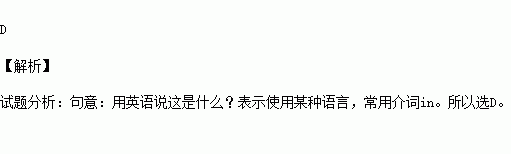
What’s this English?
A.to B. for C. at D. in
---Could you tell me _______yesterday?
--- Because my bike was broken on my way here.
A. why you came late
B. why do you come late
C. why you come late
D. why did you come late
Martin Lynch, an American businessman, had been going on vacation to a small Mexican (墨西哥的)fishing village for a number of years. One morning while going for a walk along the beach, he saw his friend Pablo Perez, a local fisherman. Martin watched Pablo unload his boat and pack the fish in a box.
Martin noticed Pablo was smiling and looked very happy. He could also see several large fish in the boat. Martin greeted Pablo and asked how long it took to catch the fish. “Just a few hours,” replied Pablo. Martin asked, “Why didn’t you stay longer and catch more fish?” “I have enough for my family,” Pablo said. “And what do you do with the rest of your day?” asked Martin. “I take a nap, play with my children, spend time with my wife, and go into the village to see my friends and play cards, I have a full and busy life.” Martin explained that if Pablo worked longer hours and caught more fish, he could make more money. With the extra money, Pablo could buy more boats and catch money more fish. By selling the fish, Pablo could open his own factory and sell direct to supermarkets.
“Then what?” asked Pablo. “Well you would probably have to move to Mexico City to run the business. Finally, you would be able to sell your business and make millions of dollars,” replied Martin. “How long will that take?” asked Pablo.
Martin thought for a while and said it would probably take at least 15 years.
“And then what” asked Pablo.
“Well, that’s the best part,” Martin said. “You will be able to retire, buy a house near the ocean, sleep longer, play with your children, spend more time with your wife, see your friends, and play cards.”
1. What is the story mainly about?
A. A businessman and a fisherman have become friends.
B. A businessman learns how to fish from a fisherman.
C. A businessman gives advice to a fisherman.
2. What makes the Mexican fisherman happy?
A. Many friends to visit him.
B. A full and busy life.
C. More boats and more fish.
3. How can the fisherman make more money in the businessman’s view?
A. By buying a supermarket.
B. To work longer and catch more fish.
C. By selling his own business.
4.What can we infer from the passage?
A. The fisherman will stay the same with his life
B. The fisherman will leave the village for Mexico City
C. It takes all day for the fisherman to catch large fish
Tu Youyou is famous ____ her medical research and won the Nobel Prize this year.
A. of B. for C. as D. to
用括号内所给单词的适当形式填空。
1.Is this book ______(your)?
2.I like ______(I) new school very much.
3.These are her ______( eraser).
4.I have a good friend and ______name is Linda (she )
5.Here are two ___ (photo ) for you.
---What do you usually do to celebrate the Spring Festival? --- We usually ________.
A. make a pumpkin lantern
B. watch the moon
C. eat rice dumplings
D. get together and have a big dinner
—How do you usually go to work?
—On foot. Walking is much than driving during the heavy traffic time.
A. fast B. faster C. more faster D. Fastest
动词填空
1.After hearing the latest news, Tom suggested ________________ (sell) the house but Ann didn’t agree.
2.This story tells us a lesson --- the early bird ________________ (catch) the worm.
3.As soon as Eddie finishes the job, he ________________ (allow) to have two weeks off.
4.No one in the small town ______________ (deal) with such a problem before. They don’t know what to do.
5.---How did the accident happen?
---Oh, I could hardly see anything clearly because it ________________ (rain) hard.
6.I am afraid the life we are used to ________________ (change) a lot in a few years’ time.
7._______ the tourists ________________ (remind) to wear warm clothes before they climbed the mountain?
8.She was forced ________________ (give) up her plan because of the bad weather.
—How do you ___________ the new supermarket in town?
—It’s clean and big. The great thing is that we can buy things ___________ there.
A.think of; cheaply B.think about; cheap
C.feel about; cheap D.like; cheaply

 激活思维优加课堂系列答案
 活力试卷系列答案激活思维优加课堂系列答案活力试卷系列答案