题目内容
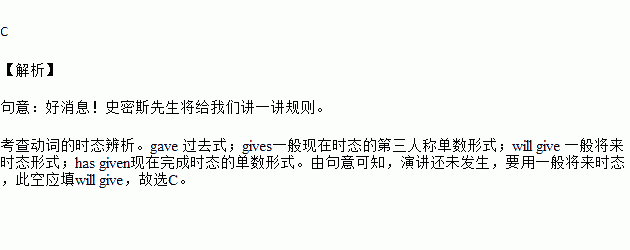
Good news! Mr Smith ______ us a speech about the rules.
A.gave B.gives C.will give D.has given

 第1卷单元月考期中期末系列答案
We all dream about things that we would like to do and things we hope to achieve in the future. But are everybody’s dreams the same? Here are some of the findings of a survey about hopes and dreams, in which thousands of students across China took part.
What are the hopes of teenagers? We received several different answers to the question: what would you like to do after you finish your education? It seems that some students would like to start work as soon as they can, so that they can help offer their parents better lives. Other students hope to go on studying after they finish school and to go to university. Although money is important, many teenagers want to do jobs they like. According to the survey, the most popular choice of job is computer programming.
What are the dreams of teenagers? Teenagers have all kinds of dreams. Some are more realistic(现实的) than others. For example, many students would like to be volunteers if Beijing could hold the World Cup, maybe working as translators or tour guides. And many students dream of having a trip to every corner of the world one day.
According to the survey, less realistic dreams are also common, but many students reported that they were willing to work hard to achieve their dreams. Quite a few dreamed of becoming famous, perhaps famous sports people or singers. Some students would like to go on exciting trips. One student would love to sail across the Pacific Ocean. And then there are dreams that there is no possibility for students to achieve. Three students would like to be able to fly.
It is clear from the survey that teenagers have similar hopes. It seems that most students hope to have a good education and find a good job. On the other hand, students dream of very different things: good things, and even crazy things. It is very important to dream, so hold on your dreams, one day they may just be realized.
A survey about some Chinese students’ hopes and dreams | |
| ●Some students want to begin work as soon as possible to help1.their parents with better lives. |
| ●Some students have more realistic dreams, such as working as volunteers at the World Cup and6.around the world. |
| ●The survey shows that teenagers’ hopes are9.while their dreams are different. |

Two little boys
Two little boys had two little toys Each had a wooden horse. Joyfully they played each summer’s day Soldiers (士兵) both, of course. Then Jack broke off his horse’s head, Sad for his toy, then cried with joy As his young friend Joe said: Did you think I would leave you crying When there’s room on my horse for two? Climb up here, Jack, and don’t be crying I can go just as fast with two When we grow up we’ll both be soldiers
And I wonder if we’l remember When we were two little boys. | Long years past, war came so _____ Bravely they marched away. Guns roared loud and in the mad crowd
Up goes a shout, a horse rushes out Out from the crowd, to where Joe lay Then came a voice he knew: Did you think I would leave you dying When there’s room on my horse for two? Climb up here, Joe, we’ll soon be flying I can go just as fast with two. Now we are both real soldiers And our horses are not toys And I remember When we were two little boys. |
 And our horses will not be toys
 Wounded and dying lie
1.What happened to Jack’s toy horse?
A.Its head was broken off. B.It was taken by soldiers.
C.It was broken by Joe. D.It was lost in the war.
2.The best word for the blank is .
A.fast B.hard C.slow D.quick
3.What is the song mainly about?
A.Dangerous war. B.Interesting games.
C.Pleasant summer. D.Valuable friendship.