题目内容

Sixteen years ago, a boy gave me an important gift. It was a smile.

It was the early autumn of my first year at a middle school, and my old school was far away. As a result, no one knew who I was. I was very lonely, and afraid to make friends with anyone.

Every time I heard the other students talking and laughing, I felt my heart break. I couldn't talk with anyone about my problems.

Then one day, my classmates were talking happily with their friends, but I was sitting at my desk unhappily as usual. At that moment, a boy entered the classroom. I didn't know who he was. He passed me and then turned back. He looked at me, with a smile.

Suddenly, I felt the touch of something bright and friendly. It made me feel happy and warm. That smile changed my life. I started to talk with other students and made friends. Day by day, I became closer to everyone in my class. The boy with the lucky smile has become my best friend now.

One day I asked him why he had smiled, but he couldn't remember doing so!

It doesn't matter because all the dark days have gone. I believe that the world is what you think it is. If you think it is lonely, you might always be alone. So smile at the world and it will smile back.

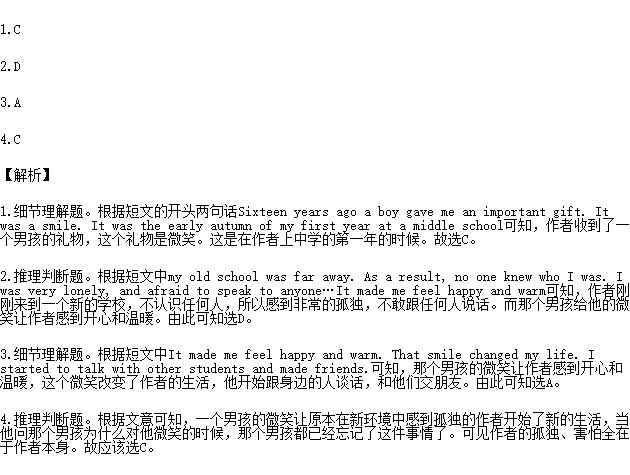
1.When did the writer get the gift?

A. At the age of 16.

B. After making friends with the boy.

C. In the first year at a middle school.

D. After becoming closer to everyone in her class.

2.Why was the smile an important gift?

A. Because the writer's old school was far away.

B. Because the writer didn't know who the boy was.

C. Because the smile didn't mean anything to the boy.

D. Because the writer felt lonely and had no friends and it made her feel happy and warm.

3.How did the smile change her life?

A. She started to make friends.

B. She became the best friend of the boy

C. Her parents didn't worry about her any more.

D. She realized that she was lonely.

4.Where does she now think her feeling of unhappiness came from?

A. From her old school. B. From her parents.

C. From herself. D. From her class
练习册系列答案
相关题目

阅读理解

Once there was a man traveling in a faraway village. As he was passing the elephants, he suddenly stopped. He found that these huge elephants were being held by only a small rope(绳子) tied to their front leg. No chains(锁链), no cages(笼子). It was clear that the elephants could, at any time, break away from their ropes but for some reason, they did not.

He saw a trainer nearby and asked why these animals just stood there and didn’t try to get away. “Well,” the trainer said, “when they are very young and much smaller, we use the same size rope to tie them and, at that time, it’s enough to hold them. As they grow up, they still believe they cannot break away. They believe the rope can hold them, so they never try to break free.”

How could it be? These animals could at any time break free from their ropes. But because they always stuck right where they were, they believed they couldn’t.

Just like the elephants, how many of us go through life believing that we cannot do something, just because we failed at it once before?

___________________. We should never give up the struggle(挣扎) in life.

1.What did the writer see in the village?

A. Chains B. Elephants

C. Cages D. Farmers

2.Why do the elephants never try up to break free from the ropes?

A. Because they think they cannot.

B. Because they are too old to do it.

C. Because they like their living places.

D. Because they get on well with the trainer.

3.How did the man feel after he heard what the trainer said?

A. Happy B. Surprised

C. Angry D. Nervous

4.Which of the following is the missing part in the last paragraph?

A. Failing is part of learning.

B. We should be different from others.

C. Helping animals is helping ourselves.

D. Traveling always makes people relaxed.

5.What is the best title for this test?

A. Pleasant trip

B. A Clever Trainer

C. Elephant Training

D. The Elephant Rope

Ask any student which subject he or she hates most. 9 out of 10 students will answer "math". No matter which country you visit, no matter which grade you are in, you may not learn art, geography, chemistry or Chinese, but you always learn math. Why is this so? How come so many students hate math, and yet cannot avoid learning it in school?

Jenny Sanders, a high school student in California, asks, "What good do we get from learning math? We can use computers to compute numbers, and we can use computers to store information. I think learning math at school is a waste of time."

However, there is much more to math than just learning to add and subtract (减) numbers. In fact, math is not so much about calculation (计算) as it is about learning to think logically (逻辑地) and solving problems. Of course, Jenny was right that we can use computers to do calculations, but how would we even know how to use the computer if we can't think logically? In short, computers are only tools when solving problems.

For example, imagine you are a cook and must serve dinner to 100 guests. How should you divide

your resources so that you can get the job done most efficiently (高效地)? In situations like this, the ability to think logically will get you to a reasonable answer and solve your problem.

1.According to the passage, which subject do students always learn in different grades at school?

A. Chinese B. Math

C. Geography D.Art.

2.What does Jenny Sanders think of learning math?

A. Interesting B. Boring

C. Useless D. Difficult.

3. Which of the following is TURE according to the passage?

A. 90﹪of the students hate learning math.

B. Students can learn math well with computers.

C. Math can do calculations and store information.

D. Math helps students learn all the other subjects well.

4.What does the underlined word "resources" mean in the passage?

A. 科目 B. 效率 C. 信息 D. 资源

违法和不良信息举报电话:027-86699610 举报邮箱:58377363@163.com

精英家教网