题目内容
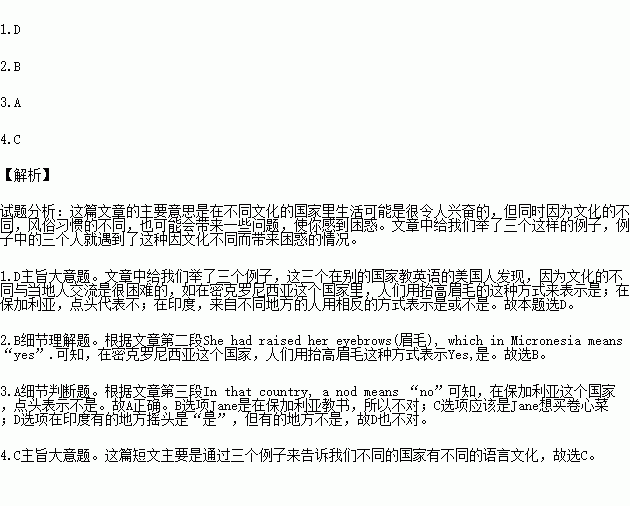
Living in a foreign culture can be exciting, but it can also be confusing(令人迷惑的). A group of Americans who taught English in other countries recently discussed their experiences. They decided that miscommunications were always possible, even over something as simple as“yes”and“no”.
On her first day in Micronesia, an island in the Pacific, Lisa thought people weren’t paying any attention to her. The day was hot. She went into a store and asked, “Do you have cold drinks? ”The woman there didn’t say anything. Lisa repeated the question. Still the woman said nothing. She later learned that the woman had answered her: She had raised her eyebrows(眉毛), which in Micronesia means” yes”.
Jan remembered an experience she had in Bulgaria, a country in Europe. She went to a restaurant that was known for its cabbage. She asked the waiter, “Do you have cabbage today? ”He nodded his head. Jan waited, but the cabbage never came. In that country, a nod means” no”.
Tom had a similar problem when he arrived in India. After explaining something in class, he asked his students if they understood. They answered with many different nods and shakes of the head. He thought some people had not understood, so he explained again. When he asked again, they did the same thing. He soon found out that his students did understand. In India, people nod and shake their heads in different ways depending on where they come from. You have to know where a person is from to understand whether they mean“yes”or“no”.
1. These Americans teaching English in other countries found that they ______ .
A. should go abroad for vacations
B. needed to learn foreign languages
C. should often discuss their experiences
D. had problems with communications
2.People in Micronesia show“yes”by ______ .
A. nodding heads B. raising eyebrows
C. shaking heads D. saying “no”
3. Which of the following is TRUE according to(根据)this passage?
A. In Bulgaria, nodding heads means no.
B. Jan taught English on a Pacific island.
C. Lisa was trying to buy some cabbage.
D. In India, only shaking heads means” yes”.
4.The passage is mainly about ______ .
A. body language in foreign restaurants
B. class discussion in Indian schools
C. miscommunication in different cultures
D. English teaching in other countries

 阅读快车系列答案
书面表达
下面表格反映的是Andy一家10年来的变化,请你根据其内容,以Changes to Andy’s family为题,写一篇调查报告。
Ten years ago | Now | |
Flat | A small flat with two rooms | A big flat with ten rooms |
Vehicle | Two bikes | A car |
Appliance | A 21-inch TV set | A big TV set and two small ones |
要求:1. 内容充实,覆盖要点;2. 报告中要包含总结和感想;3. 70词左右,开头已经给出,不计入总词数。
Changes to Andy’s family
Great changes have taken place to Andy’s family in the past 10 years.
___________________________________________________________________________________
___________________________________________________________________________________
___________________________________________________________________________________
___________________________________________________________________________________
___________________________________________________________________________________
___________________________________________________________________________________