题目内容
---Hello, may I speak to Mr. Smith?
---Sorry, he isn’t in. He______ the office.
- A.has been to
- B.has gone to
- C.has been away
试题分析:句意:你好,可以找史密斯先生接电话吗?——抱歉,他不在。他已经去了办公室。结合语境可知下文强调的是现在已经完成的动作,故用现象完成时态。选项AC强调的是持续到现在的状态,故选A。
考点:瞬间动词和持续性动词
点评:完成时态中的动词有瞬间动词和持续性动词之分,瞬间动词的过去分词强调的是动作的完成,持续性动词强调的是动作的持续性。现在完成时态中表示一段时间的时间状语不能和瞬间动词连用,持续性动词不能和表示瞬间时间的时间状语连用,需注意区分。

 课堂全解字词句段篇章系列答案
 步步高口算题卡系列答案
从方框中选择最佳选项完成对话,有两项多余。
| A. My parents got angry with me. B. Maybe I can help you with it. C. The teacher said I could do better. D. What’s the matter with you? E. I really had a difficult time studying math. F. Why not go home and say sorry to your parents? G. That’s too bad. |
B: I argued with my parents last night.
A: Why did you do that?
B: I got my report card yesterday. I didn’t do well in math. 【小题2】
A: 【小题3】 You should work harder at math.
B: I know, but I find it really difficult and I really don’t know how to improve it.
A: 【小题4】
B: That’s great. Thanks a lot.
A: You’re welcome. 【小题5】
B: I will.

A greeting is a way of saying "Hello" to someone. People in different countries greet each other in different ways. Here are some.
World Greetings
|
Philippine |
The everyday greeting for friends is a handshake for both men and women. Men sometimes pat each other on the back. |
|
Japan |
When people meet for the first time, they usually bow. In business, people also shake hands. In formal situations, people often exchange business cards. When you give a business card, give it with two hands. This is polite. Special note: In Japan, a smile can have different meanings. It usually means that the person is happy, or that the person thinks something is funny. But it can also mean that the person is embarrassed. |
|
New Zealand |
Usually, both men and women shake hands when they meet someone for the first time. Fun fact: If you see two people pressing their noses together, they are probably Maori. The Maori are the native people of New Zealand. This is their traditional greeting. |
|
Brazil |
Men often shake hands when they meet for the first time. When women meet, they kiss each other on the cheek. Women also kiss male friends to say hello. When you shake hands, look at the person in the eyes. This shows interest and friendliness. |
1.In this passage, which of the following is NOT mentioned?
A.Kisses. B.Hugs. C.Bows. D.Handshakes.
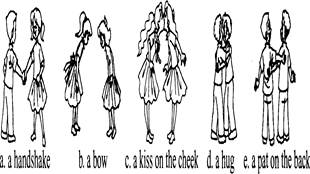
2.Of the five pictures above (a, b, c, d and e), which is the same way to greet each other in the four countries?
A.a B.b C.c D.d
3.Which of the following is TRUE according to the passage?
A.Both men and women shake hands in Brazil when they meet.
B.Japanese won't smile until they feel very happy.
C.The Maori often press their noses together to greet each other.
D.In Philippine, people shake hands only when they meet for the first time.