题目内容

口语运用(每小题 1分,共 5分)

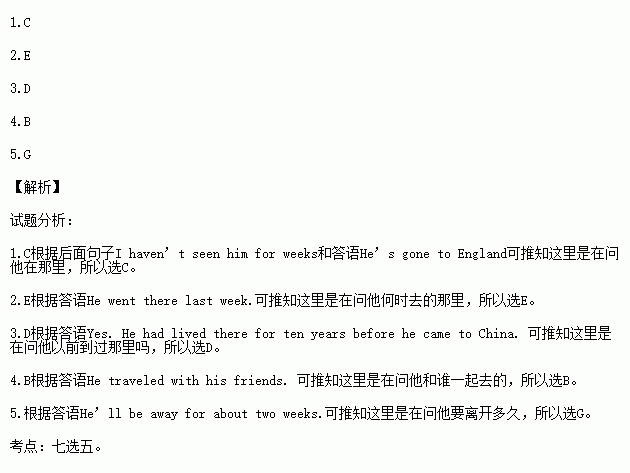
阅读下面对话,从方框内 7 个选项中选择 5 个恰当的句子完成此对话,并将其番号填入题前括号 内。

A. How often does he go out?

B. Who did he travel with?

C. Where is Jim?

D. Has he ever been there before?

E. When did he go there?

F. Has he gone to England?

G. How long will he be away?

A: Excuse me, Bob. 1. I haven’t seen him for weeks.

B: He’s gone to England.

A: Really? 2.

B: He went there last week.

A: 3.

B: Yes. He had lived there for ten years before he came to China.

A: 4.

B: He traveled with his friends.

A: 5.

B: He’ll be away for about two weeks.

A: Oh, thank you. I’ll call him this evening.
练习册系列答案
相关题目

You can't remember who sings a certain song from the 90s. You Google it. You're arguing with a friend about who played Mickey in The Goonies. You solve the problem by Googling it. You don't know the way to that new restaurant. You Google Maps it.

We hold the answers to about all of life's questions in our hands today. But that means our brains are feeling free to take some rest. According to the Daily Mail, our growing reliance on(依赖) the Internet for fact checking is making our memories worse.

Scientists at Harvard University found people now regard Google and other search engines as an outside part of their own brains, rather than a tool. Writing in the Journal Scientific American, Harvard psychologists Daniel Wegner and Adrian Ward warn that people who believe their memorable facts that are saved online are much worse at remembering them.

"The Internet is also unlike a human memory partner; it knows more and can produce the information more quickly, You can find almost all information today easily through a quick Internet search. It may be that the Internet is taking the place of people's memory."

In a series of tests, researchers found it was easy for people to remember information well if they believed it would be deleted.

Those who thought it was stored on a computer were more forgetful, even if they were asked to keep the information in mind.

1.When people want to check a fact, probably they will .

A. look up in a book

B. ask friends

C. use the Internet

D. go to teachers for help

2.According to the passage, if we depend on the Internet for fact checking, .

A. our brains will become smaller

B. our brains will become bigger

C. our memories will become worse

D. our memories will become better

3.People are easy to remember things well if they know .

A. they will lose the information

B. they will lose the computer

C. the information is good for them

D. the information is important

4.The writer wants to tell us .

A. not to use Google

B. Google is bad for our memory

C. Google is a good tool for checking facts

D. not to depend on the Internet for checking facts too much

students bring mobile phones to school? Earlier this month, some experts in Beijing had a discussion about this question. There is on it.

One side suggested that schools mobile phones completely. Mobile phones have distracted (分心) students with games and hurt students with bad messages, they said.

side argued that we should not refuse to eat for fear of choking(因噎废食). We should stop the act of sending bad messages stopping the use of mobile phones. What’s more, cell phones are when students need to call their parents, especially in time of danger.

Teens asked several students about what’s going on with mobile phones in their schools. In fact, most schools allow cell phones at school, but tell students they must until the end of the school day.

Most students think it’s a good idea to have a mobile phone, it’s turned off. Li Zefeng, 13, of Beijing, said: “Sometimes when I have to take extra classes, I need to tell my parents to pick me up later. I call them with my cell phone.”

However, some still secretly use their cell phones . Xu Nanqing, 14, of Shanghai, said once a student was trying to take a call on a mobile phone during an exam. The teacher was angry that he scolded(责备)the student in front of the whole class, Xu said.

1.A. Should B. Must C. Will D. Do

2.A. agreement B. disagreement C. differences D. difficulties

3.A. allow B. refuse C. let D. accept

4.A. The others B. The other C. Some other D. Others

5.A. instead of B. and C. but D. instead

6.A. impossible B. useful C. special D. no need

7.A. keep them off B. turn them on C. use them D. make calls

8.A. so B. unless C. even if D. because

9.A. at home B. at work C. on the bus D. at school

10.A. very B. quite C. really D. so

违法和不良信息举报电话:027-86699610 举报邮箱:58377363@163.com

精英家教网