题目内容
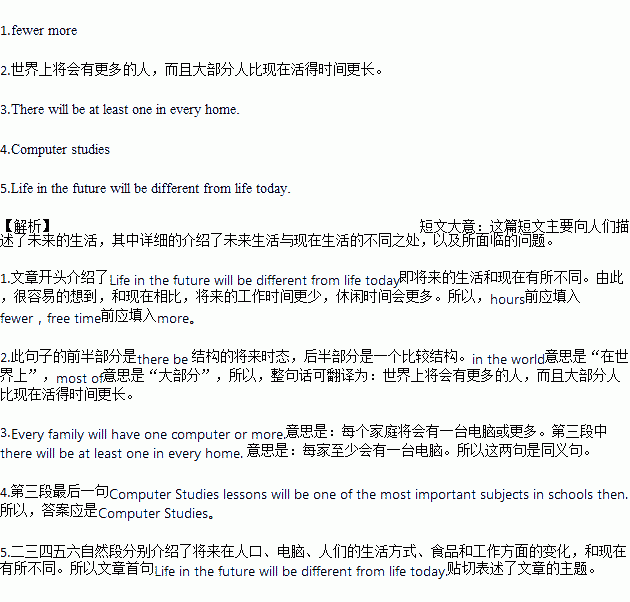
Life in the future will be different from life today. Between then and now many changes will take place(发生), but what will the changes be?
The population is growing fast. There will be many people in the world and most of them will live longer than people live now.
Computers will be much smaller and more useful, and there will be at least one in every home. And Computer Studies lessons will be one of the most important subjects in schools then.
People will work _______ hours than they do now and they will have _____ free time for sports, watching TV and travel. Traveling will be much cheaper and easier. And many more people will go to other countries for holidays.
There will be changes in our food, too. More land will be used for building new towns and houses for all the people. Then there will be less room for cows and sheep, so meat will be more expensive. Maybe no one will eat it every day. Instead they will eat more fruit and vegetables. Maybe people will be healthier.
Work in the future will be different, too. Dangerous and hard work will be done by robots(机器人). Because of this, many people will not have enough work to do. This will be a problem.
1.在文中空格处填上适当的词 _____________ ______________
2.将划线句子译成汉语_________________________________________________
3.找出同义句: Every family will have one computer or more.
________________________________________________________________________
4.回答问题:What will be one of the most important subjects?
___________________________________________________________________
5.找出或写出本文的主题句_________________________________________________

Jia Meng used to keep a diary (日记) in Chinese. But one year ago, the 14-year-old girl from Hei Longjiang began to write her diary in English, because Jia found her mother was reading her diary secretly. She changed the language because her mother can’t read English. “It’s like killing two birds with one stone.” said Jia, “My privacy (隐私) became safe and my English improves a lot.”
Jia’s mother is not the only mom who reads her child’s diary. Recently, Renmin University of China did a national survey among over 2, 3000 parents. The reports say that 40% of parents read their children’s secrets. That’s why, like Jia, many teenagers try to find ways to protect their privacy.
Wu Lei, 15, of Shanxi, keeps a diary, too. But he doesn’t write it on paper. He writes on the Internet which he thinks is perfectly safe because his parents “know nothing about the Internet.”
Lu Huan, 13, of Guangdong, said her parents always secretly listened to the talk between her friends and her on the telephone in their room. To solve this problem, Lu asked her parents to buy her a mobile phone.
“Parents want to know what is going on in their children’s lives,” said Shao Xiazhen, a teenage expert in Beijing. “ But sometimes they go about it the wrong way.” Shao gave teenagers the idea that instead of hiding their secrets, talking to parents is a better way. “If your parents know that you are safe, they’ll let you keep your secrets.”
Title: Finding 1.to protect privacy | |
Phenomenon(现象) | It’s 2. that 40% of parents read children’s secrets. |
Examples | Jia Meng used to keep a diary in Chinese but now she has been used to that in the English 3.. |
Wu Lei thinks writing 4. instead of on paper is a safe way to stop parents from 5. his diary. | |
Lu Huan asked her parents to buy her a mobile phone because her parents’ action 6.her talk with her friends. | |
7. on protecting privacy | Since parents 8.what was happening in children’s lives, a teenage expert 9. Shao Xiazhen advised that hiding the secrets should be less 10.than talking to parents. |