题目内容

根据句意,写出括号内所给单词的适当形式。

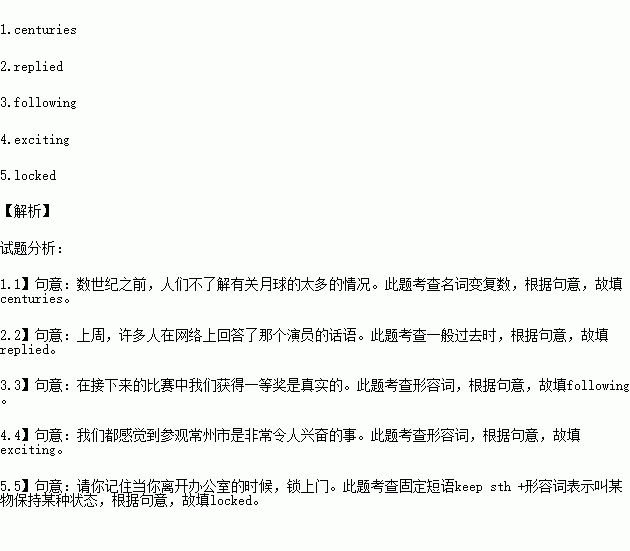
1.People didn’t know much about the moon ________ (century) ago.

2.Many people _______________ (reply) to the actor’s words on the Internet last week.

3.It’s true that we won the first prize during the _______________ (follow) match.

4.We all felt it _______________ (excite) to visit Changzhou Joyland.

5.Please remember to keep the door ______________ (lock) when you leave the office.
练习册系列答案
相关题目

请仔细阅读第1-5题,从A到F的六个选项中选出符合各段主题的句子,其中一项为多余选项。

_______1. Long long ago, people did not need money. They hunted animals and gathered wild fruits and other plants for food. They made clothes from animal skin and lived in caves.

_______2.As time passed, people settled in villages and began to plant crops. Sometimes, families produced more than they needed, so they started to trade with other families. Later, people began to use money as a means of exchange. However, it was not the kind of money we use today. They used shells, rice, salt, large stones, furs, dried fish, gold, etc.

_______3. During the 600s B. C., people began using coins as money. They soon found that coins were easier to handle than goods and lasted a long time. Later, countries began to make their own coins.

________4.The Chinese were the first to use paper money, probably as early as the eleventh century. The Italian explorer Marco Polo saw the Chinese using paper money when he visited China in the 1200s. However, European countries did not start using paper money until 1600s.

_______5.Today, we have many ways to pay for things. We do not use only coins or paper money. Often, people prefer to pay for things by check or credit card. Paying with a check or credit card is easier and safer than carrying around a lot of “real” money.

A. Money is the outcome(结果) of social development.

B. Besides coins and paper money, people now pay by check or credit card.

C. The Chinese were the first to use paper money.

D. People began to use coins because they were easier to handle and lasted a long time.

E. There was no money long long ago.

F. We use only coins or paper money to pay for things.

Once a boy often made trouble. His mother gave him many nails(钉子). She told him to hammer(锤,钉)one in the garden fence(栅栏) every time he lost his patience and fought with someone. The first day he hammered 27 nails. In the following weeks he learned how to control himself better and the number of nails hammered became smaller and smaller. He learned it was easier to control himself than to hammer nails.

The day finally came when he didn’t hammer any nails. He went to tell his mother about it. Then his mother told him to pull off a nail from the fence each time he didn’t lose his patience. After some days he told his mother that all the nails had been pulled off, so she took him to the fence and said to him, “You’ve behaved well, but look at all the holes in the fence. The fence will never be again like it was before. When you fight with someone, you leave wounds(伤口)in him like these. The trouble may be over, but the wounds will always be there.”

So, learn to control yourself before you hammer the nail in the fence. Try not to leave any holes in your past.

1. Losing control may bring you ________.

A. good luck B. trouble

C. nails D. a hammer

2. The boy used to _______.

A. be polite B. be impatient

C. be careless D. be friendly to others

3. Why did the mother give her son nails?

A. To put the garden fence right.

B. To put them away.

C. To help him understand something.

D. To make him lose patience.

4. In what condition (条件) could the boy pull off a nail?

A. He could control himself.

B. He fought with others.

C. He wanted to do so.

D. His mother asked him to do so.

5. The writer wants us to ______.

A. praise the clever mother

B. correct our mistakes

C. learn to control ourselves

D. know hammering nails is useful

违法和不良信息举报电话:027-86699610 举报邮箱:58377363@163.com

精英家教网