【题目】

Some of the greatest problems we face today are the destruction (破坏) of our environment. Brown clouds, polluted water, endangered wild animals.., these problems seem so huge.

So my family does what we can. We take cloth bags to stores instead of using plastic bags. We walk where we don't have to drive...

But does it do any good? When I am the only one in line at the market with cloth bags, am I doing any good? Does my walking to stores make any real difference to the world?

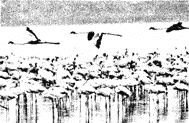
I recently learned something about flamingos (火烈鸟) which like to get together in groups of a thousand or more. Every year, when the time comes for migration (迁徙), a few of them first takeoff from the lake. But none of the others seem to notice, so the small group returns. However, the next day they try again. This time few more fly along with them, but most of them still pay no attention, so they return again. They try for several times. Every time a few more birds join in but, since the thousands of others still take no notice, the great migration plan is once more stopped.

Then one day something changes. The same small group of birds once again starts flying and a small number more join in just as before, then more. Finally, they all take flight and the migration really begins. What a spectacular sight it must be—thousands of flamingos taking off into the sky at once!

A few can make a difference. Even if you're the one to take the first step, and continue trying, others will someday take notice and together we will solve even our greatest problems.

1Where would you most probably read this passage?

A. A guidebook. B. A movie poster.

C. A personal blog(博客). D. A geology(地质) magazine.

2Why does the writer use cloth bags in stores?

A. Because he wants to do some good to the environment.

B. Because he thinks plastic bags are more expensive.

C. Because there are only cloth bags in stores.

D. Because all the people use cloth bags in stores.

3What does the underlined word "spectacular" in Paragraph 5 probably mean?

A. Frustrating. B. Surprising. C. Terrible. D. Fantastic.

4Which of the following is TRUE according to the passage?

A. Even if we can walk there, we still drive over.

B. Flamingos like to get together in groups of a thousand or more.

C. Brown clouds and polluted water are the only problems we face today.

D. When a few of the flamingos first take off from the lake, all the others follow at once.

5What's the writer's purpose of writing this article?

A. To show that the writer loves to see the migration of flamingos.

B. To tell readers to continue trying and it can make a difference.

C. To introduce a special kind of flamingo to readers.

D. To show that there're many problems in the world.

【题目】

Some scientists say that animals in the ocean are

increasingly threatened(威胁) by noise pollution caused by

human beings. The noise that influences sea animals comes

from a number of human activities. It is caused mainly by

industrial underwater explosions(爆炸) , ocean drilling, and

ship engines. Such noises are added to natural sounds.

These sounds include the breaking of ice fields, underwater

earthquakes, and sounds made by animals themselves.

Decibels (分贝) measured in water are different from those measured on land. A noise of one hundred and twenty decibels on land causes pain to human ears. In water, a decibel level of one hundred and ninety five would have the same effect(效果).

Some scientists have proposed setting a noise limit (限度)of one hundred and twenty decibels in oceans. They have observed that noises at that level can frighten and confuse whales(鲸鱼).

A team of American and Canadian scientists discovered that louder noises can seriously injure some animals. The research team found that powerful underwater explosions were causing whales in the area to lose their hearing. This seriously affected the whales' ability to exchange information and find their way. Some of the whales even died. The explosions had caused their ears to bleed.

Many researchers whose work depends on ocean sounds object to a limit of one hundred and twenty decibels. They say such a limit would mean an end to important industrial and scientific research. Scientists do not know how much and what kinds of noises are harmful to ocean animals. However, many scientists suspect that noise is a greater danger than they believed. It’s time for them to take action to help ocean animals.

1Which of the following is not caused by human beings?

A. The noise of industrial underwater explosions.

B. The noise of ocean drilling.

C. The sound of underwater earthquakes

D. The noise of ship engines.

2What does the second paragraph mainly tell us?

A. The same noise measures differently on land and in the ocean.

B. Different places may have different types of noises.

C. The noises can cause humans to lose hearing.

D. There are different kinds of natural sounds in the ocean.

3Which of the following statements is TRUE?

A. Powerful underwater explosions aren’t harmful to whales’ ears.

B. Many researchers are against the noise limit of 120 decibels.

C. Noises cannot cause whales’ death.

D. The noise limit of 120 decibels would hardly influence the industrial research.

4According to the passage, we can infer that scientists will probably .

A. work hard to cut down natural sounds.

B. stop industrial and scientific research in oceans.

C. try their best to make no noise.

D. protect ocean animals from harmful noises.

违法和不良信息举报电话:027-86699610 举报邮箱:58377363@163.com

精英家教网